
How Much Does a Manual Wheelchair Weigh in Kg?
Here’s the short answer: anywhere from 2.3 kg to 19 kg, depending on type, material, and build.
Here’s how the numbers break down across the main types:
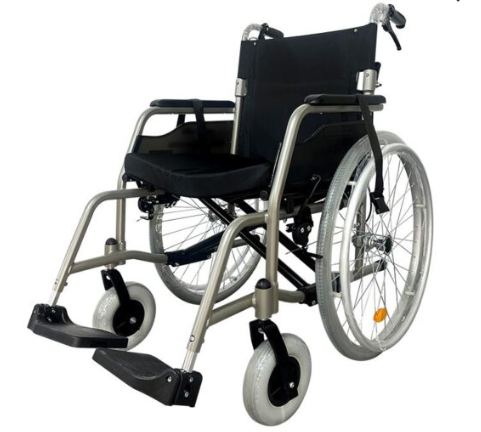
|
Type |
Weight Range (kg) |
Typical Use Case |
|---|---|---|
|
Ultralight (carbon fibre) |
3.5 – 10 kg |
Active users, frequent travel |
|
Lightweight (aluminium/titanium) |
10 – 14 kg |
Day-to-day independence, part-time caregiving |
|
Standard |
14 – 19 kg |
Full-time home or facility use |
The weight you can live with comes down to how often you lift it — and who’s doing the lifting.
How Much Does a Manual Wheelchair Weigh? (Quick Answer by Type)
Weight and load capacity move in opposite directions. The lighter the wheelchair, the less it holds. A heavier chair carries more — that extra mass comes from reinforced materials built to handle serious loads.
That tradeoff shapes every category in the table below.
|
Type |
Weight Range (kg) |
Weight Capacity |
Key Feature |
|---|---|---|---|
|
Standard / Basic |
16 – 20 kg |
up to 136 kg |
Steel frame, workhorse build |
|
Lightweight |
12 – 17 kg |
136 – 159 kg |
Aluminum frame, easier to lift |
|
Transport / Travel |
7 – 14 kg |
113 – 136 kg |
Small rear wheels, caregiver-pushed |
|
Ultralight |
under 14 kg |
136 kg+ |
Aerospace aluminum, fully adjustable |
|
Heavy-Duty / Bariatric |
17 – 44 kg |
136 – 317 kg+ |
Reinforced frame, maximum durability |
A few things worth understanding about these numbers:
Standard wheelchairs are the ones you see parked in hospital corridors. Steel frames. Reliable, low-cost, and flat-out heavy. You’ll feel that weight every time you fold it into a car.
Lightweight wheelchairs drop a few kilograms through aluminum construction. That difference sounds small on paper. Repeated every day across a week of caregiving, it adds up fast.
Transport wheelchairs put portability first, not independence. Small rear wheels mean a caregiver does the pushing. You get a chair that’s noticeably easier to fold up and stow in a trunk.
Ultralight chairs are built for people who self-propel every day. Aerospace-grade aluminum keeps the frame strong without the bulk. Adjustable components let you fine-tune the fit. The weight stays low so it doesn’t slow you down.
Bariatric chairs sit at the opposite end of the scale. The reinforced frame pushes weight up — sometimes past 40 kg. In return, the structure holds users up to 317 kg and beyond.
One quick note: chair weights are measured without legrests attached. Add them back, and expect another 1 – 2 kg depending on the model.
Standard Manual Wheelchair Weight in Kg: What’s Typical?
Most standard manual wheelchairs fall between 15 and 20 kg. That number has been the industry baseline for decades — and it exists for a reason.
Steel frames are cheap, durable, and built to take punishment. They’re also dense. That density pushes a standard chair past 16 kg before you’ve added a single accessory.
What “Standard” Really Means
In wheelchair classification, “standard” isn’t just a marketing label. It’s a weight threshold. Any manual wheelchair that exceeds 16.3 kg (36 lbs) qualifies as standard class. Below that line, you’re in lightweight or ultralight territory.
The standard tier covers the widest band. It absorbs a lot of variation — a 15 kg chair and a 20 kg chair are both “standard,” but lifting them into a car boot feels very different.
Notice the pattern: as weight climbs, capacity follows. A 17 kg chair holding 250 kg is no accident. The reinforcement needed to support that load is what adds the mass.
Who Standard Weight Works For
Standard-weight chairs aren’t a compromise. For the right user, they’re the correct answer.
They work well when:
– The chair stays in one location — a home, care facility, or hospital ward
– A caregiver handles all transport and doesn’t need to lift it solo on a regular basis
– Terrain is unpredictable and stability matters more than agility
– The user needs strong seated support for extended everyday use
They become a problem when:
– You’re loading and unloading a car multiple times a day
– The caregiver has back or shoulder limitations
– You’re traveling by air and need to meet airline weight restrictions
A 15–20 kg chair doesn’t fold away with ease or travel light. What it does offer is a rock-solid platform — consistent, durable, and built for the long haul. For institutional settings and home use where the chair seldom leaves its spot, that tradeoff makes solid sense.
What Factors Affect Manual Wheelchair Weight? (Materials & Components Breakdown)
Two wheelchairs can look almost identical on a product page and weigh 9 kg apart. That gap isn’t random — it comes from every material choice and component decision made during the build.
Knowing what drives wheelchair weight gives you real leverage comparing models. Here’s where the mass actually comes from.
The Frame: Where Most of the Weight Lives
The frame is the single biggest variable. The material choice sets the ceiling on everything else.
|
Frame Material |
Typical Weight |
Strength-to-Weight Ratio |
|---|---|---|
|
Steel |
17 – 23 kg |
Lowest |
|
Aluminum alloy |
8 – 14 kg |
Moderate |
|
Titanium alloy |
≤ 5 kg |
~2× aluminum |
|
Carbon fiber |
≤ 3.5 kg |
~3–4× steel |
Steel is cheap and tough. It’s also dense. That density pushes standard steel wheelchair weight past 17 kg before a single accessory is added.
Aluminum wheelchair weight drops by a clear margin. The metal is lighter at the same strength level. That’s why the entire lightweight category runs on aluminum alloy frames.
Titanium goes further. It matches steel’s strength at about half the mass. That’s why ultralight wheelchair weight figures under 5 kg belong almost entirely to titanium or carbon fiber wheelchair weight builds. Carbon fiber sits at the extreme end — it has the best strength-to-weight ratio of any common wheelchair material, and the price reflects that.
Components: The Accumulated Weight You Don’t Think About
The frame sets the baseline. Components do the rest. Here’s what each major part adds to the total:
|
Component |
Weight Contribution |
% of Total Weight |
|---|---|---|
|
Drive wheels (24″ pair) |
1.5 – 2 kg |
~10 – 15% |
|
Seat system (upholstery/sling) |
1 – 2 kg |
~8 – 12% |
|
Armrests + footrests |
0.5 – 1 kg |
~4 – 7% |
|
Folding mechanism |
0.5 – 1.5 kg |
~5 – 10% |
Wheels are worth paying close attention to. A 6-spoke mag wheel adds 0.8 kg per pair over a lite-spoke equivalent. That’s close to a full kilogram gained from one component swap — before you’ve touched anything else on the chair.
The folding mechanism adds real weight too. Cross-brace folding systems include structural parts that a rigid-frame chair doesn’t need. A rigid self-propelled wheelchair frame will almost always weigh less than a folding version built from the same material.
Customization: What Add-Ons Do to the Scale
Accessories are where the numbers start to creep up. Each addition looks minor on its own. Add them together, and they’re not.
-
Adjustable backrest: +0.5 – 1 kg
-
Anti-tippers (pair): +0.3 – 0.7 kg
-
Headrest support: +0.2 – 0.5 kg
-
Total across full custom config: +1 – 3 kg
A chair listed at 11 kg in base configuration can land at 13–14 kg once it’s set up for real daily use. It’s still lightweight — but worth knowing before you place the order.
How to Choose a Manual Wheelchair Weight That Matches Your Lifestyle
The right wheelchair weight isn’t the lightest one available. It’s the lightest one that fits your life.
Three questions cut through most of the confusion. Answer them straight, and the correct weight range becomes clear.
Question 1: What’s your primary use case?
This one decision narrows the field fast.
-
Daily self-propulsion → stay at or under 12 kg. Propulsion research shows a 9 kg increase in total system weight cuts self-selected rolling speed by 3.74–10.81% across surfaces. You feel it most on carpet, where peak push forces hit hardest.
-
Frequent outings and travel → 14 kg or under. The extra mass changes how you start moving, not just how you roll once you’re going.
-
Caregiver-pushed full time → 14–20 kg works fine. Studies show adding 5–10 kg to a caregiver-pushed chair creates little force change at low speeds on flat ground. The caregiver’s strength matters more than the chair’s weight here.
-
Outdoor or sport use → 7 kg or under. On rough terrain, each extra kilogram adds up across every single stroke.
Question 2: What are the physical limits involved?
You weigh more than 76 kg? Your caregiver has below-average strength? Take whatever range Question 1 gave you and subtract 1–2 kg. The research is clear: heavier users face close to double the shoulder load, pushrim forces, and median nerve injury risk compared to lighter users. For users with a BMI above 27.6 kg/m², a lightweight chair isn’t just a preference — it’s protection.
Axle position matters too. A rear-set axle shifts how weight is spread and cuts propulsion effort. This works on its own, separate from the chair’s listed weight.
Question 3: How does it get stored and transported?
Stairs with no elevator? Keep the total loaded weight at or below 14 kg. Car trunk access? Check that the folded chair comes in under 16 kg. Non-use rates rise fast above that point — people who find the lift too hard simply stop using the chair.
Put those three answers together and you get something specific:
|
Primary Use |
Weight Target |
Likely Frame |
|---|---|---|
|
Daily self-propulsion |
≤ 12 kg |
Ultralight titanium or carbon fiber |
|
Regular outings |
≤ 14 kg |
Lightweight aluminum |
|
Caregiver-assisted |
14 – 20 kg |
Aluminum or steel |
|
Outdoor / sport |
≤ 7 kg |
Carbon fiber or titanium |
The numbers do the deciding. Your job is to answer each question straight — including the ones about storage and who handles the lifting — before the chair ships.
Conclusion
Wheelchair weight isn’t just a spec on a product page. It’s the difference between independence and frustration — between a chair that fits your life and one that fights it.
Before you buy, ask yourself one honest question: Who’s lifting this, and how often? That answer will point you in the right direction faster than any spec sheet.
At Gracemedy, our lightweight manual wheelchairs are built around real-world needs. Easy to fold. Easy to carry. Built to go wherever you go. Browse our collection and find the folding wheelchair weight that works for your life.
The right chair doesn’t slow you down. It keeps you moving.
