
Planning for aging in place or need quick accessibility solutions? Understanding wheelchair ramp costs helps before you invest.
Most homeowners spend $1,000 to $3,000 for a basic residential ramp. Prices change based on materials, installation work, and ADA compliance needs. These factors can push your total to $10,000 or more for permanent setups.
The good news? You have more options than you think. Portable ramps start under $100. Modular systems give you both affordability and long life.
Even better news: Medicare, insurance, and grant programs may cover a big portion of your expenses. You just need to know where to look.
This pricing guide breaks down real costs for every ramp type. You’ll see hidden expenses contractors don’t always mention upfront. Plus, you’ll learn how to calculate what your specific project needs. This helps you make a confident choice without overspending or cutting corners on safety.
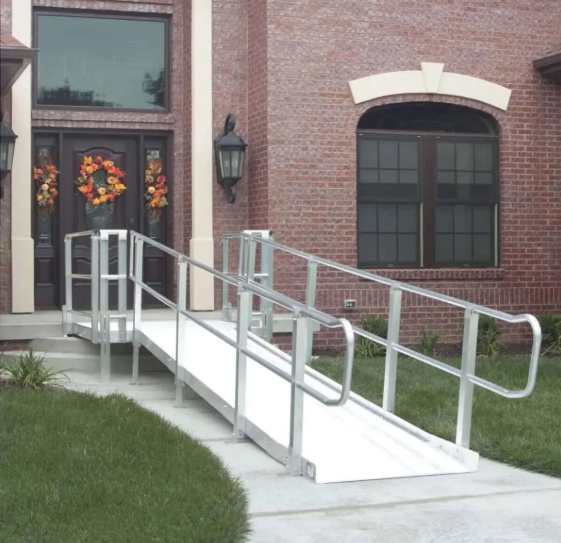
Average Wheelchair Ramp Costs by Type
Wheelchair ramp prices change a lot based on your choice. A simple threshold ramp might cost just $65. A commercial-grade aluminum setup can go over $20,000.
Material makes the biggest difference in what you’ll pay. Rubber ramps sit at the budget end—$55 to $165 per linear foot. Steel and concrete are the high-end options at $220 to $275 per foot. Aluminum sits in the middle. It ranges from $100 to $220 per linear foot. This depends on prefabricated or custom options.
Here’s what each major material costs:
|
Material |
Cost Per Linear Foot |
Typical Total Cost |
|---|---|---|
|
Rubber |
$55–$165 |
Varies by application |
|
Prefabricated Aluminum |
$100–$150 |
$1,000–$10,000+ |
|
Custom Aluminum |
$165–$220 |
$2,000–$5,000 |
|
Composite |
$165–$220 |
Project-dependent |
|
Wood |
$110–$275 |
$1,000–$3,000 |
|
Steel/Metal |
$220–$275 |
Premium range |
|
Concrete |
$220–$275 |
$3,000–$10,000 |
Costs by Configuration Type
Threshold ramps handle single-step problems. Expect to pay $65 to $315 for these small solutions. They work great for doorways. They also handle small height changes.
Portable ramps give you flexibility. Standard versions run $110 to $2,200. Most homeowners spend $100 to $500. Foldable models for travel cost $200 to $800. You can move these yourself. No professional help needed.
Modular systems mix staying power with flexibility. Basic setups start at $440. They reach $5,500 for standard setups. Custom modular builds with specific turns or platforms go over $5,000. These aluminum sections bolt together. You can change them around if your needs shift.
Permanent ramps cost the most. Construction runs from $1,100 to $6,600 for home projects. Commercial aluminum setups start at $5,000. They often go past $20,000 for ADA-compliant designs. Long ramps push costs higher.
Professional installation adds 20–30% to material costs. Most homeowners using pros spend $1,012 to $3,160 total. DIY setup cuts this cost. But you need carpentry skills and time to do it yourself.
Cost Breakdown by Ramp Length and Rise Height
The vertical rise determines your ramp length. ADA guidelines require a 1:12 slope ratio for safety. Each inch of vertical rise needs 12 inches of ramp length. A 24-inch porch height requires a full 24-foot ramp. Rise and length control your entire budget.
Here’s how costs scale with different ramp lengths:
|
Ramp Length |
Vertical Rise Covered |
Total Cost Range |
|---|---|---|
|
4 feet |
4 inches |
$220–$1,100 |
|
8 feet |
8 inches |
$440–$2,200 |
|
12 feet |
12 inches |
$660–$3,300 |
|
16 feet |
16 inches |
$880–$4,400 |
|
20 feet |
20 inches |
$1,100–$5,500 |
|
24 feet |
24 inches |
$1,320–$6,600 |
|
28 feet |
28 inches |
$1,540–$7,700 |
|
32 feet |
32 inches |
$1,760–$8,800 |
Higher Rises Add Complexity and Cost
Rises above 36 inches need ramps longer than 36 feet. Most building codes require rest platforms every 30 feet. You might need switchback designs to fit your yard space. These designs push costs to $3,600–$7,500 or more.
A two-story entry with a 48-inch rise needs a 48-foot ramp. Platforms are required for safety codes. You’ll need 50+ linear feet of ramp plus platform construction with landings and turns. Material costs alone exceed $5,500 for aluminum. Professional installation adds $1,650–$2,750 to your total.
Landing platforms cost $165–$550 each based on size. Factor these into any multi-level ramp project from the start.
Material Cost Comparison: Aluminum vs Wood vs Concrete
Each ramp material has different durability, maintenance needs, and lifetime value. Your choice affects initial spending plus what you’ll pay over 10-20 years of use.
Aluminum Ramps: Premium Price, Minimal Upkeep
Aluminum leads the residential market for good reasons. Prefabricated systems cost $100-$150 per linear foot. Custom configurations run $165-$220 per foot. A typical 24-foot modular aluminum ramp costs $3,960 to $5,280 installed.
Market conditions push these prices higher. Aluminum hit $2,800 per ton in 2026—a three-year peak. Clean energy demand drove this spike. Supply constraints continue. The 50% tariff on imported aluminum adds major cost pressure. Prices will stay high through 2026 with little relief ahead.
Higher upfront costs bring long-term savings. These ramps never rot. They resist rust with proper coating. Extreme weather won’t warp them. Maintenance costs almost nothing over 20 years. You won’t repaint, reseal, or replace sections like other materials need.
Aluminum also wins on flexibility. Modular systems take apart if you move homes or need layout changes. Resale value stays strong—used aluminum ramps fetch 40-60% of original price. This beats wood (15-25%) and concrete (zero—it’s permanent).
Wood Ramps: Budget-Friendly but High-Maintenance
Wood offers the lowest entry point at $110-$275 per linear foot depending on lumber grade. A 24-foot pressure-treated pine ramp costs $2,640-$6,600 total. That’s $1,320 less than comparable aluminum at minimum pricing.
Lumber markets show stability heading into 2026. Framing lumber settled at $425-$475 per thousand board feet—near historical averages after years of ups and downs. Forecasts predict 3-5% increases through Q2 2026. Project bids should factor in 4-6% escalation for Q2-Q3. Regional gaps matter: West Coast lumber costs run 8-12% higher than Midwest or Southeast prices.
The hidden cost in wood comes from maintenance. Reseal every 2-3 years ($200-$400 per treatment). Weather damage needs board replacement every 5-8 years in harsh climates. Termites and rot threaten structure in humid regions. Total 15-year ownership costs often match aluminum despite lower starting price.
Wood works best for temporary needs (1-3 years) or covered installations protected from direct weather. Choose pressure-treated southern yellow pine for outdoor durability. Cedar and composite wood-plastic blends cost 30-40% more but resist rot better.
Concrete Ramps: Permanent Investment with Premium Pricing
Concrete permanent ramps cost $220-$275 per linear foot. A standard 24-foot installation runs $5,280-$6,600 before site prep and finishing work. Complex designs with multiple landings top $10,000.
Concrete input costs climbed through 2025. Ready-mix concrete jumped 6-8% year-over-year. Portland cement increased 7-10% due to energy cost pressures. Urban aggregate prices rose 5-7%. The 2026 outlook projects another 4-6% increase overall. Coastal and urban markets face 8-10% hikes where transportation adds premium charges.
These high costs buy ultimate permanence. Well-installed concrete ramps last 30+ years with little maintenance beyond occasional crack sealing. They handle heavy power wheelchairs and scooters without flexing. Resale value transfers with your home as a fixed improvement that appeals to aging-in-place buyers.
Concrete makes sense for commercial properties, apartment buildings, or homeowners certain they’ll never relocate. The installation needs professional contractors. Cure times run 7-14 days. Site modification is permanent. You can’t take it with you or reconfigure the layout later.
Bottom line: Aluminum balances performance and flexibility for most residential needs. Wood suits tight budgets and temporary applications. Concrete delivers permanence for those who won’t relocate and value maximum durability over the premium investment.
Wheelchair Ramp Cost Calculator: Estimate Your Project
Quick math gets you close to real quotes. Take your needed ramp length. Multiply by material cost per foot. Add labor if you’re hiring contractors. That’s your baseline budget.
The basic formula works like this:
(Ramp length in feet × Material cost per foot) + Labor + Add-ons = Total project cost
Start with your vertical rise. Measure from ground level to your door threshold or porch deck. Take that height and multiply by 12 for ADA-compliant slope. A 30-inch rise needs a 30-foot ramp (30 × 12 = 360 inches = 30 feet).
Sample calculation for a 24-foot aluminum ramp:
– Material: 24 ft × $150/ft = $3,600
– Labor: 24 ft × $60/ft = $1,440
– Permits: $300
– Total estimate: $5,340
Want to switch to pressure-treated wood? Your math becomes 24 ft × $110/ft = $2,640 materials. Labor drops to $960 (wood installs faster). Total: $3,900. That’s $1,440 in savings.
Location changes these numbers a lot. The same 24-foot wood ramp costs $1,643 in Abilene. But in Oxnard? You’ll pay $2,434. That’s a 48% regional gap for identical materials.
Run this calculator before you request contractor bids. You’ll avoid sticker shock. Plus, you can spot inflated quotes right away.
How to Choose the Right Ramp for Your Budget
Your budget shapes what you can install today. Price ranges help you find solutions that work without giving up safety or access.
Budget Tiers and What They Buy You
Under $500: Temporary Solutions
This range covers quick access needs without permanent changes. Threshold ramps handle single steps for $50-$500. Mini ramps cost $110-$220. They work for doorways or small height changes. Basic portable ramps start at $110.
Rental programs fit tight budgets too. Pay $20-$60 per week or $80-$200+ per month. This works for recovery periods or temporary living. No installation costs. No commitment.
$500-$2,000: Short-Term Permanent Options
Semi-permanent modular systems cost $385-$2,200. These aluminum kits install in hours with basic tools. You get real strength without concrete work. Perfect for renters or homeowners who might move.
Short ramps up to 8 feet also fit here. Choose rubber at $55-$165 per foot. Or go with aluminum at $110-$165 per foot. Most simple setups stay under $2,000 total.
$2,000-$5,000: Standard Permanent Installations
Most home projects land in this tier. You get 12-16 foot permanent ramps with pro installation. Modular systems reach $5,500 at the high end. That includes custom turns and platforms.
Aluminum and composite materials rule this range. Wood works too if you accept more upkeep. This budget handles typical porch heights of 12-16 inches. All slopes meet ADA rules.
$5,000+: Complex Custom Designs
Long ramps over 20 feet push into premium territory. Concrete and steel start here at $5,280-$6,600 for materials alone. Multi-level designs with switchbacks cost $3,000-$7,500+.
Business-grade aluminum systems exceed $10,000. These handle heavy traffic every day. They meet strict ADA business standards. Plan for $20,000+ on apartment buildings or public facilities.
Material Selection by Budget Priority
Match your material choice to what matters most:
Lowest upfront cost? Choose rubber ($55-$165/foot) or pressure-treated wood ($110-$165/foot). These beat aluminum by 30-50% at first.
Best long-term value? Aluminum ($110-$150/foot) wins. Zero rot. Little upkeep needed. Resale value holds at 40-60%. Wood drops to 15-25%.
Maximum strength? Concrete ($220-$275/foot) or steel ($220-$275/foot) last 30+ years. Almost no upkeep needed. Premium pricing buys you a ramp that lasts.
Need flexibility? Modular aluminum systems come apart if you move. Wood and concrete stay put forever.
Run the math on 10-year ownership costs, not just today’s price tag. A $2,640 wood ramp needs $800-$1,600 in sealing and repairs over 10 years. That $3,960 aluminum ramp needs nothing. The gap closes fast.
Conclusion
Wheelchair ramp installation cost doesn’t need to stress you out. You might look at a $100 threshold ramp for your entryway. Or maybe you need a $7,000 permanent setup. Your choice depends on what you need, your budget, and your timeline. Balance what you pay now with what it’s worth later. Aluminum ramps last long and need little care. Temporary options work well if you can’t make permanent changes.
