
Picking the wrong wheelchair for a child is more than just an inconvenience. It can interfere with spinal development, postural alignment, and long-term mobility. Many parents, caregivers, and even some procurement teams still assume a smaller adult model will get the job done. That assumption is more common than it should be.
The differences between a pediatric wheelchair vs adult wheelchair go far deeper than seat width or color. Pediatric chairs use growth-adaptive frame geometry. They include anti-tip devices built for smaller bodies. Their harness restraint systems are designed around a child’s center of gravity — not an adult’s.
These are not minor details. They are precise, consequential differences that affect how a child moves, grows, and functions every day. What follows is a specification-level breakdown of how these two categories differ — and why those differences carry so much weight for the child relying on that chair daily.

Pediatric Wheelchair Vs Adult Wheelchair Structural And Safety Differences
Seat width is where most people start. It should not be where they stop.
The gap between a pediatric wheelchair and an adult wheelchair goes beyond size. It covers every measurable dimension — and some that are harder to measure. Think about how a frame responds to a growing spine. Or how a footrest angle shapes hip positioning six months from now.
Picking a pediatric wheelchair is not about finding a smaller chair. You need a chair built around the physics and biology of a child’s body. Those are not the same as an adult’s — not even close.
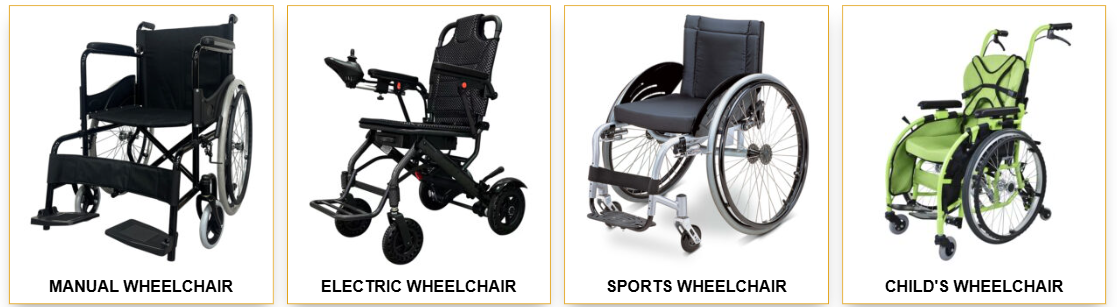
Children and adults differ greatly in their physical structure, developmental needs, and safety standards. Children are not simply miniature adults, and an unsuitable wheelchair can hinder their normal physical development. Therefore, wheelchair manufacturer design and produce them separately to meet the needs of both adults and children’s healthy growth and development.
Seat Dimensions & Frame Architecture: How the Structural Design Differs
The numbers tell the story.
A pediatric wheelchair seat runs 10″ to 14″ wide (25–36 cm). An adult seat runs 16″ to 20″ (41–51 cm). That 30–40% difference is not random. It reflects how a child’s pelvis is proportioned during active growth. Seat depth follows the same pattern: 10–12″ for children versus 16–18″ for adults. That 30% reduction keeps the child from sliding forward and losing postural control.
Seat height drops too. Children’s chairs sit at 12–16″ from the floor. Adult chairs sit at 18–22″. That lower position does more than fit a smaller body. It gives a child’s feet real ground contact, which sends proprioceptive feedback into a still-developing nervous system.
Material Selection Is an Engineering Decision, Not a Cost Decision
Children’s frames use aluminum alloy or engineering-grade plastic. Aluminum sits at 2.7 g/cm³. Structural plastic comes in at 1.2 g/cm³. Both materials work well here because a child’s load demand stays under 50 kg. High tensile strength is not the goal. Cutting weight by up to 40% is.
Adult frames use steel, and there’s a clear reason for that. Steel yields at over 250 MPa versus aluminum’s 200 MPa. Loads can exceed 100 kg across varied terrain. At that point, fatigue resistance matters more than saving weight.
Growth-Adaptive Adjustability: The Feature Adult Wheelchairs Don’t Have
Children grow 2.5 to 3 inches every year. A chair that fits a 5-year-old will be the wrong size by age 7. That is not a product complaint — it is biology. Growth-adaptive pediatric wheelchairs exist to solve this exact problem.
Adult wheelchairs adjust within a fixed adult range. That range does not move. A pediatric growth-adaptive chair moves with the child — across multiple dimensions, in small steps, without requiring a full equipment replacement every 18 months.
What Adjusts — and How Far
Seat depth is the most critical dimension. It also changes most often. As a child’s legs lengthen, the seat platform slides forward. The backrest stays put. That one adjustment — minimal hardware, no full reconfiguration — handles up to 5 inches of growth. In practice, that covers years of development, not months.
Seat width can expand up to 2 inches outward. You may need to swap the cushion or add a wider back support. The frame takes the change without needing replacement.
Backrest height follows seat depth changes to keep spinal contact steady. Dynamic backrest systems — like those on the Karma Flexx Adapt — absorb movement and hold postural support as the child’s trunk grows.
Footplates stay in position during seat depth adjustments, keeping the thighs supported. This detail matters. Footplates that drift out of position cause the upper leg to lose its support base. Postural stability then breaks down from the ground up.
Postural Support Systems: Back, Hip, and Spine Protection Designed for Kids
A child’s spine is not a scaled-down adult spine. It is a structure still forming. A wheelchair that fails to support it properly does more than cause discomfort. It changes the shape of the spine itself.
This is where pediatric postural support systems become essential. Research on adaptive seating in children with cerebral palsy backs what clinicians have observed for years: commercial modular contoured seating and low-cost contoured foam both produce measurable improvements in sitting posture and postural control. Three out of 21 reviewed studies met high-quality criteria. The evidence base is still growing — but the clinical direction is clear.
Why Back and Hip Support Cannot Be Borrowed from Adult Designs
Pediatric postural systems target three structural zones at once: the pelvis, the lumbar spine, and the lateral trunk. Each zone needs its own solution.
Pelvic positioning comes first. The pelvis is the foundation. It tilts or rotates, and every structure above it shifts to compensate. Hold that compensation for hours each day, and it becomes a deformity. Pediatric chairs use contoured seat bases and pelvic positioning belts built to match a child’s narrower hip width and shorter femur length. Adult pelvic hardware simply does not fit these dimensions. Modifying it is possible, but modified hardware tends to lose position under a child’s movement patterns.
Lateral trunk supports close the gap between the backrest and the child’s ribcage. Children with reduced trunk muscle tone — common in CP, spina bifida, and muscular dystrophy — cannot pull themselves back to center on their own. Pediatric chairs mount lateral supports at adjustable heights that follow the child’s trunk length. Adult reference points do not apply here.
Backrest contouring follows spinal curvature, not chair geometry. A child’s lumbar curve is shallower than an adult’s. A flat or adult-curved backrest leaves a contact gap at the lumbar segment. That gap means zero support exactly where the spine needs it most.
Safety Restraint & Anti-Tip Mechanisms: Pediatric-Specific Protective Features
Tipping a child out of a wheelchair is not a hypothetical risk. It is a documented mechanical reality. The entire restraint design of a pediatric chair exists to prevent it.
Children’s centers of gravity sit higher on the torso than adults’. Their heads are larger relative to body mass. Their trunk muscles are weaker, less coordinated, or — in conditions like cerebral palsy and spina bifida — absent altogether. Put those three facts together and you get a body that tips faster, recovers less, and sustains more serious injury in a fall.
Pediatric wheelchairs address this through two connected systems: restraint hardware and anti-tip geometry. Neither is an afterthought. Both are built into the frame from the start.
Anti-Tip Device Positioning
Standard adult anti-tip wheels extend from the rear frame at a fixed height. That height is set for adult chair geometry. On a pediatric chair, the same position lands wrong — too far from the ground to catch a real tip in time.
Pediatric anti-tip devices mount lower and closer to the rear axle. That shorter engagement distance matches where a child’s center of gravity sits. The result: the chair catches itself before the tipping angle gets too far to recover.
Together, these systems do more than keep a child in the chair. They keep the chair under the child — stable, predictable, and safe across every surface the school day brings.
Wheel Configuration & Mobility Base: Designed for Different Environments
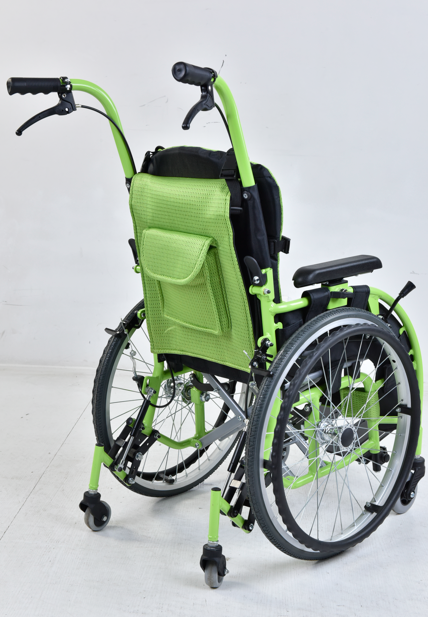
A pediatric wheelchair’s wheel setup is not just a smaller adult chair. It’s a purpose-built mobility system built around where children spend their time — school corridors, classroom doorways, therapy rooms, and home hallways.
Pediatric chairs use smaller rear wheels and tighter caster diameters to handle indoor spaces well. That smaller footprint cuts rolling resistance in tight areas. It also makes crossing door thresholds easier without extra push force. Adult chairs work the opposite way. Larger rear wheels handle uneven outdoor terrain and cover longer distances with less effort — a trade-off that suits adult users but creates real problems for a child moving through a school hallway.
Rear wheel positioning plays a big role too. A forward-set rear axle shortens the chair’s total length, shifts the center of mass backward, and reduces rotational inertia. The result? Zero-radius turns become much faster and easier. Research shows that total knee flexion combined with forward wheel placement reduces wheelchair length by 39%, rolling resistance by 21%, and moment of inertia by 42%.
Propulsion mode is another key difference:
Pediatric chairs are caregiver-propelled. Push handle height and position are set for an adult standing behind a small child — not for the child’s own reach
Adult chairs are built for self-propulsion. Rear wheel placement and handrim geometry are tuned to reduce shoulder strain during independent use
For powered pediatric models, speed governors and adjustable joystick sensitivity add a safety layer. Adult power chairs don’t need these features as a default setting.
Pediatric vs Adult Wheelchair: Side-by-Side Specification Comparison
The numbers make the case on their own.
|
Specification |
Pediatric |
Adult |
|---|---|---|
|
Seat Width |
8–18″ (adjustable) |
16–20″ (fixed) |
|
Seat Depth |
8–20″ (adjustable) |
16–20″ (fixed) |
|
Max User Weight |
30–50 kg typical |
75 kg+ |
|
Chair Weight (manual) |
8–20 kg |
15–25 kg |
|
Tilt Range |
30°–55° |
Rarely adjustable |
One column adjusts. The other stays fixed. Pediatric chairs are built to grow with the child. Adult chairs are built around a set size. That one difference shapes every other design choice.
Pediatric chairs give you up to 4″ of seat width adjustment and 5–6″ of seat depth range. Backrest height moves between 11″ and 15″. Armrests and leg rests adjust too. Adult chairs treat none of this as a design priority.
Most buyers miss one key detail: where you start inside that adjustment range matters a lot. A child fitted at the midpoint loses half the growth window on day one. A child fitted at the minimum keeps the full range open — years of use before the next equipment review becomes necessary.
Powered specs tell a separate story. Pediatric power chairs run a 34Ah battery, reach 10 kph, and cover 30 km per charge. That matches a school-day schedule well. Adult powered chairs weigh 130–155 kg with batteries. You are not comparing two versions of the same thing. These are two completely different categories of equipment.
Conclusion
Choosing between a pediatric wheelchair and an adult wheelchair isn’t about size. It’s about biology, safety, and how a child’s body develops over time. A growing spine needs a frame that grows with it. A child at risk of tipping forward can’t depend on safety mechanisms built for a 180-pound adult.
That’s why the differences matter — from wheelchair seat width for children and weight capacity limits to anti-tip devices, lateral supports, and harness systems. Children’s bodies have different needs. The equipment must match those needs.
