
Sitting in a wheelchair for hours isn’t just uncomfortable. It can damage skin tissue, strain your spine, and drain your energy well before midday. For people with limited mobility, the wrong seating solution is a real health risk — not just a minor inconvenience.
That’s where a manual tilt in space wheelchair changes things. Standard wheelchairs hold you in one fixed position. A tilt-in-space design moves your entire seating unit as one piece — shifting pressure points, supporting your posture, and giving your body the relief it needs throughout the day.
What Is a Manual Tilt in Space Wheelchair?
Think of it as a chair that moves with you — not against you.
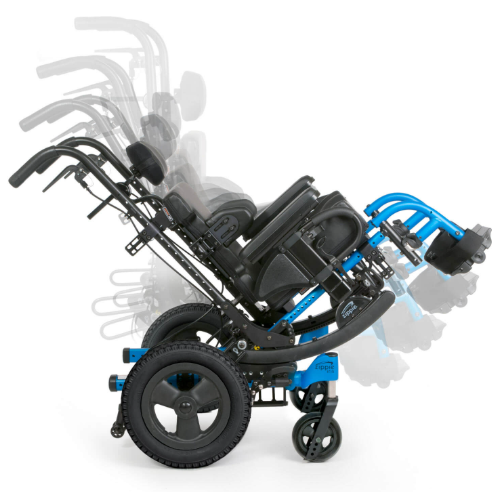
A manual tilt in space wheelchair is a specialized seating system. The entire seat unit — backrest, seat pan, and legrests — rotates together as one rigid structure. That rotation happens around a pivot point placed near the user’s center of gravity (COG). Here’s what makes this design different from a standard wheelchair: your hip angle, knee angle, and internal posture stay the same. None of it shifts. Your orientation to the ground changes, but your body position does not.
That one difference matters more than most people expect.
How Does the Tilt Mechanism Work?
The engineering behind a tilt-in-space wheelchair is surprisingly simple. That simplicity is what makes it reliable.
At the core of every manual tilt system is a pivot pin. This pin connects a pair of L-shaped or U-shaped rails — mounted to the underside of the seat — to a housing unit. The caregiver activates the tilt. The rails rotate around this pin, carrying the entire seating unit backward in one clean, controlled arc. The seat, the backrest, the legrests — they all travel together. Nothing separates. Nothing shifts out of alignment.
The Role of the Pivot Point
That pivot pin placement is no accident. Engineers put it close to the user’s center of gravity (COG) — near the knee pivot of the forward housing. This placement does two critical things:
-
It minimizes shear forces on the user’s skin during movement
-
It reduces sliding inside the seat, which is a common cause of skin breakdown in reclined wheelchairs
You get a tilt motion that feels smooth and predictable. It’s nothing like the abrupt lean-back you’d experience in a reclining chair.
Springs, Levers, and Locks
A coil spring connects the seat rails back to the housing via a bolt bar. The seat tilts backward. The spring compresses. Release it, and the spring pushes the seat back toward upright. A tension adjustment cap on the bolt lets technicians dial in the spring resistance. This is useful for matching the mechanism to users of different body weights.
The tilt lock runs on a pawl-and-lever system. A lateral shift of the lever engages or disengages the pawl from the housing. An overcenter spring holds the lever in place — locked or unlocked — so there’s no accidental drift mid-use.
Why This Matters for the User
The full assembly — housing, bolt bar, load bracket — uses compact metal stampings. This keeps the profile low and the total weight manageable. On a manual wheelchair, every gram affects usability, so that matters.
The result: a wheelchair positioning system that tilts with precision, holds its position, and returns smoothly — every single time.
Key Benefits of a Manual Tilt in Space Wheelchair
The human body was never built to hold one position for eight hours. Tissue breaks down. Blood slows. Muscles fight gravity until posture gives out. A manual tilt in space wheelchair stops that process — not through complex mechanics, but through one well-designed movement.
Here’s what that movement delivers.
Pressure Redistribution — The Foundation of Everything
Pressure injuries don’t give warnings. They build quietly under the ischial tuberosities (ITs) — the two bony points you sit on — until skin tissue starts breaking down from the inside out.
A tilt-in-space wheelchair tackles this head-on. The entire seating unit tilts backward. Body weight shifts away from the ITs and spreads across the backrest surface. That larger contact area cuts peak pressure at any single point by a wide margin.
The clinical threshold matters here: a minimum of 25° posterior tilt is needed for real IT pressure relief. Anything less and the redistribution is cosmetic, not functional. Pair that angle with a repositioning schedule — every 30 minutes, held for 1 to 2 minutes — and you have a pressure management routine that holds up in practice.
Standard reclining chairs shift the hip angle as they recline. A tilt-in-space chair doesn’t. The thigh-to-torso angle stays fixed throughout the tilt. The user stays put and doesn’t slide forward. Shear forces — the friction between skin layers that tears capillaries and speeds up tissue damage — stay low from the start.

Posture Management and Trunk Support
Gravity doesn’t let up. For users with reduced muscle endurance or neurological conditions, it wins — pulling the pelvis into a posterior tilt, rounding the upper spine into kyphosis, and collapsing the trunk sideways over time.
The tilt mechanism pushes back against gravity rather than giving in. Rotating the seating unit backward takes the muscular load of staying upright off the user. The spine holds its alignment. The trunk stays supported. Lateral deviation and scoliotic progression — both common in long-term static seating — are cut down.
For users with low trunk control, this isn’t about comfort. It’s a clinical necessity.
The tilt also keeps the head and chest in a centered position. For people with limited neck strength, that has a ripple effect beyond posture:
– Better eye contact
– Improved social engagement
– More meaningful interaction with the environment
A Shankar et al. qualitative study backed this up — tilt use tied to greater comfort, independence, and environmental control. Starting self-propulsion early in tilt chairs also linked to better walking ability at discharge.
Respiratory, Circulatory, and Digestive Function
Poor posture compresses the chest. Breathing suffers first. A backward tilt opens the chest cavity, gives the lungs more room to expand, and brings in more oxygen. Pressure on the abdomen drops. Digestion improves. The visual field opens up.
For pediatric users — many of whom spend key developmental years in seating systems — these physical benefits add up over time. Growth-adjustable frames in tilt chairs let the seating system grow with the child, so you’re not replacing equipment every few years.
On the circulatory side, tilting up to 50° posterior shifts body weight in a way that boosts blood flow to the lower limbs. That cuts down on edema, eases pelvic and hip discomfort, and extends how long a user can sit comfortably. Users stay active and engaged longer — without needing a full transfer.
Caregiver Safety and Operational Simplicity
Moving a full-size adult in a standard wheelchair usually takes two people, real physical effort, and carries a serious risk of back injury for the caregiver. A manual tilt changes that.
One caregiver can activate the tilt, reposition the user, and stabilize the chair — no transfer, no lift, no strain. For care facilities, that means lower labor costs and fewer manual handling injuries.
The tilted position also lowers the center of gravity. That makes the chair more stable outdoors. Footplate clearance on slopes and rough ground gets easier to manage — a real-world advantage that standard manual wheelchair designs can’t offer.
For users prone to extensor spasticity, the smooth, steady arc of the tilt reduces the sudden position changes that set off muscle responses. Wheelchair seat tilt angle adjustments move gradually and stay fully in the caregiver’s hands.
These benefits don’t work in isolation — they build on each other. Pressure relief protects skin integrity. Better posture opens up the chest for breathing. Less caregiver effort means repositioning happens on schedule, every time. Each function supports the next.
That’s what sets a pressure relief wheelchair built around tilt mechanics apart from a standard seating solution. It handles the full picture of what prolonged sitting does to the body — not just one issue at a time.
Who Needs a Manual Tilt in Space Wheelchair? (Ideal User Profiles)
Not everyone who uses a wheelchair needs a tilt-in-space system. But for a specific group of people, it isn’t optional — it’s the difference between staying healthy in a chair and slowly breaking down in one.
The defining factor is simple: can the person shift their own weight while seated?
A “no” answer — or even an inconsistent one — puts a manual tilt in space wheelchair on the table. Users who cannot reposition themselves face growing risks with every hour seated. Pressure builds. Posture collapses. Skin breaks down. The tilt mechanism exists to manage what the user’s body can no longer handle alone.
A Quick Reference by User Type
|
User Profile |
Primary Need |
What the Tilt Delivers |
|---|---|---|
|
SCI / neurological conditions |
Pressure relief, postural stability |
Weight shift away from ischial tuberosities |
|
Elderly in residential care |
Pressure ulcer prevention |
Extended sitting tolerance with regular redistribution |
|
Poor trunk control / kyphosis |
Spinal alignment |
Gravity-assisted posture support without muscle effort |
|
Pediatric users |
Developmental positioning |
Growth-adaptable frame with consistent postural alignment |
|
Staff-dependent care settings |
Operational simplicity |
Single-caregiver operation, no transfer required |
Conclusion
The right wheelchair does more than move someone from point A to point B. It protects their body, preserves their dignity, and makes every hour of sitting safer.
A manual tilt in space wheelchair does something most people never think about until they need it: it shifts pressure before damage happens. Are you a caregiver researching options for a loved one with cerebral palsy? A therapist building a seating and mobility plan? Or just someone trying to understand what makes a postural support wheelchair different from everything else on the market? The answer is the same — positioning done right.
You now have the knowledge. The next step is finding a solution built around the specific person who’ll sit in it.
Browse Grace Medy’s adaptive wheelchair series to explore tilt-in-space models built with real clinical needs in mind. The best wheelchair is the one that fits your life — not just the catalog.
