
Finding the best wheelchair for seniors isn’t as simple as picking the highest-rated option on Amazon. The right chair depends on a few key factors:
Does your loved one still have upper body strength?
How much does a caregiver need to help?
Does portability matter?
How much independence do they want to get back?
Pick the wrong chair, and you’re stuck with discomfort, frustration, and expensive equipment gathering dust in the corner. Pick the right one, and it changes someone’s life every single day.
This guide breaks down every major wheelchair type clearly. You’ll see which features matter most for older adults, plus a straightforward decision framework to help match the right chair to the right person.

What Is The Best Wheelchair For Seniors?
The honest answer: there isn’t one single best wheelchair. There’s the best one for your situation.
Most standard chairs fit 16–18 inch seat widths and hold up to 300 lbs. Know those two numbers before you buy anything.
The right wheelchair doesn’t just move someone from room to room. It gives them their day back.
What Makes a Wheelchair “The Best” for Seniors (And Why There’s No Single Answer)
The data makes this clear: wheelchair fit depends on overlapping variables. These variables shift a lot across age groups.
A 65–74-year-old with orthopedic issues who lives on their own tends to have enough upper body strength for a lightweight manual chair
A 75+ adult with cardiovascular or neurological conditions — in assisted living — often can’t propel a manual chair at all. In fact, 61% of older adults report difficulty with manual propulsion
Diagnosis plays a big role too. Neurological conditions point toward standard manual chairs. Orthopedic conditions lean toward power chairs. Cardiovascular conditions show up in both groups.
“Best” isn’t a product. It’s a match between a specific person and a specific chair.
Type 1 — Manual Wheelchairs: Best for Seniors With Upper Body Strength or Active Caregivers
Manual wheelchairs are where most families start — and for good reason. They’re simpler, lighter, and far cheaper than power chairs.

What the Numbers Mean
One spec that gets skipped too often: the 100°–120° arm-forearm angle at the pushrim. That’s the sweet zone for smooth, efficient propulsion. Get the seat height wrong, and every push turns into a short, choppy strain instead of a long, smooth stroke. More pushes. More fatigue. More shoulder damage over time.
Weight matters just as much. Chairs over 35 lbs drain users fast — and caregivers feel it every time they lift one into a car trunk.
Top Models Worth Knowing
|
Model |
Weight |
Price |
Best For |
|---|---|---|---|
|
Grace Medy (titanium/carbon) |
12–25 lbs |
$3,000–$8,000 |
High-performance self-propulsion |
|
Sunrise Medical Quickie |
Under 30 lbs |
$2,000–$6,000 |
Low seat-to-floor (13.5–14.5″) |
|
Invacare Lynx |
25–35 lbs |
$300–$1,000 |
Everyday caregiver use |
The Hard Limit
Manual wheelchairs have one firm requirement: upper body strength. Shoulder conditions, arm weakness, chronic fatigue — any of these make self-propulsion unsustainable over time. A manual chair won’t solve that problem. It just turns daily movement into a physical battle.
Type 2 — Transport Wheelchairs: Best for Caregiver-Assisted Seniors on the Go
Transport wheelchairs solve a specific problem — and they solve it well. Some seniors don’t need to self-propel. They just need to get places. This chair is built for that reality.
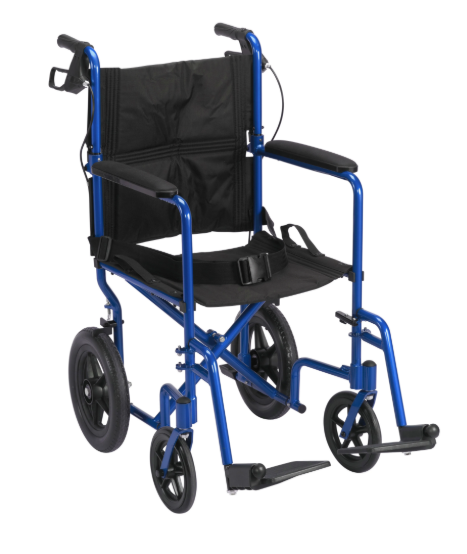
The design tells the whole story. Standard manual chairs use large rear wheels for independent propulsion. Transport chairs use small 8-inch rear wheels instead. That one difference changes everything: narrower profile, lighter frame, easier trunk storage. The senior rides. The caregiver drives. Clean division of labor.
Where These Chairs Belong
|
Situation |
Why It Works |
|---|---|
|
Medical appointments |
Fits narrow ADA bathrooms (23–32″) and tight clinic hallways |
|
Air travel |
Lightweight fold fits overhead or checks without hassle |
|
Short errands |
One caregiver can manage it solo |
|
Tight indoor spaces |
Noticeably narrower than standard manual chairs |
One real limitation worth knowing: transport chairs aren’t full-time chairs. No self-propulsion means the senior relies on a caregiver for every move. For outings, appointments, and travel — they’re hard to beat. For all-day independence, you’ll need something else.
Type 3 — Power/Electric Wheelchair: Best for Seniors Who Want Maximum Independence
Manual propulsion isn’t always possible. Power wheelchairs don’t just fill that gap — they remove it.
These aren’t upgraded scooters. Group 3 power chairs are built for seniors with serious neurological or physical conditions: ALS, spinal cord injuries, stroke with hemiplegia, late-stage Parkinson’s, late-stage MS. These are diagnoses where asking someone to self-propel isn’t just unrealistic — it’s cruel.
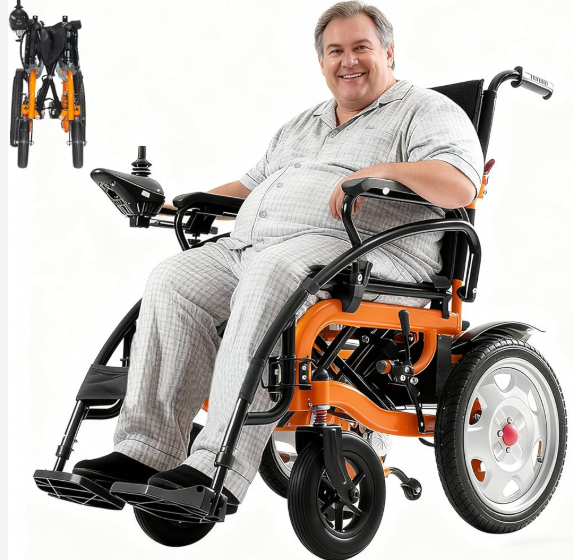
Power Functions That Change Day-to-Day Life
Group 3 chairs go far beyond basic movement:
Power tilt and recline — shifts pressure, cuts fatigue
Power elevating leg rests — key for circulation and edema management
Adjustable seat height — seniors can reach countertops, make eye contact, feel like themselves again
Improved suspension — absorbs vibration that would otherwise trigger spasms or pain
Folding Power Wheelchairs: The Best of Both Worlds for Traveling Seniors
Folding power wheelchairs go where traditional power chairs can’t. They fit into real life. A standard Group 3 chair weighs 138+ lbs and doesn’t fold. A folding power chair weighs 50–65 lbs. It collapses in seconds and fits in a car trunk — no taking it apart first. No ramp. No lift. No production.
Snowbirds, frequent flyers, anyone who refuses to let mobility hold them back — this is the category worth knowing.
What Sets These Apart
|
Feature |
Folding Power Chair |
Traditional Power Chair |
|---|---|---|
|
Weight |
50–65 lbs |
100+ lbs |
|
Battery |
Lithium (airline compliant) |
Often lead-acid (not) |
|
Travel |
Trunk-ready, no taking apart needed |
Requires lift or ramp |
|
Storage |
Fits apartments, small spaces |
Bulky, needs dedicated space |
These chairs are FDA Class II medical devices — not consumer gadgets. Some seniors still walk short distances but need powered support for longer trips. A scooter doesn’t quite cover it. A traditional power chair is too bulky. These chairs fill that gap.
Power vs. Manual vs. Transport: Side-by-Side Comparison for Seniors
Three chairs. Three different philosophies about what mobility should look like.
|
Dimension |
Manual |
Power |
Transport |
|---|---|---|---|
|
Cost |
$300–$2,000 |
$1,000–$2,500+ |
$200–$800 |
|
Weight |
25–35 lbs |
100+ lbs |
~20–30 lbs |
|
Independence |
Requires upper body strength |
Cognitive ability + vision |
Caregiver-operated only |
|
Terrain |
Flat indoor/outdoor |
Slopes, carpet, longer distances |
Smooth surfaces only |
|
Travel |
Easy — folds into trunk |
Difficult — heavy, won’t break down |
Easiest of the three |
|
Maintenance |
Low — no battery |
High — charging, controls |
Lowest — push and go |
Which Chair Fits Which Senior
The table shows what each chair is. This section tells you who each chair is for.
Active 70-year-old living alone → Manual. Lightweight models (25–35 lbs) let you self-propel with less effort — 43% less oxygen per meter than passive transport. Less fatigue. Real independence.
75-year-old with mild arm weakness → Power-assist on a manual frame. The motor handles the hard work on slopes. The chair stays portable.
82-year-old with dementia, full caregiver support → Transport. At 20–30 lbs, one caregiver manages it with ease. No folding or breakdown needed. Over 2.8 million family caregivers list mobility as their top daily concern.
85-year-old with severe weakness or obesity → Power chair. Medicare covers it once a physician confirms that indoor manual propulsion is not physically possible.
How to Choose the Right Wheelchair for a Senior: A Decision Guide by Situation
Situation drives everything. Not specs. Not star ratings. Not what the discharge nurse handed you on the way out of the hospital.
Here’s a simple decision guide built around five real scenarios. Each one matches a specific chair type, with real numbers to back it up.
Match the Chair to the Life Being Lived
Lives alone, arthritis, one-story home
Go folding manual lightweight. The Drive Medical Transit 501 weighs 26 lbs, folds to 11 inches wide, and sits at a 19-inch seat height. That’s easy to manage alone. Arthritis doesn’t mean helpless — it means the chair needs to do more of the work.
Frail senior, lives with a caregiver, multi-story apartment
Go lightweight transport. The Karman XO-101 weighs 22 lbs, holds up to 250 lbs, and has an 18-inch seat. One caregiver lifts it without strain. The elevator handles the floors.
Severe mobility loss, nursing facility
Go power chair. The Pride Jazzy Passport covers 20.4 miles per charge, weighs 44 lbs, and has a joystick built for weak grip. The user gets independence back — on their own terms.
Ambulatory but balance-impaired, suburban home with ramps
Go manual with power assist. The Outlander SE paired with the SmartDrive MX2+ runs a 25W motor, covers 12 miles, and cuts push effort by 30%. That difference adds up across a full day.
Cardiovascular issues, urban apartment
Go standard power base manual. The seat adjusts between 16–19 inches. That range fits the variety of body types this condition tends to affect.
Conclusion
There’s no single “best wheelchair for seniors.” There’s only the best one for your situation.
Upper body strength still there? A lightweight manual chair gives real freedom without extra bulk or hassle. Mobility is limited and independence matters most? A power wheelchair changes the game. Always on the go? A folding power chair proves its worth on every single trip.
The right choice comes down to three things:
The senior’s physical needs
The caregiver’s level of involvement
The budget you’re working with
Line those three up, and the decision gets much clearer.
Your next step: Use the decision guide and comparison table above to narrow things down to two or three options. Then test before you buy. Most medical supply stores let you try before you commit.
The best wheelchair for seniors isn’t stumbled upon. You choose it — with purpose, care, and the right information in hand.
