
Picking the wrong wheelchair creates more than discomfort—it puts users at risk. A wheelchair that can’t handle the user’s weight may break down and cause serious injuries. Plus, you’ve wasted money on equipment that fails to work. Thousands of families and caregivers struggle with one key question: what is the difference between a standard and bariatric wheelchair, and which one keeps users safe and comfortable?
The difference goes beyond just size. A standard wheelchair handles users up to 250-300 pounds. The seat measures 18 inches wide. A bariatric wheelchair? It’s built stronger. The seat spans 20-30 inches wide. These chairs support 700 pounds or more.
Frame strength matters. Seat width matters. Getting these specs right separates confident movement from daily safety worries.
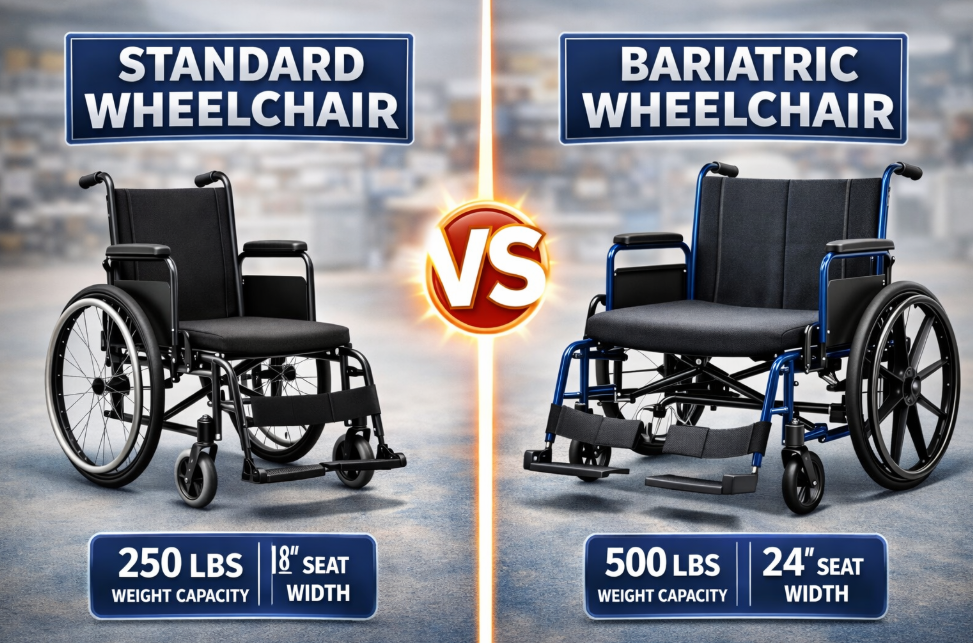
Standard Wheelchair: Core Specs and What They Mean
A standard wheelchair has specific measurements. These numbers tell you who can use the chair and where it fits.
Weight Limits
Most standard wheelchairs hold 250 to 300 pounds. Manual models weigh 36 to 40 pounds on their own. This weight capacity wheelchair range fits users between 150 and 250 pounds.
The frame breaks down under more weight. Need to support more? Look for heavy-duty equipment instead.
Seat and Frame Measurements
Wheelchair seat width runs from 16 to 20 inches. 18 inches is most common. The seat depth measures 16 to 18 inches (457mm typical). Seat height sits at 19 to 19.5 inches from the floor.
These numbers matter for proper fit:
– Seat width should match your hip-to-hip measurement (straight across)
– Seat depth equals the distance from your hip to the back of your knee
– Seat height matches from the back of your knee down to your foot bottom
The backrest rises 18 to 24 inches. Armrests reach 30 inches high. Push handles for caregivers sit at 36 inches.
Overall Wheelchair Size
The chair measures 25 to 26 inches wide from wheel to wheel. Height reaches 36 inches. Length varies from 32 to 42 inches based on wheel size.
Here’s a quick calculation: add 8 inches to the seat width to get total width. An 18-inch seat creates a 26-inch wide chair overall.
Why? Large rear wheel tires add about 9 inches to the seat width. A 24-inch rear wheel (self-propelled model) makes the chair about 38 inches long. Smaller 14-inch wheels on transit models bring length down to 36 inches.
Bariatric Wheelchair: Heavy-Duty Design and Enhanced Features
Bariatric wheelchairs support 300 to 1,000 pounds. Standard models can’t handle that much weight. The engineering differs. Frames use stronger materials. Seats span 20 to 36 inches wide. Each part gets upgraded to handle heavy loads without breaking.
Weight Capacity Built Into the Frame
Three capacity levels exist for bariatric wheelchairs:
300-500 pounds: Carbon steel frames with steel gussets at stress points. Dual cross bars run beneath the seat. Side frames and caster journals spread the weight across the chair.
500-700 pounds: Folding frames feature double cross braces for extra strength. Aircraft-grade aluminum cuts the chair’s weight to 63-73 pounds. The Karman BT10 fits this category.
700-1,000 pounds: Carbon steel construction with dual cross braces. The Invacare 9000 Topaz uses this build. These chairs weigh more but handle extreme loads without risk.
Compare this to standard models. A Drive Sentra Extra HD rated for 500 pounds weighs 54-66 pounds. A standard chair holding 250 pounds weighs just 36-40 pounds.
Extra Wide Wheelchair Seats Prevent Pressure Injuries
Bariatric models feature seats 20-36 inches wide. This goes beyond just fitting larger bodies. Wide seats reduce pressure points. Pressure points cause skin breakdown.
A 22-inch seat supports users up to 450 pounds (McKesson K7). Users weighing 550 pounds need 24-inch widths. The Drive Sentra offers 20, 22, and 24-inch options with 18-inch depth.
Broader seats create wider chairs. A 22-inch seat makes a 30-inch wide chair. Some models reach 32.5 inches total width. Measure your doorways before buying.
Heavy-gauge Naugahyde covers these wider frames. This material resists tears. It also spreads body weight better than standard fabric.
Safety Systems That Handle Real-World Stress
Strong wheelchair frames require matching safety features:
Wheels and tires: Reinforced rubber handles 350-1,000 pound loads. Dual axle systems let you adjust seat height from 17.5 to 21 inches. Larger wheels (often 24 inches) boost stability.
Anti-tippers: Models rated above 350 pounds include these as standard. The Invacare Tracer IV adds these on all 350-450 pound capacity versions.
Stronger suspension: Double cross braces absorb impact from bumps and curbs. Hammertone or silver vein finishes protect against rust and wear.
Adjustable Components for Individual Fit
Bariatric chairs offer custom options. Standard models don’t include these:
Armrests: Choose removable desk-length or full-length padded designs. The Drive Sentra EC and Invacare 9000 XDT use flip-back arms. You can swing them away for easier transfers.
Legrests and footrests: Swing-away detachable options come standard. Elevating legrests boost circulation. Most 450-pound capacity models (McKesson, Nova) include these at no extra cost.
Seat-to-floor height: Adjusts from 17.5 to 21 inches. The right height boosts posture. It also makes transfers safer.
These adjustments help users between 350 and 700 pounds. A proper fit boosts independence. It also reduces strain on caregivers.
Moving Around: Size, Space, and Effort
Wheelchair size controls how you move. Standard manual chairs usually run 24–28 inches wide. They fit through 32-inch doorways with no problem. Bariatric models differ. They often go wider than 40 inches. This changes your daily access. Size affects every turn. Standard chairs need a 60-inch circle to spin around. Bariatric models need 66–72 inches. Most home hallways and restrooms are too small for that.
Indoor and Outdoor Challenges
You face distinct tests indoors. Narrow doorways are just the start. Consider the weight. A user plus the chair can hit 400–600 lbs. This takes up about 30% of a small elevator’s limit. It fills up accessible bathroom stalls too. You often find zero room to transfer. Outside, your setup matters. Big, air-filled casters handle bumps better than small solid wheels. But they need more room to turn. Watch out for soft ground like grass. The heavy load sinks the wheels. Moving becomes much harder compared to standard chairs.
Physical Strain and Solutions
Weight changes how things move. You need 40–60% more force per stroke to push a bariatric chair yourself compared to a standard one. You get tired fast. Caregivers have it tough too. Pushing on flat ground takes 140% more effort. Ramps can become dangerous.
Power assist systems help:
Hub-mounted units cut push effort by 80%. They keep the width the same.
Front attachments make the chair longer. But they handle rough ground well.
Rear units give you balanced help for mixed places.
Check your vertical space too. Bariatric seats often sit higher, around 18–22 inches. This supports the frame. This height helps with standing transfers. But you might not fit your legs under standard dining tables.
Cost Analysis: Initial Investment and Long-Term Value
Price tags tell just part of the story. A $300 standard wheelchair looks cheaper than a $1,200 bariatric model at checkout. But total ownership costs flip this around over time.
Long-Term Value Shows in the Numbers
Calculate net present value to see true costs. Take a $500 bariatric wheelchair. Use a 10% discount rate over five years. You avoid $180 in replacement costs each year. Plus you prevent $200 in injury risks. Present value of benefits reaches $680. Total costs with minor upkeep hit $580. Net gain: $100 plus peace of mind.
Ratios above 1.05 signal smart money moves. A standard chair for an oversized user shows 0.94 ratio—you lose money. The proper bariatric model hits 1.35 ratio. Benefits beat costs by 35%.
Payback periods matter for budgets. A $700 bariatric chair saves $175 each year through avoided replacements and repairs. You break even in 4 years. The chair lasts 20-40 years with steel construction. You gain 16-36 years of free service after that.
Making the Smart Choice
List your real costs beyond sticker price. Count initial purchase, maintenance each year, insurance premiums, how often you replace it, and injury risks. A bariatric wheelchair costs more today. But it delivers 3-5 times lower total ownership costs over a decade. The wheelchair load capacity you need tells you which choice protects both your safety and your wallet for the long haul.
Conclusion
Standard vs. bariatric wheelchair? This choice affects safety, dignity, and long-term health. The main differences: weight capacity (standard: 250-300 lbs vs. bariatric: 450-1,000+ lbs), seat width (standard: 16-18″ vs. bariatric: 20-30″), and reinforced frame construction that prevents serious failure.
Does the user weigh over 250 pounds? Feels uncomfortable in a standard wheelchair? Needs extra side support? A bariatric wheelchair isn’t a luxury. It’s medically necessary. The higher upfront cost ($500-$2,000) prevents injuries. It removes the need for replacement. Quality of life improves significantly.
Your next step: Measure hip width while seated. Confirm actual weight. Talk to a healthcare provider about medical necessity documents for insurance coverage. Don’t cut corners on safety to save money. The wrong wheelchair breaks down and can cause serious injury.
At Gracemedy, we provide detailed specs and expert guidance. This helps you make this important decision with confidence. Choose strength. Choose comfort. Choose the right wheelchair the first time.
