
Installing a ramp for a loved one at home? Making sure your business meets accessibility standards? Getting the measurements right goes beyond compliance. It’s about safety and dignity.
A bad wheelchair ramp calculation creates problems. You lose independence instead of gaining it. You face expensive fixes instead of meeting ADA requirements.
The tough part? You need to handle slope ratios, landing sizes, and handrail specs. Plus, your ramp must work well and meet code.
Our wheelchair ramp guide and length calculator removes the guesswork from ramp planning. You get an easy calculation tool combined with expert insights on ADA compliant ramp specifications.
You’ll find out how long your ramp needs to be. You’ll learn which materials work best for your situation. You’ll see how to avoid the five most common mistakes that cause failed inspections.
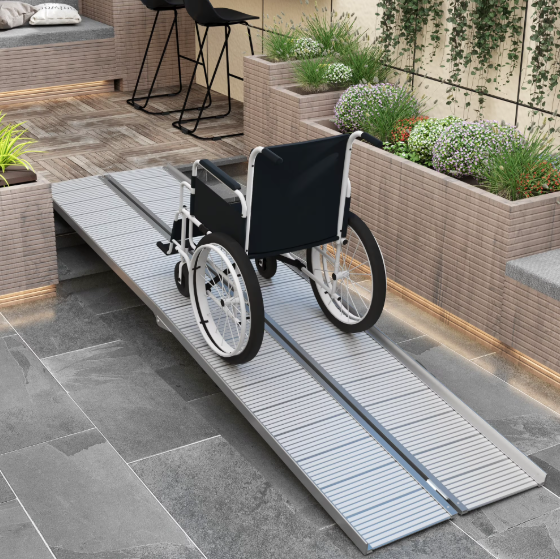
Step-by-Step Wheelchair Ramp Planning Guide
You’ve got the measurements. Now comes the real work: turning numbers into a safe, functional ramp. Here’s the full process, from first assessment to final inspection.
Step 1: Measure Your Vertical Rise
Start at the threshold or entry point where the ramp will begin. Measure straight down to the landing surface. This vertical distance controls all other numbers.
Use a level and measuring tape for accuracy. A 30-inch rise needs a 30-foot ramp at the standard 1:12 ratio. Even a half-inch error here grows across the entire length.
Common home rises range from 6 to 36 inches. Business buildings often have greater heights. These need multiple runs with landings.
Step 2: Calculate Required Ramp Length
Use the 1:12 ratio: take your vertical rise (in inches) and times it by 12. A 24-inch rise requires 288 inches, or 24 feet of ramp length.
Tight on space? Your options are limited. For rises under 6 inches, you can use a 1:10 slope. For rises under 3 inches, a 1:8 slope works. These steeper grades feel much harder to use.
Note: this is horizontal projection distance, not the actual ramp surface length. The angled surface will be a bit longer.
Step 3: Plan Landing Locations
ADA standards cap each ramp run at 30 inches of vertical rise. You need a level landing after every 30 inches of height gain.
Each landing must measure at least 60 inches long in the direction of travel. Width matches your ramp width (minimum 36 inches). Does the ramp turn? You need a 5-foot by 5-foot platform.
These landings do three things: rest stops for manual wheelchair users, turning space for powered chairs, and emergency stopping zones. Don’t skip them to save space.
Step 4: Verify Clear Width Requirements
Measure your available width. The ramp needs 36 inches of clear space between handrails. This width cannot include:
-
Handrail posts or mounting hardware
-
Flared sides or decorative edges
-
Any objects that reduce the travel path
Most builders go with 42 to 48 inches total width. This gives you the 36-inch clear path plus room for handrails and edge protection.
Step 5: Check Cross Slope and Surface Requirements
The cross slope (side-to-side tilt) maxes out at 1:48. Go steeper and wheelchairs risk tipping sideways.
Your surface needs three qualities: firm, stable, and slip-resistant in all weather. Concrete works well but can ice over. Wood decking needs proper treatment and spacing. Go with textured coatings for aluminum surfaces.
Test for vertical changes. Any bump over 1/4 inch creates a tripping hazard. Changes between 1/4 and 1/2 inch need beveling at a 1:2 slope maximum.
Step 6: Determine Handrail and Edge Protection Needs
Handrails are required if your rise exceeds 6 inches OR horizontal projection exceeds 72 inches. You need them on both sides.
Edge protection stops wheels from slipping off. Does your ramp sit more than 4 inches above ground and lack a wall boundary? Add either:
-
Guide curbs at least 2 inches high on each side
-
Wheel guide rails 2 to 4 inches high, centered 3 inches above the ramp surface
Step 7: Review Local Code Variations
Federal ADA sets the baseline. Your state or city might demand more. Some areas require:
-
Wider clear widths (42 inches instead of 36)
-
Longer landings (72 inches instead of 60)
-
Specific materials or surface treatments
-
Extra inspections or permits
Contact your local building department before buying materials. A licensed contractor with ADA experience can handle these variations and pull needed permits.
Go beyond minimum standards to improve usability. Many builders use 1:14 or 1:16 slopes if space allows. The gentler grade makes a real difference for manual wheelchair users and people with limited upper body strength.
Ramp Width, Handrail and Safety Requirements
Width, handrails, and safety features make the difference between a code-compliant ramp and a liability risk. These elements work together to prevent accidents. Everyone can use the ramp with confidence.
Clear Width Standards
The 36-inch minimum clear width applies to the usable travel path between handrails. This measurement excludes handrail posts, mounting brackets, or any objects that narrow the passage.
Most ADA compliant ramp specifications call for 48 inches total width. You get the required 36-inch clear path. Plus, there’s space for handrail installation and edge protection. Curb ramps follow the same 48-inch standard. Measure at the narrowest point parallel to grade breaks.
Want extra room for two-way traffic or larger mobility devices? Go with 60 inches. This width fits powered wheelchairs and scooters. One person can pass another with ease.
Handrail Specifications That Meet Code
Handrails become mandatory at a vertical rise of 6 inches or more. You need them on both sides of the ramp. No exceptions for residential wheelchair ramp or commercial installations.
Ramp handrail requirements specify these exact dimensions:
Height ranges from 24 to 38 inches above the ramp surface. Mount them at 34 to 36 inches for the most comfortable grip height across different users.
Each handrail extends 12 inches beyond the top and bottom of each ramp run. These extensions give users something to grab before stepping onto or off the ramp. Returns to walls or posts must be smooth to prevent clothing from catching.
Gripping surface diameter matters for hand control. Circular rails stay between 1.25 and 2 inches. Non-circular profiles measure 4 to 6.25 inches around the perimeter. Keep 1.5 inches of clear space between the handrail and any wall.
The rails must run without breaks along each ramp segment. Breaks at landing points only. Never mid-run where someone might lose their grip.
Common Wheelchair Ramp Configurations with Length Examples
Real-world ramp projects follow patterns based on height, space, and use. Different rises need specific measurements. Builders use these numbers every day.
Standard ADA 1:12 Configurations
The 1:12 ramp ratio forms the foundation for commercial and public access. Every inch of vertical rise needs 12 inches of horizontal ramp length. This creates a 4.8-degree incline. It’s gentle enough for independent wheelchair use.
A single 7-inch step (typical residential height) needs a 7-foot ramp. Three standard steps totaling 21 inches require 21 feet of straight run. Most front porches sit 24 inches above grade. You’ll need a 24-foot ramp before adding landing space.
Commercial ramp standards max out at 30 inches of rise per run. This translates to 30 feet of ramp before you must install a level landing. Taller entries need multiple runs. Place 60-inch platforms between each section.
The math stays simple. Take your measured rise in inches. That number becomes your ramp length in feet. A 15-inch rise = 15 feet. An 8-inch rise = 8 feet. You don’t need complex calculations.
Quick Reference: Rise-to-Length Conversions
|
Vertical Rise |
1:12 ADA Standard |
2:12 Residential |
3:12 Unoccupied Use |
|---|---|---|---|
|
7 inches |
7 feet |
3.5 feet |
2.3 feet |
|
21 inches |
21 feet |
10.5 feet |
7 feet |
|
24 inches |
24 feet |
12 feet |
8 feet |
|
30 inches |
30 feet |
15 feet |
10 feet |
The 3:12 ratio appears in the table but carries a major restriction. Use it for unoccupied purposes alone. This 15-degree slope works for equipment ramps or cargo access. Never use it for wheelchairs with people in them. The angle creates tip-over risk. It violates ADA compliant ramp specifications for occupied ramps.
These lengths show horizontal projection. That’s the footprint your ramp occupies. The real ramp surface runs longer due to the angle. A 24-foot 1:12 ramp has about 24.1 feet of walking surface. The difference grows with steeper slopes.
Wheelchair Ramp Material Options and Cost Considerations
Your material choice controls three things: budget, maintenance needs, and lifespan. Each option has different upfront costs, durability levels, and installation needs.
Material Comparison and Price Points
Rubber ramps start at $50 to $165 per linear foot. This makes them the cheapest choice. The soft, non-slip surface works great for indoor shower ramps and threshold transitions. But rubber can’t handle outdoor conditions or heavy use. Heat warps it. Cold makes it brittle.
Wood ramps run $100 to $250 per foot for materials. Pressure-treated lumber fights rot better than untreated wood. You still need to seal it every year and apply non-slip coating. Moisture warps wooden boards. Winter freeze-thaw cycles loosen fasteners. A full wooden ramp costs $1,000 to $2,500 installed. Plan for regular upkeep or replacement within 5 to 7 years.
Aluminum ramps price at $150 to $220 per foot for custom builds. Prefabricated aluminum sections drop to $100 to $165 per foot. The grooved surface grips wheelchair tires in rain and snow. It resists corrosion far longer than wood. Lightweight panels make installation easier but can flex under heavy power chairs. Check for loose bolts every year to avoid safety problems.
Composite materials blend wood fibers with plastic polymers. Expect $165 to $220 per linear foot. This synthetic mix resists moisture damage that ruins wood. It won’t warp, rot, or splinter. It handles impacts better than both wood and basic aluminum. The price matches its middle-tier performance.
Concrete ramps cost $220 to $275 per foot for materials and forming. Complex installation drives total project costs to $3,000 to $10,000 or more. Textured finishes prevent slipping. A permanent installation lasts 30+ years with minimal upkeep. Removing it is almost impossible. Poor soil sites need retaining walls and compacted sand bases. These add thousands to your budget.
Steel and metal ramps range from $200 to $275 per foot. Factory powder coating fights rust. But scratches expose bare metal to moisture. Corrosion starts within months at damage points. Galvanized steel adds 15% to material costs. It prevents rust for 15 to 20 years. Steel handles the heaviest loads. Commercial buildings use it where aluminum would flex.
Complete Installation Costs
A residential aluminum ramp with landings and handrails totals $1,000 to $10,000+. A 24-foot straight run with one 5×5 platform costs around $4,500. Add multiple turns and you’ll push past $8,000.
Commercial aluminum ramps start at $5,000. Long runs with ADA-compliant landings every 30 feet reach $20,000 or more. A business entrance with a 60-inch rise needs two ramp runs plus a mid-point platform. This setup averages $12,000 to $15,000 installed.
Concrete installations run $3,000 to $10,000 for typical residential heights. Commercial pours exceed $15,000. This includes engineering, excavation, forming, and finishing work.
Labor and Assembly Costs
Standard labor rates hit $60 to $100 per linear foot. Coastal cities lean toward the upper range. Rural areas stay closer to $60. A contractor needs about 4 hours to put together and mount a typical modular system.
Portable ramps cut labor to near zero. A 4-foot portable ramp costs $220+ ready to use. Twenty-foot portable sections run $1,100 to $5,500. This depends on weight capacity and surface treatment. Thirty-two-foot portable setups reach $1,760 to $8,800.
DIY vs. Professional Installation
Materials for a DIY build cost $500 to $2,000. You’ll need basic carpentry skills and tools. Your shopping list: pressure-treated lumber, galvanized hardware, and slip-resistant coating.
Skip professional installation and you lose warranty coverage on most modular ramp systems. Poor assembly creates legal risks. Code violations force expensive rebuilds. The $2,000 you save upfront turns into $5,000 in fixes after a building inspector issues a stop-work order.
Threshold Ramps and Small Solutions
Single-step solutions start at $65 to $315. Rubber threshold ramps made from recycled tire materials cost $65 to $120. Aluminum or composite versions handle heavier power chairs for $150 to $315. These small ramps clear door sills, single steps, and van entries. No permits or installation crews needed.
Wheelchair Ramp Maintenance and Longevity
70% of wheelchair ramp failures trace back to weather damage or skipped maintenance. A ramp sitting unused doesn’t stay safe. Wood warps. Metal corrodes. Non-slip surfaces wear smooth. Regular checks catch these problems before someone gets hurt.
Cleaning and Surface Maintenance
Clean your ramp every four weeks. Dirt and debris collect in corners, along edges, and under handrails. This buildup holds moisture against surfaces. Metal rusts faster. Wood rots quicker.
Sweep the entire ramp surface. Pay extra attention to landing areas where wheelchairs pause. Remove leaves and organic matter right away. These create slick spots when wet.
Check your non-slip tape and coatings during cleaning. Worn areas lose their grip. One library discovered this after users reported slipping. The staff replaced bad tape strips the same day. Don’t wait for complaints to find safety hazards.
Put on fresh anti-slip treatments when existing coverage shows wear. Smooth patches need quick attention. A wheelchair skidding sideways creates serious injury risk.
Material-Specific Care
Metal ramps in humid climates rust at exposed edges and fastener points. Check these areas every month. Small rust spots spread fast. Wire-brush surface rust. Put on rust-blocking primer and matching paint. Deep rust through the metal needs professional replacement.
Wood ramps need sealed surfaces to block moisture. Check for gaps in your sealant each year. Put on deck sealant every 12 to 18 months. Pressure-treated lumber still rots without proper sealing. Look for soft spots by pressing a screwdriver tip into the wood. It shouldn’t sink more than 1/8 inch.
Concrete ramps crack from temperature changes. Small hairline cracks under 1/8 inch wide can be watched. Wider cracks need patching compound. Cracks that grow between checks signal foundation movement. Call a structural engineer.
Vehicle Ramp and Lift Maintenance
Wheelchair lifts and vehicle-mounted ramps need professional service every six months. This keeps your warranty coverage valid. Skip these checks and manufacturers void their guarantees.
Technicians check hydraulic systems, alignment, electrical connections, and safety sensors. They look for frayed wires and loose mounting bolts. Professional service includes cleaning, adjustment, and oiling of moving parts.
Between service appointments, look for obvious damage after each use. Test the operation each week even if you haven’t used it. Long periods without movement cause hydraulic seals to dry out.
Conclusion
Building an ADA compliant ramp doesn’t have to be overwhelming. You have the right measurements and material choices now. You understand wheelchair ramp slope requirements. This puts you in position to create a safe, durable accessibility solution that serves its users well.
Three pillars make ramp installation successful. First, use precise calculations with the 1:12 ratio. Second, match quality materials to your environment. Third, maintain the ramp regularly to preserve safety and function. Installing a portable wheelchair ramp for temporary access? Or investing in a permanent modular ramp system? These basics stay the same either way.
Proper ramp design means more than just compliance. It’s about dignity. It’s about independence. It’s about removing barriers that shouldn’t exist. Don’t let uncertainty delay accessibility improvements. Use the calculator above to finalize your measurements. Review your local building codes. Consult with certified installers who can bring your plans to life. Every day without proper access is one too many.
