
Finding the right pediatric wheelchair supplier in Canada is a serious decision. A child’s mobility, comfort, and independence are on the line — there’s no room for guesswork.
You might be a parent researching options for the first time. Or an occupational therapist putting together a trusted vendor shortlist. Or a procurement specialist checking provincial funding compatibility under programs like ADP or AADL. No matter your role, the stakes are high.
Canada’s market is large. But not every supplier delivers the same level of customization, clinical support, or post-sale accountability. The differences matter.
This guide ranks the top 10 pediatric wheelchair suppliers in Canada across manual, power, and complex rehab categories. Use it to make a faster, smarter, more confident choice.
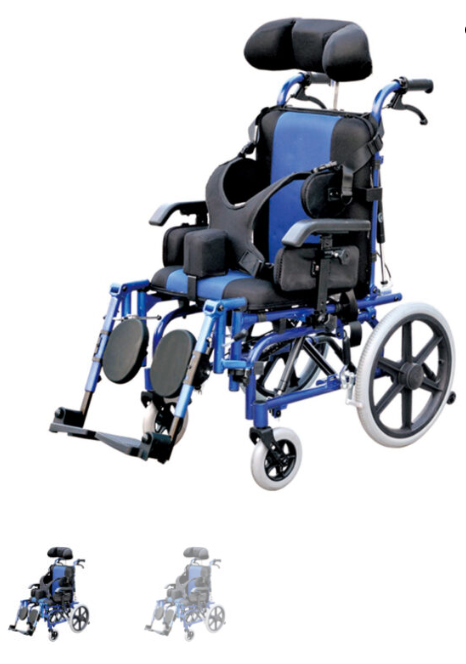
Top 10 Pediatric Wheelchair Suppliers in Canada
Canada’s pediatric wheelchair market has over 40 active suppliers. But few focus on children’s mobility at a clinical level. The ones that do make a real difference.
1. Convaid Inc. — Best for Lightweight Folding Pediatric Wheelchairs
Convaid spent decades building one thing: wheelchairs for kids. That focus shows in every detail.
You get four core series — EZRider, Trekker, Rodeo, and Cruiser. Each one targets a different mix of weight capacity, tilt range, and growth support.
Here’s a quick look at two key models:
-
Trekker — The seating module weighs just 10–11.5 lbs. Tilt range runs from -10° to +45°. Seat depth adjusts from 4.75″ to 12.25″.
-
EZRider — Built for heavier kids. It supports up to 250 lbs with seat widths from 12″ to 18″.
The biggest long-term value? Tool-less 5″ seat depth adjustment across multiple models. This covers up to five years of growth. So one chair, one funding application, five years of fit. That math works in your favor.
Folded size stays practical too. The EZRider collapses to 44.5″–48″ × 13.5″–14″. That’s narrow enough for standard vehicle trunks and school bus storage.
Best for: Families and OTs who want portability, multi-year usability, and clinical-grade tilt options — without the added weight or cost of a power chair.
2. Sunrise Medical (ZIPPIE Series) — Best for Growing Children Seeking Independence
Children grow fast. Their wheelchairs should keep up.
Sunrise Medical built the ZIPPIE series around that one truth. Four models — IRIS, Zone, GS, and X’CAPE — each have growth adjustment built into the frame. Not as an add-on. Not as a pricey upgrade.
Here’s what that looks like in practice:
-
ZIPPIE Zone: 3″ built-in depth growth + 2″ via sling upholstery. Seat width scales from 8″–16″ through part replacement. Weighs just 14 lbs.
-
ZIPPIE X’CAPE: Starts at 8.6 kg. Seat width grows to 18″, depth to 20″. The XLOCK folding system gives you rigid-frame performance in a folding body.
-
ZIPPIE IRIS: Includes a True Fit Growth Kit — free within the first five years. It covers both width and depth adjustments as your child grows.
The IRIS also rotates up to 60° posterior around the center of gravity. That’s not something most chairs do. Competing models typically rely on basic pivot systems — nothing close to this range of motion.
Best for: OTs and families who want one chair that works across multiple growth stages. You get fewer re-prescription cycles and far fewer funding applications to deal with.
3. Grace Medy — Best for Pediatric Seating & Positioning Systems
Seating is a medical intervention. Grace Medy builds around that fact as a pediatric wheelchairs manufacturer.
The Cerebral Palsy Wheelchair and Child Wheelchair series go beyond basic seating. These chairs work as positioning systems. They hold posture, distribute pressure, and adjust as a child’s body grows and changes.
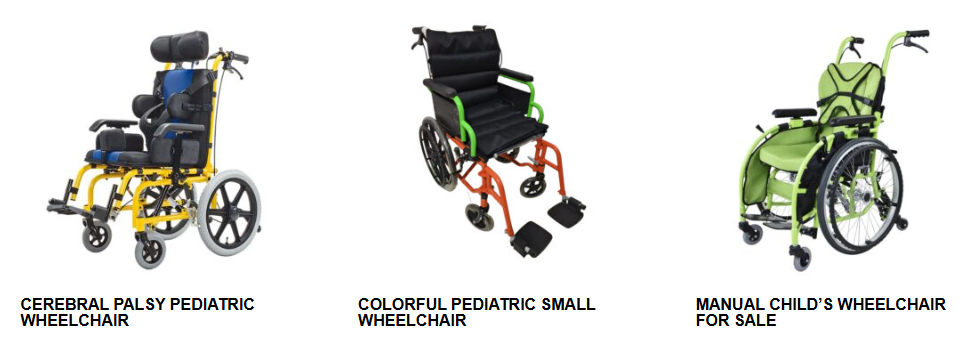
The component options are practical and specific:
Cushions: Memory foam, gel, or breathable mesh. You choose the thickness. Pressure distribution is built into the design — not added as an afterthought.
Pedals: 0–90° angle adjustment, anti-slip, foldable. Shaped around actual leg curvature — not a one-size geometry.
Backrest: Adjustable for trunk support. This reduces spinal strain during long hours of use.
Seat: Ergonomic hip positioning with pressure-distribution cushions. Keeps the child stable throughout the day.
Frames come in high-strength aluminum alloy or carbon fiber. You get quick-release wheel compatibility across pneumatic, solid, and high-elastic PU tire options.
Quality gets tested — not assumed. Every frame passes a 150% nominal load test held for 24 hours. Zero tolerance for deformation, joint looseness, or weld cracks. Slope stability gets validated on dynamic 8° ramps.
Grace Medy holds CE, ISO 13485, and FDA certifications. Output runs at 3,000+ units per day. Bulk orders come with pricing reductions of 15–30% — a practical fit for both institutional procurement and individual purchases.
Best for: OTs and procurement teams sourcing custom pediatric seating for CP or low-tone diagnoses. Clinical-grade adjustability and verified load testing take priority here over off-the-shelf options.
4. Motion Composites — Best Canadian-Made Ultralight Pediatric Wheelchairs
Motion Composites builds in Canada. That’s not a marketing line — it’s a real advantage for families working through provincial funding programs and local service needs.
The flagship pediatric model uses T700 high-modulus carbon fiber. Transport weight without rear wheels: 10.6 lbs (4.8 kg). With wheels and locks attached: 20.7 lbs (9.4 kg). For school hallways, vehicle transfers, and everyday caregiver handling, that weight is the whole argument.
The fit range covers a lot of ground:
Seat width: 12″–16″
Seat depth: 12″–19″ (infinite increments, up to 3″ adjustable growth range)
Back height: 9″–21″
Back angle: 90°–105°
Wheel camber: 0°, 3°, or 6°
The frame is WC-19 crash tested — you can anchor it in motor vehicles with confidence. Not every pediatric chair meets that standard. It’s a practical must for school transportation and medical appointments.
A free Growth Kit ships with every purchase. Pair that with the infinite seat depth adjustment, and one chair can cover several growth stages. Fewer replacement cycles. Fewer funding reapplications.
Best for: Families and OTs who put weight first, want Canadian-made build quality, and need a chair that holds up through years of hard, regular use.
5. Ki Mobility — Best for Versatile Pediatric Seating & Accessories
Ki Mobility’s pediatric line runs on one straightforward idea: one supplier handles the whole system — frame, cushion, back support, footrests, and accessories. No piecing together parts from four different vendors.
The Spark is the lightest starting point at 7.94 lbs (3.6 kg). Seat depth adjusts +4″ in 1″ increments. Built-in angle adjustment reaches 32°. That range covers real growth across a single funding cycle — without swapping out the chair.
The LittleWave series steps up for more complex needs:
LittleWave Clik — 12.5 lbs, seat width/depth both scale from 8″–16″, 0–8° camber
LittleWave Arc / Flip — tilt range 0–45°, seat width up to 18″, transit approved
LittleWave Flip (x:panda) — specialized variant, 32 lbs, seat depth adjusts 4″–14″
All three models are transit approved. For school transportation, that’s a must-have, not a nice-to-have.
The Axiom for Kids cushion pairs with these frames. Widths run 8″–16″, depths 8″–18″, weight capacity 165 lbs. Skin protection and positioning are built into the geometry from the start — not added on as an afterthought.
Footrest hangers come with a lifetime warranty. They swing away at 60°–90° and adjust in 0.5″ increments, starting from a minimum length of 3.75″.
Best for: OTs who need a full pediatric seating system from one source. Frame adjustability, transit compliance, and long-term accessory support all come together — no trade-offs required.
6. Maple Leaf Wheelchair — Best Canadian Family-Owned Supplier for Manual & Tilt Models
Maple Leaf Wheelchair focuses on one thing: tilt systems built for real bodies, at prices that won’t break the bank.
Three models make up their pediatric and complex rehab lineup.
SuperTilt is their flagship chair. You get infinite 45° tilt, seat widths from 14″–18″, and a 250 lb standard capacity — upgradeable to 500 lbs. Base price starts at $2,110 CAD, excluding seating configurations. Most suppliers won’t publish that number. Maple Leaf does.
LowRider takes a different approach to dynamic positioning. A front-pivot mechanism keeps seat rise low during tilt. That detail matters for kids with tone issues or postural asymmetry. You can choose two tilt ranges — 20° or 30° — each with distinct seat-to-floor options.
MLT brings recline into the mix. Gas cylinders power a one-piece elevating legrest. Seat depth reaches 20″. It weighs 60 lbs, so it’s on the heavier side — but it’s built for users who need full postural support all day long.
All three models share the same warranty coverage: 5-year frame, 2-year components. Steel frames, anti-tippers, and adjustable stroller handles come standard.
Positioning accessories are well-stocked:
– Articulating legrests
– Multi-axis headrest
– Leg bolsters
– Padded arm troughs
You get a full body management toolkit. No need to source parts from outside.
Maple Leaf serves Toronto and the GTA.
Best for: Families and OTs in Ontario’s funding corridor who need a configurable tilt chair, clear base pricing, and solid warranty coverage.
7. Pride Mobility (Quantum Rehab) — Best for Pediatric Power Wheelchairs
Power mobility for children with SMA, DMD, or complex neuromuscular conditions is its own clinical subspecialty. It’s not just another product category. Quantum Rehab, Pride Mobility’s complex rehab division, understands that — and builds accordingly.
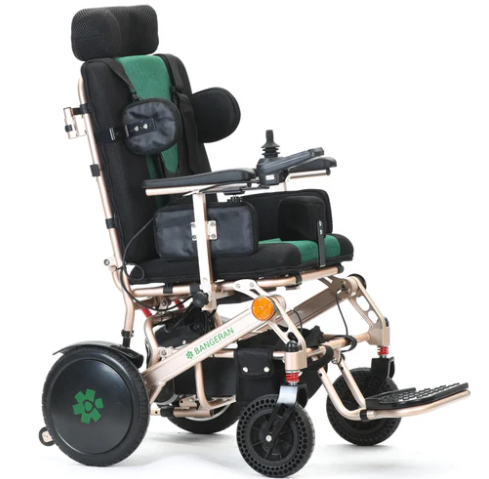
Two models cover the pediatric range: the Q6 Edge 2.0 and the Q6 Edge 3. Both run on Group 3 power bases. Both hold up to 300 lbs. Both fit the Pediatric TRU-Balance 3 Positioning seating system — a trunk and hip support structure you can configure to the child’s body. It calls for nine precise body measurements before you order. Shoulder width, axilla height, thigh depth. Nothing gets guessed.
The Q6 Edge 3 is listed under AADL benefit W592 in Alberta (part numbers WP0001575 adult, WP0001576 pediatric). That’s worth knowing if you’re working through provincial funding.
Motor selection shapes the whole system:
Standard 6 mph, 2-pole motors — included, no upcharge
Accu-Trac motors (+$995–$1,360) — built for switched drive controls: head arrays, chin joysticks, sip-and-puff inputs. Essential for children with little or no hand function
7 mph, 4-pole motors (+$700) — not covered by AADL
Accu-Trac pairs with Q-Logic 3 electronics — the platform that supports alternative drive inputs for SMA and DMD users. That combination is the core clinical case for this chair. You get a system where the motor, electronics, and seating all work toward one goal: giving the child full control.
Base pricing starts at $8,055 CAD (Q6 Edge 2.0, multiple actuator config). The 6-wheel mid-wheel drive platform turns in 20.5″. That fits most home layouts with standard doorways — no major renovations needed.
For Canadian orders: Pride Mobility Canada is based in Beamsville, ON. Phone: 888-570-1113. Email: [email protected].
Best for: Children with progressive neuromuscular conditions who need alternative drive access, full power positioning (tilt + recline + leg elevation), and a chair that fits provincial complex rehab funding pathways.
8. Permobil — Best for Complex Rehab & Power Positioning Needs
Some children need more than a wheelchair. They need a positioning system that moves with them, adapts to their body, and supports clinical goals all day long. Permobil builds for that user.
Three models make up their complex rehab lineup:
M3 Corpus (mid-wheel drive) — 330 lb capacity, 0–50° posterior tilt, full 85–180° power recline, 12″ seat elevator, 20.5″ turning radius. It fits tight spaces without losing function.
F3 Corpus (front-wheel drive) — adds ActiveHeight (12–14″ elevation) and ActiveReach (30° forward tilt, 4.5″ added reach). That reach feature is a big deal. Cabinets, tabletops, peer-level interaction — a child can access all of these on their own. That opens up a lot.
C300 — a compact front-wheel option, 260 lb frame, 25″ turning radius.
Every model qualifies under Group 3 CRT standards. That covers power tilt, recline, leg elevation, and alternative drive controls — all available for funding purposes.
Best for: Children with cerebral palsy, spina bifida, or progressive neuromuscular diagnoses. These kids need full power positioning and pressure management backed by clinical evidence — not a basic power chair.
9. Firefly — Best for Pediatric Mobility & Play Independence
Firefly doesn’t build traditional wheelchairs. It builds tools for exploration.
The product line targets young, active kids — children aged 1 to 8 who need movement support without being stuck in a static chair all day.
Three products make up the lineup:
Upsee (Mobility Harness) — A standing and walking harness for ages 1–8. You get four sizes covering chest circumferences from 50–71cm and hip circumferences from 50–73cm. Max user weight is 25kg. The adult and child share connected footplates. Movement feels collaborative, not just assisted.
Scooot (4-in-1 Mobility Rider) — Four modes: scoot, ride, push, crawl. Built for ages 2–6, max 22kg. Seat width is 230mm. Hip-to-footplate adjusts from 520–630mm. Head control is required. Use it outdoors on flat surfaces.
moveR / Firefly 2.5 (Power Assist Attachment) — A 350W motor clips onto any manual wheelchair in under five seconds. Top speed: 12mph forward. Range: 15+ miles per charge. Weight capacity: 280lbs including the chair. This isn’t a toy. It’s a serious power add-on for active pediatric users.
Best for: Families with young children who need movement variety — standing, crawling, and powered mobility. It’s a strong fit where play-based independence is the clinical goal.
10. Amylior — Best for Power Seating & Aftermarket Upgrade Systems
Amylior doesn’t build chairs from scratch. Instead, it makes the chair you already have do more — a lot more.
The Alltrack M3 is where most pediatric-adjacent cases start. Seat width runs from 14″–24″. Seat-to-floor drops as low as 15.5″. You get the full HCPCS power seating menu too:
Power Tilt (E1002)
Power Recline (E1004)
Independent elevating legrests (E1010)
Alta 11″ power seat elevation (E2298)
That’s a full postural management toolkit, already coded for funding.
For heavier or more complex users, the Alltrack HD3 steps up. It handles up to 550 lbs, with 45° VHD tilt and 160° recline.
Both platforms share the same modular core. You get Memory Seating, Dual-Action 6-wheel suspension, and Smart-Track assistive drive. Plus, the system works with Switch-It, ASL, and MO-VIS control systems. Alternative access for kids with limited hand function is built directly into the platform. It’s not added on after the fact.
Best for: OTs upgrading an existing power base with clinical-grade seating components, or procurement teams sourcing a configurable system with full HCPCS code alignment.
Pediatric Wheelchair Suppliers in Canada: Comparison Table
Ten suppliers. Very different strengths. Here’s a quick breakdown before you read any full profile.
|
# |
Supplier |
Best For |
Chair Type |
Est. Price (CAD) |
|---|---|---|---|---|
|
1 |
Sunrise Medical |
Growing children, independence |
Manual |
Custom |
|
2 |
Permobil |
Complex rehab, power positioning |
Power + Manual |
Custom |
|
3 |
Grace Medy |
CP seating, custom positioning |
Manual |
Custom |
|
4 |
Convaid Inc. |
Lightweight folding, multi-year fit |
Manual |
Custom |
|
5 |
Ki Mobility |
Full seating systems, OT sourcing |
Manual |
Custom |
|
6 |
Maple Leaf Wheelchair |
Tilt systems, Ontario families |
Manual/Tilt |
From $2,110 |
|
7 |
Pride Mobility (Quantum) |
Neuromuscular conditions, alt-drive |
Power |
From $8,055 |
|
8 |
Motion Composites |
Ultralight, Canadian-made |
Manual |
Custom |
|
9 |
Firefly |
Play-based mobility, ages 1–8 |
Adaptive/Power Assist |
Custom |
|
10 |
Amylior |
Power seating upgrades, HCPCS coding |
Power |
Custom |
Three suppliers — Permobil, Sunrise Medical, and Pride Mobility — carry provincial funding codes across ADP, AADL, and BC programs. Reimbursement is a common starting point for many families. These three give you the shortest path to funding approval.
Conclusion
Picking the right pediatric wheelchair supplier in Canada goes far beyond a simple purchase. It directly shapes a child’s independence, comfort, and growth over time.
The ten suppliers listed here cover every major need:
Ultralight manual frames
Complex power rehab systems
Custom seating and positioning
Everything in between
First-time parent or an OT updating your referral list — the next step is the same. Cut your shortlist down to two or three suppliers. Check that they work with your provincial funding program (ADP, AADL, or EDP). Then request a clinical assessment before you commit.
Don’t let perfect get in the way of equipped. The right children’s adaptive mobility device is out there — and now you know where to find it.
