
Finding the right wheelchair for outdoor adventures should be easy. You might want to hit the beach, explore hiking trails, or roll across uneven sidewalks and grassy parks. The wheelchair you pick makes all the difference between freedom and frustration.
Here’s the reality: not all wheelchairs handle rough ground the same way. Standard indoor models struggle on gravel paths, grass, and slopes. Outdoor lovers face these challenges every day.
Today’s outdoor wheelchairs come with special features that change everything. Heavy-duty wheels conquer tough surfaces. Advanced suspension systems smooth out bumpy rides. These features open up new possibilities.
This guide covers what you need to know. Manual or power options? Beach-specific designs? All-terrain features? We break it all down. You’ll match the perfect wheelchair to your outdoor lifestyle. No guesswork. No expensive mistakes.
Manual Wheelchairs for Outdoor Use: A Condensed Guide
Outdoor manual wheelchairs are tough machines. They follow ISO 7176 standards. You can reach speeds up to 15 km/h. They support users up to 120 kg. Unlike indoor models, every part targets rough terrain. You get unmatched safety and reliability in real conditions.
Wheel Configuration & Stability
Your wheel setup drives performance. Rear wheels run 22-26 inches. You often see a 0-3 degree camber (outward tilt). This helps you turn on uneven ground. Wide-tread tires grab onto gravel and wet surfaces. Front casters matter just as much. Outdoor models start at 8 inches and reach 26 inches. A width of 2-3 inches stops them from sinking into grass. They won’t get stuck in pavement gaps either.
Design & Adjustability
A long wheelbase adds stability. It spreads your weight to stop tipping on slopes. Plus, a low center of gravity smooths out bumps. You can move rear axles to optimize balance. Pick different footrests to clear rocks. Tipping levers help attendants handle curbs.
Durability & Propulsion
ISO 7176-8:2014 testing proves the strength. Chairs face static loads and hits like potholes. They survive 200,000 fatigue cycles. For movement, standard push-rims handle simple paths. Lever propulsion systems give you a mechanical edge. You climb hills with less work. On hard trails, swap front casters for large wheels. This four-wheel setup rolls better over long trips.
Power Wheelchairs: Mid-Wheel vs Rear-Wheel vs 4×4 All-Terrain Drive
Where your wheels sit—the drive configuration—changes everything. It affects moving, turning, and handling obstacles. Check out how these systems handle the outdoors.
Rear-Wheel Drive (RWD): Speed on Smooth Ground
RWD puts the power wheels in the back. You get high speeds and great stability on flat pavement. The four-wheel design soaks up shocks, so your ride feels smooth. But rough ground causes trouble. Front casters hit bumps first, making curbs hard to climb. Also, steep hills can trigger the anti-tip wheels and stop you. They turn wide, so be careful in tight spaces.
Mid-Wheel Drive (MWD): Indoor Agility, Outdoor Limits
MWD uses six wheels, with the main drive centered under your seat. You get the tightest turns possible—even spinning 360 degrees in one spot. Beginners find it stable and easy to learn. But outdoor rides get bumpy. Six wheels mean more contact with the ground, so shocks travel right through the frame. It is safe, but you’ll feel the rough patches more than with other models.
Front-Wheel Drive (FWD): The Climber
FWD puts the power up front. Large wheels pull you over curbs instead of pushing from behind. This works best for climbing hills or city streets. It handles bumps well too. Just know that top speeds are lower to keep the chair straight. Also, it steers like a forklift. You will need some practice to get used to it.
Quick Verdict
Need to handle extreme mud or sand? 4×4 models are your heavy-duty choice. For standard use: choose MWD for tight indoor turns, RWD for speed on flats, or FWD for the best outdoor climbing. Don’t just guess—test drive one on your actual daily path.
All-Terrain and Off-Road Wheelchairs
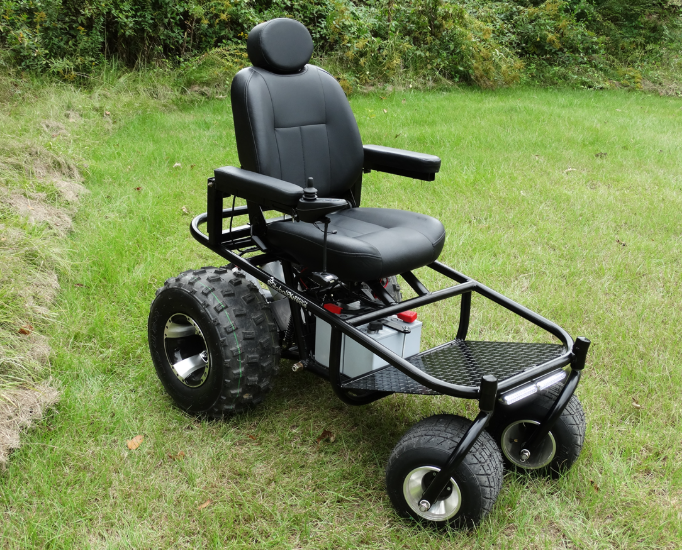
Standard indoor models fail in mud, sand, snow, and gravel. All-terrain wheelchairs fix this with specialized engineering. These machines don’t focus on being small. Instead, you get raw power and stability. This lets you handle the outdoors seriously.
Power & Range
Real off-road skill comes from high-torque motors. Heavy-duty 4×4 models use four separate 700-watt motors. That totals 2,800W. They pull through deep sand with no strain. Dual 1,000-watt motors give you the torque to climb steep 15-degree slopes. You usually get a 35 km range on mixed terrain. Plus, there are options to upgrade from lead-acid to lighter lithium batteries.
Suspension & Ride Quality
Comfort on rough ground is a must, not a luxury. Systems with four spring dampers or moving arms let wheels adjust to rocks and holes. This keeps the frame level if a wheel hits a rut. Big, low-pressure knobby tires (often 14 inches) help too. They absorb shocks that would otherwise shake you.
Build & Specs
You need weight for stability. Full-size 4×4 rigs often weigh over 320 lbs empty. This gives a solid feel on technical trails. Foldable versions work for travel, but you lose some power for portability. Check for 120A controllers for quick handling. Look for ISO crash-test safety. Adjustable seats (tilt, recline, width) keep you comfortable all day.
Folding and Portable Power Wheelchairs for Outdoor Travel
Travel becomes far easier when a power wheelchair folds into a car trunk or can be checked at the airport. In 2024, the global folding power wheelchair market reached $1.5 billion. Today’s portable models combine real outdoor performance with lightweight frames under 50 pounds.
Real-World Outdoor Capability
The Fold & Go MagSHOCK® shows what portable power chairs can handle. It climbs 25-degree inclines and has been tested on 21 trails worldwide, including Glacier National Park, the Canadian Rockies, North Cascades, and Vietnam’s Cu Chi jungle trails. Its mountain-bike-style frame rolls over gravel, rocks, roots, cobblestones, and grass. On a single charge, it can run for two full days of touring and has been approved by TSA agents in major international airports. It folds compactly to fit SUV trunks.
Portable power wheelchairs have proven effective on West Virginia’s loose gravel trails, European cobblestones in Rome and Rhodes, Valletta’s hills, Iceland’s Geysir paths, and long-distance travel in Dubai. With the right specs, they manage grass, dirt, slopes, and uneven terrain.
Key Specs Across Popular Models
EZ-GO offers up to 9 miles of range (12 miles on the Deluxe version), 4 mph top speed, solid tires, and up to 300-pound capacity. LiteRider Envy delivers a 15.5-mile range with a 300-pound capacity and larger seating. Shoprider Jimmie breaks into lightweight pieces for airline travel, with rear-wheel drive for better outdoor handling. Foldawheel Eco leads with a 22-mile range, while Merits Health Travel-Ease folds like a manual wheelchair with powered mobility.
Travel-Focused Design
Most models offer 10–20 miles of range, 220–330-pound capacity, anti-tip wheels, emergency brakes, tight turning radius, and airline-friendly batteries. These features make them suitable for airports, taxis, cruise ports, boardwalks, and full-day sightseeing without frequent recharging.
Quick Comparison: Find Your Perfect Match
I broke down the six main types here. This table maps out their strengths and shows where you might face challenges.
|
Type |
Best Terrain |
You’ll Love It Because… |
The Trade-off |
|---|---|---|---|
|
Outdoor Manual |
Gravel, uneven paths, grass |
It’s tough. You get full control and it handles rough bumps without failing. |
You need upper body strength. Or, add a power assist. |
|
RWD Power |
Flat pavement, long roads |
High speeds feel stable. You get a smooth ride on flat ground. |
Turns are wide. Climbing curbs is hard; front wheels hit first. |
|
MWD Power |
Tight indoor spaces, simple floors |
Great agility. Spin a full circle in one spot. Beginners learn it fast. |
Rides feel bumpy outside. You feel ground shocks through the six wheels. |
|
FWD Power |
Hills, curbs, city obstacles |
Climbs well. Big front wheels pull you over obstacles rather than pushing. |
Practice your steering; it feels like a forklift. Also, it goes slower. |
|
4×4 All-Terrain |
Deep mud, sand, snow, steep trails |
Huge power. High torque and suspension tackle tough conditions nicely. |
It’s heavy and big. You need a special vehicle to move it. |
|
Folding Power |
Airports, tourist spots, light trails |
Travel freely. Fits inside a trunk or plane cargo. Vacations become easy. |
You get less stability and power compared to a 4×4. |
Conclusion
The right wheelchair opens up outdoor adventures. You can explore city sidewalks, nature trails, or beach sunsets. The perfect outdoor wheelchair for your lifestyle exists. Just match it to your terrain and mobility needs.
Here are the essentials: all-terrain wheelchairs handle rough terrain with great suspension systems. Power wheelchairs make long-distance trips easy. Manual options give active users lightweight portability. Your choice depends on where you’ll roll and how much help you want.
Don’t stay indoors overthinking this. Figure out where you’ll use it most. Test-drive options if you can. Quality weather-resistant wheelchair features and solid components mean better reliability. They’ll last you years of adventures.
