
What Is Wheelchair Accessibility?
Wheelchair accessibility means removing barriers. Specifically, it removes barriers that stop wheelchair users from moving through the world on their own terms.
That definition sounds simple. The reality is more precise — and more demanding.
True accessibility means independent navigation. Not assisted. Not worked around. Independent. A space that is accessible lets a wheelchair user enter, move through, and use it without anyone else’s help. That distinction matters.
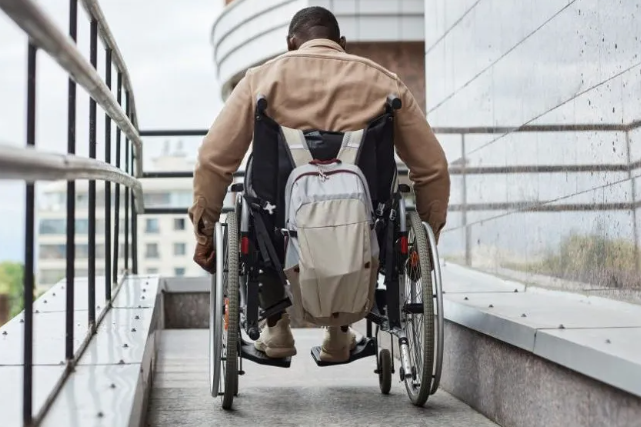
Accessibility vs. Convenience
Accessibility and convenience are not the same thing. That difference is worth understanding clearly.
Wider hallways are convenient. A 1:48 maximum cross-slope — engineered so wheels don’t drift — is an accessibility requirement. One is a nice-to-have. The other keeps a wheelchair user stable and independent.
The UN Convention on the Rights of Persons with Disabilities (Article 9) puts it directly: accessibility is not a design preference. It is a human right — one that enables full participation in society, not just physical passage through a door.
Who Benefits from Wheelchair Accessibility?
The numbers tell a story that policy documents miss. More than 3.2 million Americans use manual or power wheelchairs. For most of them, the built environment is a barrier, not a path. Half can’t even enter their own homes without hitting steps. Eight in ten struggle with public transit. These aren’t rare exceptions. This is the everyday cost of inaccessibility.
Permanent Wheelchair Users
This group feels the impact most. All 1.7 million community-dwelling wheelchair and scooter users in the United States move through a world built without them in mind.
Accessible design promises a lot. Most spaces deliver far less. Over 60% of wheelchair users cut back or stop traveling when accessible routes aren’t available. That’s not a choice. That’s forced isolation.
Accessible pathways, well-built ramps, compliant restrooms — these don’t add luxury. They give people back their freedom to move.
Older Adults
Aging and mobility loss go hand in hand. About 24.1% of U.S. older adults — around 8.5 million people — use some kind of mobility device. Among adults 75 and older, 46% live with a disability. The need for barrier-free spaces in this group isn’t on the horizon. It’s already a daily reality.
Temporary and Post-Surgery Users
Wheelchair accessibility isn’t just a lifelong need. Injury, surgery, and serious illness can create mobility limits that last weeks or months. Among older adults alone, mobility incidents happen at a rate of 61.7 per 1,000 person-years. Many of those cases follow a clear path — from canes to walkers to wheelchairs.
Accessible spaces matter for these users too. Their independence is already at risk during recovery. Good design helps protect it.
Caregivers and Families
A space that blocks access doesn’t erase the need. It just shifts the work. Two-thirds of wheelchair users face limits in basic household tasks. Family members fill those gaps — through hours of physical help, coordinating rides, and keeping constant watch.
Accessible design cuts that load. A well-built barrier-free environment lets people get around on their own. That means fewer trips, less hands-on help, and real breathing room for family caregivers.
Wheelchair Accessibility Standards & Legal Requirements (ADA and Beyond)
The ADA Framework: What’s Required
The Americans with Disabilities Act doesn’t work as a single blanket rule. It operates through two primary titles, each covering different types of spaces:
Title II applies to state and local government facilities
Title III applies to places of public accommodation — restaurants, hotels, retail stores, healthcare facilities
Both titles require compliance with the 2010 Standards for Accessible Design for any construction or major alteration completed after March 15, 2012.
The key word here is alteration. A facility that modifies an existing element must bring that element into compliance. The path of travel connecting it to the rest of the building must also meet standards. There’s a built-in cap: path-of-travel upgrades that exceed 20% of the primary alteration cost don’t require full compliance — only the primary element does. Pre-2012 elements that remain untouched sit in a safe harbor and are exempt.
Here are the specific measurements you need to know:
Accessible routes: 36-inch minimum clear width; 60×60-inch passing spaces every 200 feet; cross-slope no greater than 1:48
Doors: Maneuvering clearances vary by approach angle (front-pull approach needs 60 inches); thresholds no higher than ½ inch; handles between 34–48 inches high
Ramps: Maximum slope of 1:12; runs no longer than 30 feet; landings at least 60 inches long; handrails between 34–38 inches, extending 12 inches beyond top and bottom
Restrooms: 60-inch turning diameter; toilet centerline 16–18 inches from the wall; grab bars at 33–36 inches above finished floor
The two most common — and most costly — violations are ramp handrails that don’t extend the full 12 inches and grab bar zones blocked by toilet paper dispensers. Both need retrofits. Both lead to fines and settlements that regularly hit five figures.
How the U.S. Standard Compares Globally
The ADA is strong. It isn’t the strictest standard in the world.
|
Standard |
Key Specs |
Notable Difference |
|---|---|---|
|
ISO 21542 (International) |
Routes 1.2m wide; ramps max 1:20 |
Stricter ramp slope than ADA’s 1:12 |
|
UK Equality Act 2010 |
Long ramps max 1:20; 1.5m turning space |
Stronger discrimination penalties; applies to goods and services |
|
Australia BCA / AS 1428 |
Paths 1m wide; ramps max 1:14; grab bars at 900mm |
State-level variations; higher handrail placement |
The ADA’s 1:12 ramp slope is a legal minimum. ISO 21542 sets 1:20 as its standard. That gap isn’t just a number on paper — it reflects how much extra effort a wheelchair user puts out every single day.
Conclusion
Wheelchair accessibility isn’t a checkbox — it’s a commitment to building a world where mobility limitations don’t become life limitations.
Are you a wheelchair user managing life every day? A caregiver fighting for someone you love? A business owner making sure your space meets ADA wheelchair accessibility standards? An architect designing spaces from scratch? The principles covered here apply to all of you. Barrier-free environments don’t happen by chance. People who understand what’s at stake build them — and then act on it.
