
Are Portable Wheelchair Ramps Safe? The Direct Answer
Research, safety standards, and years of real-world use all point to the same answer: yes, portable wheelchair ramps are safe — as long as you pick the right one and set it up right.
That’s not a hedge. That’s the whole answer.
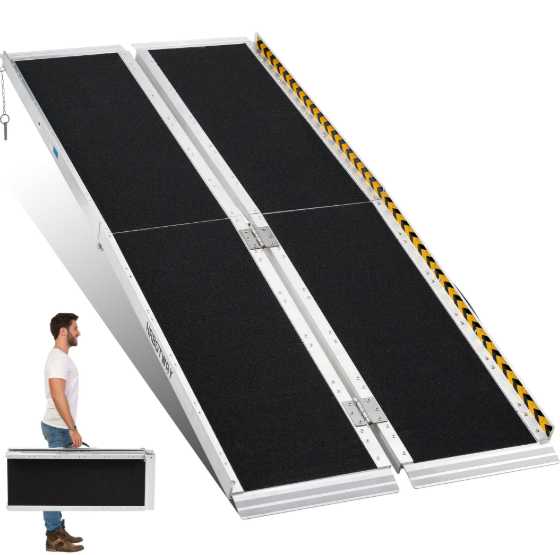
What Makes a Portable Wheelchair Ramp Safe: 5 Non-Negotiable Safety Factors
Five things. That’s it. Five measurable, checkable things separate a ramp that works from one that sends someone to the emergency room. Not ten things. Not a vague sense of “quality.” Five specific factors — and every single one has a number attached to it.
Factor 1: The Slope (Because Physics Doesn’t Negotiate)
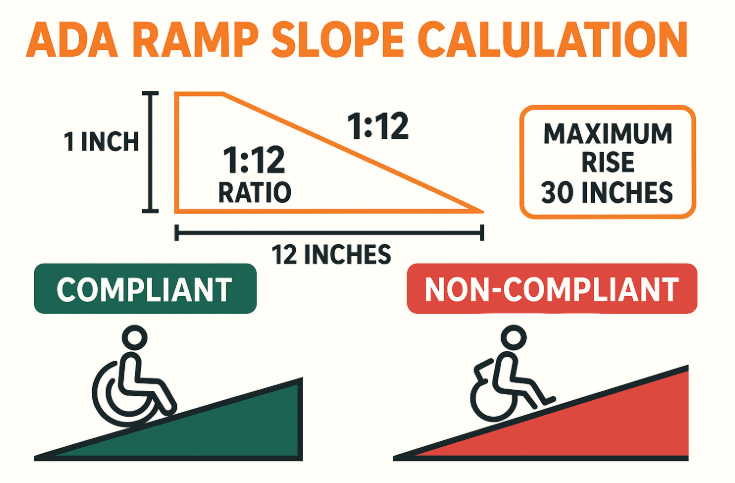
The ADA didn’t pull the 1:12 slope ratio out of thin air. It’s the angle where gravity and wheelchair physics reach a truce.
The math is straightforward: for every 1 inch of vertical rise, you need 12 inches of ramp length. A 6-inch doorstep needs a 6-foot ramp. A 24-inch porch rise needs a 24-foot ramp.
Go steeper than 1:12, and the ramp stops cooperating. Manual wheelchair users lose control on the way down. Power wheelchairs struggle on the way up. The slope isn’t a suggestion — it’s a load-bearing rule.
Measure your rise first. Everything else follows from that number.
Factor 2: Weight Capacity (Add the Margin, Always)
Most quality portable ramps hold 600 lbs minimum. Premium models reach 800 lbs and above. Those numbers matter more than most people expect, because the weight total isn’t just the user.
It includes:
– The person
– The wheelchair or scooter
– Any gear, bags, or attached equipment
– A caregiver’s partial weight during an assisted transfer
A manual wheelchair setup usually totals 200–300 lbs. A power wheelchair or scooter pushes that to 300–500 lbs — and sometimes beyond.
Here’s the rule: take your real total load, then add a 20–50% safety buffer. Everything combined weighs 600 lbs? Get a ramp rated for 800 lbs. A ramp flexing or bending under load is a ramp about to fail. The capacity rating exists so you never find out what happens past the limit.
Factor 3: Slip Resistance (The Surface You Can’t Ignore)
Not all traction surfaces perform the same way. The difference gets obvious fast the first time it rains.
Aluminum grit tread and milled channel textures are the standard to look for. These are cut straight into the ramp surface. They don’t peel. They don’t wear out after a season of outdoor use. They hold up in rain, morning dew, light snow, and the general wet mess that real life throws at you.
Glued-on grip tape and adhesive coatings? They look fine on day one. By year two, the edges are lifting and traction is gone.
Brands like PVI and EZ-Access use integrated grit tread because it outlasts every surface coating on the market. That’s the benchmark.
Factor 4: Frame Stability and Edge Guards
A ramp that wobbles is a ramp that lies to you about being safe.
High-strength aluminum frames cut out the flex and bounce that cheaper, lighter materials create. The transition points matter too. Where the ramp meets the ground, you need rubber anti-slip feet at the base. Where it meets the threshold, you need a secure transition lip at the top that locks against the surface without shifting.
Then there are edge guards. Raised side curbs of at least 2 inches do the most to prevent the most common portable ramp accident: a wheel drifting sideways and dropping off the edge. For users with limited steering control, edge guards aren’t optional. They’re the design feature doing active safety work on every single pass.
One more detail worth checking: folding ramps with horizontal hinges that sit flush with the surface. Raised hinges create a ridge in the middle of the ramp. That’s a small trip hazard — and it becomes a real hazard at speed or for users with limited motor control.
Factor 5: Handrail Requirements (Do You Actually Need Them?)
ADA guidelines are clear: handrails are required on both sides when the rise exceeds 6 inches or the ramp run exceeds 72 inches. For home entry ramps that hit those numbers, dual handrails aren’t a luxury — they’re the standard.
For compact vehicle access ramps and short portable ramps under the 6-inch threshold, a single rail or no rail is often fine. But a steep rise or a long run changes the safety picture completely. Support on both sides makes a real difference.
Ramp width should be at least 36 inches — enough room for the wheelchair, clearance for the user’s hands and feet, and space for a caregiver alongside if needed.
The Five Factors at a Glance
|
Safety Factor |
Minimum Specification |
|---|---|
|
Slope angle |
1:12 ratio (1″ rise = 1 ft length) |
|
Weight capacity |
600 lbs minimum; 800+ lbs recommended |
|
Slip-resistant surface |
Integrated grit tread or milled texture |
|
Edge guards |
2-inch raised side curbs minimum |
|
Handrails |
Both sides when rise >6″ or run >72″ |
Every ramp you consider should clear all five columns. Not four. Five. These factors don’t rank by importance — they work together. A failure in any single one makes the rest irrelevant.
The Real Risks of Portable Wheelchair Ramps (And How to Prevent Each One)
Four things go wrong with portable ramps. Not dozens of vague possibilities — four specific, preventable failure modes. Know them, and you can rule them out before anyone gets hurt.
Risk 1: Backward Tipping on Steep Slopes
A ramp angle past the 1:12 ratio changes wheelchair physics fast. The center of gravity shifts rearward. The front wheels lighten. On a steep descent, a manual wheelchair user loses control of pace — and the ramp takes over.
The slope is the first domino. Get it right, and most of what follows takes care of itself.
Risk 2: The Ramp Shifts Mid-Transfer
A ramp that moves while someone is on it ends transfers badly. The shift is often small — a slight slide, a subtle rotation — but that’s enough. The wheelchair wheel catches the shifted edge. Getting back to a safe position from there is very hard.
How to prevent it:
– Match the base pad type to the actual surface — spiked feet for soft ground, rubber for hard floors
– Follow the manufacturer’s setup instructions step by step. Skipping steps is where wobble starts
– Check that the transition lip at the top is locked tight against the threshold before the first pass
– On any unfamiliar surface, do a firm push-test by hand before a person uses the ramp
Risk 3: Overload and Structural Failure
The weight numbers on cheaper portable ramps tend to be optimistic. Substandard welds and thin aluminum profiles look the same as aviation-grade construction in a product photo. Under a 450-lb power wheelchair with a rider, they perform very differently.
A ramp that bends or flexes under load has already hit its limit. Stop using it.
Risk 4: Wet Conditions and Weather Degradation
Rain changes everything. A ramp that works fine in dry conditions can turn into a real hazard after a light morning drizzle — especially if the traction texture is a surface coating rather than a built-in feature.
Wood ramps are the worst offenders. Wet wood loses grip fast. With prolonged outdoor exposure, the structure itself starts to break down. Even aluminum ramps with adhesive grip tape begin peeling at the edges within a season or two of outdoor use.
Never use a wooden ramp that shows soft spots, warping, or surface rot
The weather risk is the most predictable of the four — and the one most often skipped during a quick setup.
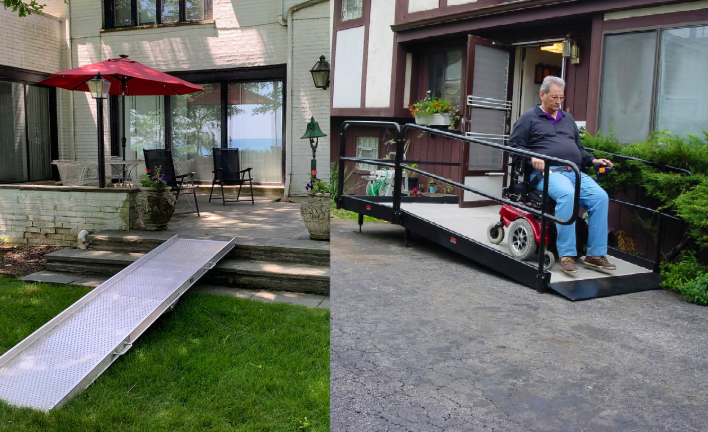
How to Use a Portable Wheelchair Ramp: A Step-by-Step Guide
Safety starts in the setup. You spend 30 seconds preparing before anyone rolls onto the ramp. This straightforward guide helps you get it right every single time.
Step 1: Start with a Solid Setup
Setting up a portable ramp sounds simple. Still, you cannot ignore the details. First, unfold the bottom half toward the lower landing. Check both lips. The top lip must sit tight against your threshold. The bottom lip needs to lay flat on the ground. Press down hard on both ends. Look out for any rocking or lifting. Secure any underside straps. Next, take a quick test walk. Step right in the middle with your full weight. A shifting ramp means you need to find the problem before a wheelchair touches it.
Step 2: The 60-Second Visual Check
Do not skip this part. Take a quick look to confirm a few key details:
Surface: Check for a dry surface. Clear away any cracks or trash.
Hinges: Look at the folding sections. They must lay flat together.
Curbs: Check the side guards. They should stand straight without bending outward.
Alignment: Place the wheelchair right in the middle of the base.
Safety gear: Lock the anti-tip wheels. Keep them ready to go.
Step 3: Moving Up the Ramp
Fasten the seatbelt first. Take off any rear-mounted bags or gear. Heavy back-loads cause tipping. A caregiver pushing a manual chair needs a wide stance. Keep feet shoulder-width apart. Apply steady, continuous pressure. Avoid rough or jerky movements. Power chairs need the lowest speed setting. Build a little momentum before hitting the ramp. Keep moving forward. Do not stop or try to turn in the middle.
Step 4: Coming Down with Control
Coming down means keeping gravity in check. Pick the lowest speed for power wheelchairs. Keep your eyes facing forward. Caregivers walking behind a manual chair must act as the brake. Tilt the user’s weight back a bit. A steep slope requires a different approach. Backing down in reverse is often the safer choice for steep inclines. Commit to the descent. Avoid sudden stops halfway down.
Step 5: Smart Storage
Finish the job by folding the ramp. Store it in a dry place. Pulling it out later requires another inspection. Do not assume the gear remains fine. Check for peeling traction tape. Look for rust on the joints. Run another quick edge test. A ramp passing checkups last month does not get a free pass today.
These steps are not complicated. You keep people safe by building a regular habit. Do these checks every single time.
Conclusion
Here’s what nobody tells you mid-panic, tape measure in hand, staring at a doorway: portable wheelchair ramps are safe. Flat-out, no-asterisk safe — as long as you pick the right one and use it right. That’s not a disclaimer. That’s just physics doing its job.