
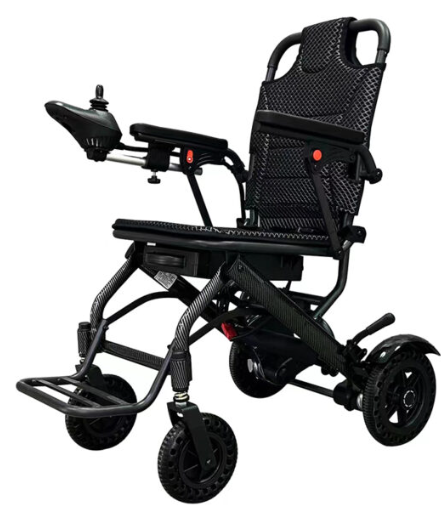
Carbon fiber electric wheelchairs are a real step forward in engineering. They’re lighter than aluminum, stronger than steel, and built for people who refuse to let mobility challenges shrink their lives.
Not every carbon fiber frame is the same, though. The difference between the right choice and the wrong one hides in details most reviews skip over.
Why Carbon Fiber Changes Everything in Electric Wheelchairs
Material science doesn’t make headlines often. But in mobility devices, one shift in raw material has changed what’s possible.
Carbon fiber sits at 1.8 g/cm³. Aluminum is 2.8. Steel is 7.85. These aren’t abstract lab numbers. They explain why a carbon fiber electric wheelchair frame weighs 40% less than aluminum and over 60% less than steel — and still handles the same load, day after day.
That weight difference gives you something most spec sheets never mention: freedom from dependency.
The Physics Behind the Portability
A lighter frame changes daily travel in real, practical ways:
Folding a carbon fiber wheelchair into a car trunk is a solo task
Carrying it up a flight of stairs is manageable
Loading it into an overhead bin on a flight no longer requires negotiating with strangers
Durability That Outlasts the Competition
Aluminum fatigues. It bends under repeated stress and corrodes over time. Carbon fiber works differently. Built with proper layup construction, it resists fatigue and absorbs road vibration rather than passing it through to the rider. It also holds up in coastal humidity and salt-spray conditions that would eat through a metal frame in a matter of seasons.
Spend hours a day in your chair, and that vibration absorption stops being a minor perk. It becomes a real reduction in joint stress and pressure-sore risk — something you feel over months of use.
The upfront cost of a carbon fiber wheelchair frame looks high at first. Spread that cost across years of lower maintenance, fewer part replacements, and less physical strain — and it stops looking expensive. It starts looking like the smart call.
5 Critical Factors Before You Buy a Carbon Fiber Electric Wheelchair
Most buyers figure out the wrong thing matters after the chair arrives. These five factors protect your investment before it ships.
Factor 1: Weight Has a Hard Threshold — Know Yours Before You Shop
Keep this number in your head: 30 lbs (13.6 kg). Go over it and daily transfers become a two-person job. Stay under it and you load into a car trunk solo, carry up a flight of stairs, and move through airports without asking for help.
The current market runs from 12 lbs to 28 lbs for ultra lightweight power wheelchairs. That’s a wide range. For solo users, 15 kg is the practical ceiling. Go beyond 25 kg and even assisted transfers add 40–60% more physical strain per lift throughout a day of regular use.
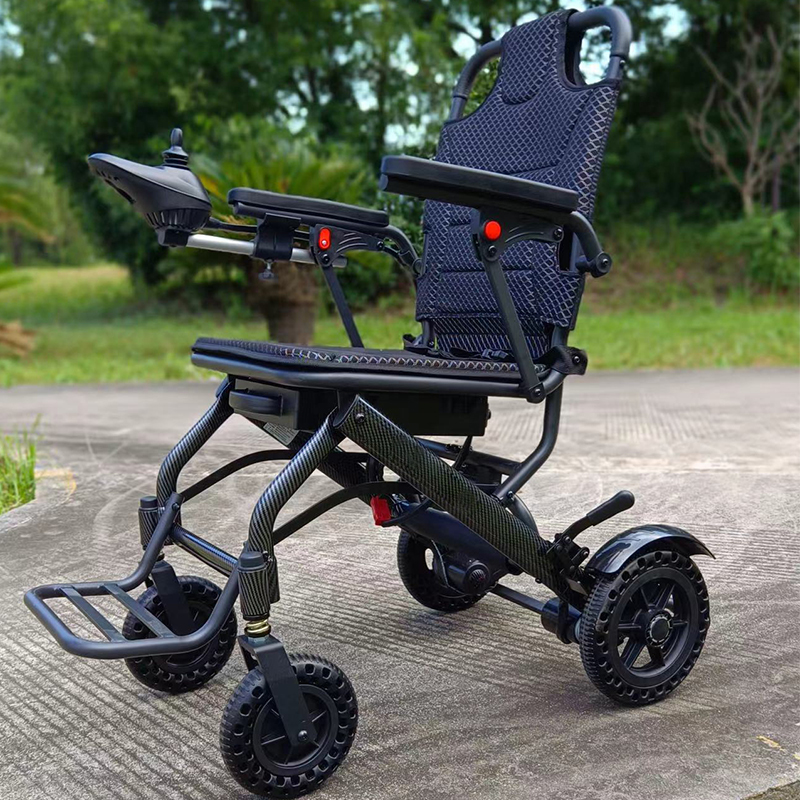
The portable electric wheelchair lightweight category exists for this exact reason. Check the complete, ready-to-ride weight — frame, battery, and footrests all included.
Factor 2: Battery Specs Determine Whether You Fly
One number controls air travel: 160 Wh. That’s the IATA hard limit for lithium-ion batteries allowed in aircraft cabins. Go over it without airline pre-approval and your chair stays on the ground.
Beyond that limit, match range to your real routes. Urban commuters need about 10 miles per charge. Travelers covering 20-mile days should look at dual-battery setups that stay under a combined 320 Wh. Carbon fiber wheelchair battery life on lightweight frames runs 15–25 miles per charge. That’s more efficient than aluminum builds — the motor carries less dead weight.
Here’s a useful test: use 80% of a charge, then stop. You should still have 20% left. That reserve keeps you from getting stranded three blocks from home.
Factor 3: Folding Isn’t a Feature — It’s a Functional Requirement
Unfold-to-seated should take five seconds or less. Go over that and it will frustrate you every day. One-hand operation under five seconds is the minimum standard worth accepting on a foldable carbon fiber electric wheelchair.
Folded dimensions matter as much as fold speed. Target under 30×60×80 cm to fit 95% of sedan trunks. Aircraft overhead bins are tighter — IATA maximum is 56×36×23 cm. Check those numbers against your specific vehicle before you buy, not after.
Carbon fiber mechanisms are rated to 10,000 fold cycles without fatigue. Aluminum multi-step systems average 10–15 seconds per fold and offer no equivalent cycle guarantee.
Factor 4: Weight Capacity Isn’t About Your Current Weight
Pick your capacity based on your weight plus 20–50 lbs of margin. That extra room covers clothing, carried items, body weight changes, and the added stress of inclines and uneven ground.
|
User Weight |
Recommended Capacity |
Seat Width |
|---|---|---|
|
140–200 lbs |
250 lbs |
16–18″ |
|
200–300 lbs |
300 lbs |
18–20″ |
|
300–400 lbs |
400 lbs |
20–22″ |
Seat width needs just as much attention. A chair that’s too narrow creates pressure points within thirty minutes. Sit in the configuration for at least that long before you finalize any order.
Factor 5: Motor Power and Terrain Must Align
The carbon fiber wheelchair frame gets all the attention. The motor is what decides what you can do in it.
Brushless motors in the 250–500W range are the current standard on quality motorized wheelchair carbon fiber builds. 300W handles grass and light gravel. 500W is the right threshold for terrain that’s uneven or sloped on a regular basis.
Carbon fiber wheelchair durability at the frame level is strong — the fatigue limit exceeds one million cycles. Aluminum frames show stress deformation after about 100,000 cycles. That structural advantage only pays off if the motor and drivetrain match it. Ask for a minimum 3-year frame warranty and confirm the model has passed corrosion testing. Total ownership costs run 20–30% lower than aluminum equivalents, factoring in repairs and part replacements across five years.
Matching the Right Carbon Fiber Electric Wheelchair to Your Lifestyle
Your chair should work around your life — not the other way around. A frequent flyer needs something very different from someone dealing with a city commute or recovering from hip surgery. Each real-world situation points to a specific type of carbon fiber electric wheelchair.
The Frequent Traveler
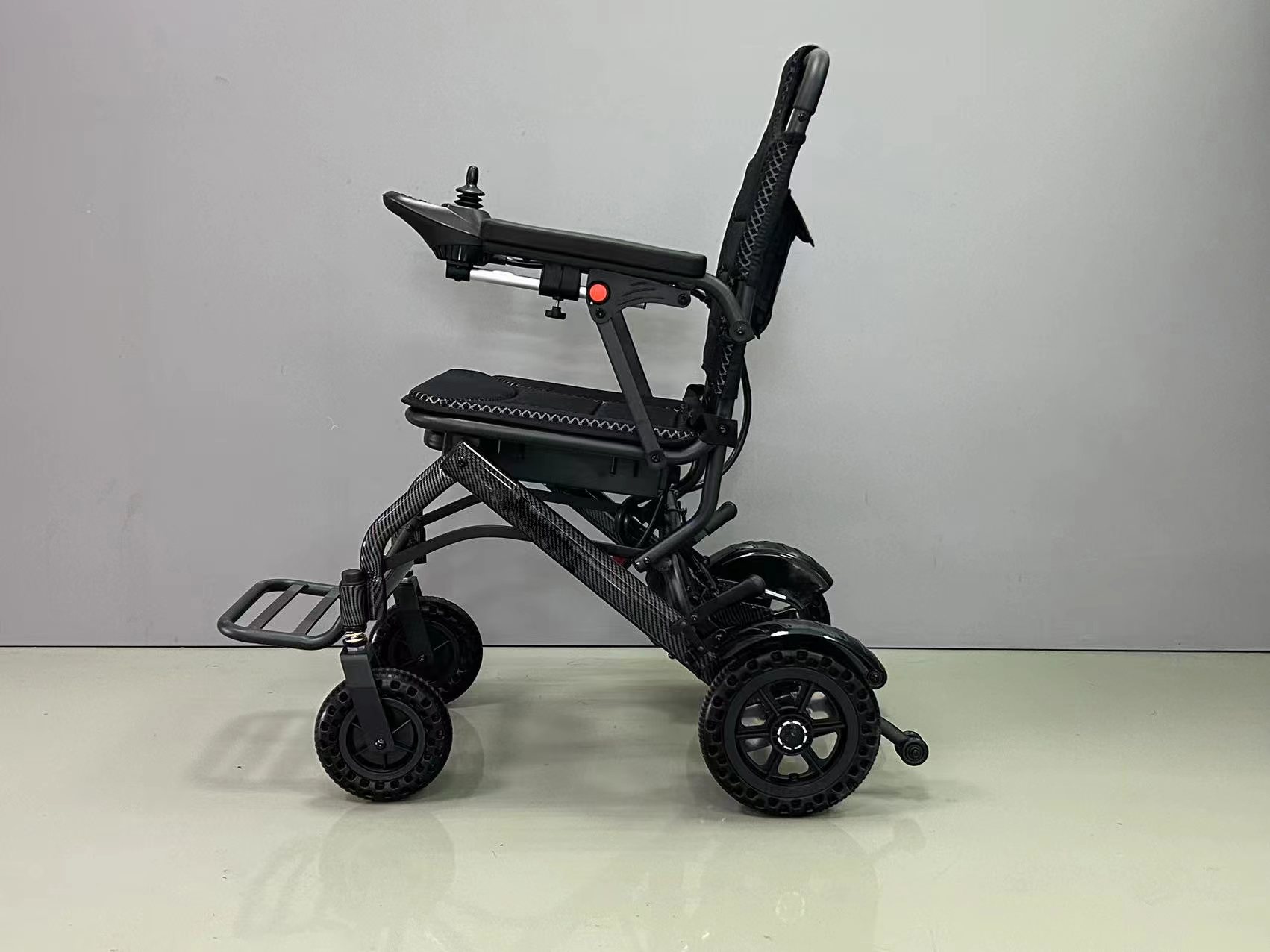
Air travel is the hardest test any portable electric wheelchair faces. Three things must line up: battery compliance, folded dimensions, and total gate-check weight.
Before every flight, run this sequence:
1. Confirm the battery label shows <160 Wh
2. Fold the chair — target 3–5 seconds
3. Measure the folded width against your carrier’s hold specs (≤12.5″ for most)
4. Total gate-check weight should stay under 50 lbs
5. Do a 12-mile real-world range test before your departure date
The Daily Urban Commuter
City travel is rough on heavy, slow-folding chairs. Subway gaps, bus aisles, and building stairs all demand a chair under 50 lbs that folds fast and handles rough pavement without shaking you to pieces.
Urban priority order: fold speed → weight → suspension → range.
The Home User With Occasional Outings
Light weight is less of a priority here. What matters is stability, seating comfort for two-to-three hour sessions, and a frame that holds up through repeated indoor-outdoor transitions over time.
Carbon fiber has strong fatigue resistance — and that matters a lot in this use case. Metal frames can show stress deformation after repeated loads. Carbon fiber holds its structure without breaking down. Look for models with a 330 lbs user capacity. Also, don’t trade ergonomics for portability you don’t need.
The core trade-off is the same across every situation: weight runs 26–50 lbs, battery range tops out at 12 miles on lightweight builds, and fold time decides whether your chair helps you or slows you down. Match those three variables to your actual routine — not the best-looking spec sheet — and the right electric wheelchair for travel or daily life becomes clear.
Carbon Fiber Electric Wheelchair Price Guide: Is the Premium Worth It?
The carbon fiber electric wheelchair market runs from $1,200 to over $8,000. That spread isn’t random — it reflects real engineering differences that show up in daily use.
Here’s how the tiers break down.
What You Get at Each Price Point
Entry-Level ($1,200–$2,500) gets you a functional carbon fiber frame at 25.5–28 lbs, a capacity of 250–300 lbs, and a range of 9–15 miles. The Feather Carbon 26X ($2,295) and Easwe C10 ($1,199) both land here. You get a single TSA-approved battery, a 2–3 second fold, and basic flat-free tires. What you don’t get: adjustable seating, a motor built for heavy daily use, or much margin for error on long routes.
Mid-Tier ($2,500–$4,000) adds real upgrades. Think 6-wheel stability platforms, regenerative braking, enhanced 24V DC sealed motors, and airline/cruise pre-approval. The Zipr Carbon Fiber at $2,399 weighs 28 lbs, carries 300 lbs, and covers 9.3 miles per charge. The Feather 29X ($2,695) hits the same weight class with a stronger drivetrain. Daily commuters and frequent travelers tend to find their sweet spot here.
Premium ($4,000+) extends motor lifespan and pushes range to 15+ miles. The spec gains over mid-tier are smaller than the price jump suggests. It’s worth it if you need consistent 300+ lb support or travel multiple times per month — otherwise, the mid-tier holds up well.
FAQ: Carbon Fiber Electric Wheelchair Buyers Ask Most
Real buyers don’t ask vague questions. They ask sharp, specific ones — the kind that surface after three evenings of reading spec sheets and still feeling unsure.
How much lighter is carbon fiber compared to aluminum?
The density gap is 1.6 g/cm³ versus 2.7 g/cm³. In real terms: a carbon fiber frame runs 12–18 kg. Aluminum runs 20–30 kg. That 30–40% reduction means you can load the chair solo. With aluminum, you’re asking for help every time.
Will it crack if I hit something hard?
Yes — and most brands won’t tell you that. Carbon fiber is stiff, not flexible. A sharp impact can crack or delaminate the frame. Aluminum would just dent instead. Run a tap test from time to time. A hollow sound means fiber separation. Got scratches? Sand the area down and keep an eye on it. Actual cracks need a professional — don’t try to fix them yourself.
Is it hard to learn for a first-time power wheelchair user?
Most people get basic forward, reverse, and turning down within one to three days. Full control on slopes and in crowded spaces takes one to two weeks. Start with joystick sensitivity set low. Cap your speed at 50% in the beginning. Do supervised 30-minute sessions to build confidence. Also, teach your support person the emergency stop — double-tap the joystick — before your first solo outing.
Conclusion
The right carbon fiber electric wheelchair does more than move you from point A to point B. It changes how you experience the world around you.
After looking at the specs, the price tiers, and the real-world trade-offs, one truth stands out: carbon fiber isn’t a luxury upgrade, it’s a structural philosophy. At the airport, running errands, or reclaiming independence on your own terms — an ultra lightweight power wheelchair frame with smart engineering gives you something no aluminum chair can. Freedom that feels natural, not like a compromise.
Now you have the framework. You know what questions to ask. You know which specs matter for your lifestyle. You know where the real value sits.
Your next step? Explore the carbon fiber electric wheelchair models at gracemedy.com and request a personalized recommendation.
The best wheelchair is the one you almost forget you’re using.