
Ultralight Wheelchair Vs Standard Wheelchair
The numbers make it clear: a standard wheelchair weighs 35–50 lbs. An ultralight model can weigh as little as 14 lbs. That gap changes everything. It’s the difference between loading your own chair into a car trunk and waiting for someone to help you.
Standard wheelchairs fold too — but their size and weight make them awkward to handle compared to ultralight models.
|
Feature |
Standard Wheelchair |
Ultralight Wheelchair |
|---|---|---|
|
Weight |
35–50 lbs |
14–19 lbs |
|
Frame Material |
Steel |
Titanium / Aluminum / Carbon Fiber |
|
Propulsion Effort |
High fatigue |
Low fatigue, agile |
|
Portability |
Moderate |
High (car & air travel ready) |
|
Customization |
Basic |
Extensive |
|
Weight Capacity |
Up to 850 lbs |
Up to 300 lbs |
The right choice comes down to how and where you use the chair — not just how much it weighs.
Weight & Portability: The Biggest Practical Difference
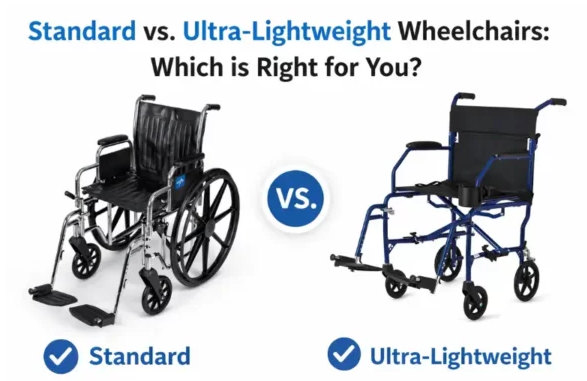
Thirty-five pounds doesn’t sound like much — until you’re hoisting it into a car trunk alone, every single day.
That’s the lived reality of a standard wheelchair. The weight gap between standard and ultralight models is not a minor spec detail. It’s a quality-of-life decision you make every day.
What the Numbers Mean in Real Life
The weight tiers break down like this:
Ultra-lightweight: 14–20 lbs (some models as light as 15 lbs)
Lightweight: 18–29 lbs (a practical middle ground)
Standard: 35–50 lbs (steel frames, built for durability over mobility)
On paper, a 20-lb difference seems manageable. In practice, it determines whether you load your own chair solo or wait for help. Research backs this up: caregivers pushing a lighter chair report 30–50% less physical effort over the course of a day. For users who self-propel, moving across uneven sidewalks or through tight grocery store aisles takes 20–40% less strain on a lightweight frame than on a steel standard chair.
Folding, Packing, and Getting Out the Door
Portability isn’t just about raw weight. It’s also about how fast and how small a chair folds when life requires it.
|
Feature |
Ultra-Lightweight / Lightweight |
Standard |
|---|---|---|
|
Folded Size |
Compact — fits sedan trunks, narrow enough for tight paths |
Bulkier — harder trunk fit, wider footprint |
|
Fold Mechanism |
Quick-fold aluminum or carbon fiber (seconds) |
Basic steel fold — slower, less compact |
|
Car Loading |
Solo lift — 15–27 lb models slide into sedans with ease |
Often needs two people at 35+ lbs |
|
Airline Check-In |
Most models under 30 lbs clear the standard 50 lb baggage limit |
Often exceeds weight and bulk restrictions |
Take a 26–27 lb aluminum transport chair as an example. It folds fast. It’s light enough for one person to handle at the car. That kind of independence isn’t a luxury — for many users, it’s the whole point.
Frame Materials Compared: Titanium, Carbon Fiber, Aluminum vs Steel
The frame material of wheelchair is more than an engineering spec. It shapes how hard patient work every day, how long patients’ chair holds up, and what will spend on maintenance over the next decade.
Four materials dominate the wheelchair market: titanium, carbon fiber, aluminum, and steel. Each one involves a specific trade-off. Know those trade-offs, and start choosing.
Steel: The Workhorse That Never Apologizes
Steel frames are heavy — and that’s something they own without apology. Hi-tensile and chromoly steel deliver excellent load-bearing stability. They also absorb vibration better than any other frame material. Steel bends before it breaks. And when repairs are needed, a local welder can handle it at low cost.
The catch is rust. Skip maintenance, and steel corrodes. Over years of regular use, vibration builds up through the frame — you feel it in your hands and shoulders. For hospital or institutional settings where the chair stays indoors, steel is a practical, cost-effective choice. For active users who push hard every day? The weight alone is reason enough to look at other options.
Aluminum: The Smart Starting Point
Most entry-level ultralight wheelchairs use 6061 or 7005 aluminum — and for good reason. Aluminum offers a value-to-weight ratio that titanium and carbon fiber can’t match at the same price. It’s light, recyclable, and holds up well under normal everyday stress.
The real limitation: aluminum wears down faster than titanium over time. It’s stiffer and less forgiving on rough terrain. Cover high daily mileage or spend a lot of time on uneven surfaces, and you’ll feel that stiffness in your arms after months of use. For moderate use and tighter budgets, aluminum wheelchair is often the right pick. For long-term, high-intensity use, it’s a starting point — not a finish line.
Titanium: The Long Game
Titanium frames — 3Al-2.5V grade in particular — weigh about 40% less than steel at the same tensile strength. Tube walls measure 0.9mm and resist denting well. The 6Al-4V grade adds stiffness for users who want more performance-focused geometry.
What makes titanium stand out isn’t just weight. It’s the ride quality. Titanium has a natural flex — a slight, controlled give that absorbs road vibration without losing energy return. That springy feel adds up over a full day of self-propulsion. Your shoulders notice the difference by the end of the day.
Then there’s how long it lasts. A well-built titanium frame holds up for 20+ years. That changes how the higher upfront cost looks once you factor in total ownership cost. No corrosion. No paint needed. Minimal repairs. It’s the chair you buy once and keep.
Carbon Fiber: The Performance Outlier
Carbon fiber wheelchair is the lightest option available. Framesets can weigh as little as 800–1,000g, with a stiffness-to-weight ratio no metal comes close to. It’s responsive, fast, and can be tuned during production to be stiffer or more flexible in specific areas.
The trade-offs are real. Carbon fiber doesn’t absorb impact like metal — it doesn’t dent, it cracks. Repairs need specialists and cost more. Recycling is hard. And the price reflects a labor-intensive build process.
For competitive wheelchair sports or users who put minimum weight above everything else, carbon fiber makes sense. For everyday durability and long-term value? Titanium serves most users better.
Side-by-Side: What the Numbers Say
|
Feature |
Steel |
Aluminum |
Titanium |
Carbon Fiber |
|---|---|---|---|---|
|
Frame Weight |
Heaviest |
Light |
Medium-Light |
Lightest |
|
Strength-to-Weight |
High |
Good |
Highest (metal) |
Highest (overall) |
|
Vibration Damping |
Excellent |
Stiff |
Exceptional |
Tunable |
|
Corrosion Resistance |
Poor |
Good |
Excellent |
Excellent |
|
Repairability |
Easy / Low cost |
Difficult |
Moderate |
Specialist required |
|
Longevity |
High (with maintenance) |
Moderate |
Very High (20+ years) |
High |
|
Price |
Lowest |
Best value |
High |
Highest |
Here’s the short version: Steel and aluminum fit different budgets and use patterns well. Titanium pays off for users who push their chair hard over many years. Carbon fiber suits performance users who know their priorities and are building around them.
Price Range & Value for Money: Is Ultralight Worth the Cost?
The price gap between a standard wheelchair and an ultralight one isn’t subtle. It’s a cliff edge.
Standard wheelchairs run $100–$500. Lightweight folding models stay under $300. Ultralight wheelchairs start at $1,000 and climb past $5,000, depending on frame material, configuration, and customization. That’s not a small step up. It’s a different category of product — and a different conversation about value.
What You’re Paying For
Titanium models sit at the higher end. They need 10–14 day build times, compared to 3–5 days for aluminum models. That extra wait isn’t red tape. It’s custom fabrication — your chair built to order.
Discounts of 10–25% off list price are common across ultralight models. Check the discounted price before you assume the sticker price is final.
The Total Cost of Ownership Argument
Paying $2,500 instead of $300 is hard to justify on specs alone. The real case for ultralight is total cost of ownership — what the chair costs you across years of full-time use, not just on day one.
A few things shift that number:
Reduced physical strain
Material longevity
Fewer repair cycles
So Is It Worth It?
It comes down to one question: how much of your life happens in this wheelchair?
Occasional use — hospital recovery, limited mobility support, short-term need — a standard chair under $300 does the job well.
Full-time, active use? The ultralight price premium pays you back. Not in one moment. It comes back in less fatigue, fewer repairs, and a chair that keeps up with your life. The math looks steep at first. Factor in time, and it shifts.
Head-to-Head Comparison Table: Ultralight vs Standard Wheelchair
Eight categories. Two chairs. One table that cuts through the noise.
|
Category |
||
|---|---|---|
|
Weight |
35–50 lbs (16–23 kg) |
14–30 lbs (6–14 kg) |
|
Frame Material |
Steel |
Aluminum, titanium, carbon fiber |
|
Price |
Lower — basic, off-the-shelf |
Higher — custom, built to spec |
|
Best For |
Part-time use, caregiver-pushed |
Active self-propellers, full-day use |
|
Portability |
Foldable, but awkward to lift |
Compact, easy to transport solo |
|
Maneuverability |
Fixed rear axle, less responsive |
Adjustable center of gravity, tuned for efficient movement |
|
Strength-to-Weight |
Durable, but heavier for the strength |
Superior ratio — lighter, just as strong |
|
Weight Capacity |
220–300 lbs |
110–300 lbs, customizable |
|
Daily Use Hours |
Under 4 hours |
Full-day independence |
Conclusion
Choosing between an ultralight wheelchair and a standard wheelchair isn’t a technical decision — it’s a personal one. The right chair fits your life: your routes, your routines, your body, and your budget.
Here’s the simple truth: full-time wheelchair users who value independence, maneuverability, and joint health almost always benefit from going lighter. That’s where the ultralight clearly wins. For occasional use, a standard model gets the job done well — and costs less upfront.