
Pushing a wheelchair shouldn’t feel like a workout — but for so many caregivers, it does.
A crowded airport terminal. A sloped driveway. A long day of errands. The wrong wheelchair turns all of these into a physical battle. Your back aches. Your arms give out. It doesn’t have to be that way.
The easiest wheelchair to push exists. Finding it comes down to a few key factors most people never think to ask about.
Frame weight, wheel diameter, handle height, rolling resistance — each one makes a real difference. Get them right, and pushing feels effortless. Get them wrong, and every outing becomes exhausting.
We’re breaking down what separates a smooth, easy push from a draining one.
Which Wheelchair Is Easiest To Push?
Here’s the short answer: lightweight manual wheelchairs — ultralight models, to be exact — win on ease of pushing. Every time.
Ultralight chairs weigh just 6–9 kg. Standard lightweight models land between 8–14 kg. That gap feels small on paper. Try pushing the heavier one across a parking lot or up a ramp solo, and you’ll feel the difference fast.
Chair type matters too. Transport and travel wheelchairs are built for companion pushing. Narrower frames, stripped-back construction, less bulk overall. They aren’t made for self-propulsion. But pure pushing? Nothing beats them.
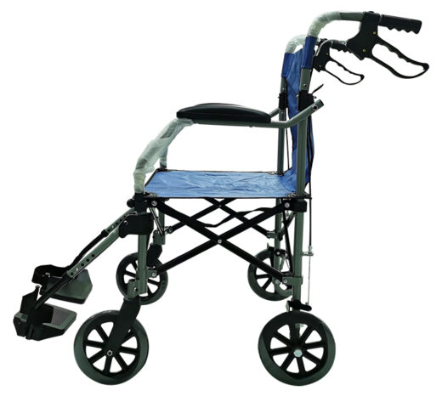
What the Numbers Look Like
|
Type |
Weight |
Push Effort |
Best Use |
|---|---|---|---|
|
6–9 kg |
Minimal |
Self-propel + caregiver |
|
|
Lightweight Manual |
8–14 kg |
Very easy |
Everyday caregiver use |
|
Transport / Travel |
Light frame |
Easiest companion push |
Pushing only |
What Makes a Wheelchair Easy to Push? (Key Factors Caregivers Should Know)
Five things decide whether pushing a wheelchair feels easy or exhausting. Most people focus on just one — weight. But a light chair can still be brutal to push if the other four factors are wrong.
Here’s what truly matters.
1. Frame Material
Frame material is the starting point. Aluminum, titanium, and carbon fiber are the top choices for lightweight wheelchair frames. They give you real structural strength without the extra bulk. Steel frames hold up well, sure — but you feel every added pound by the end of a long day. Lighter materials cut down resistance before you take a single step.
2. Wheel Size and Tire Type
This one catches most caregivers off guard. Larger rear wheels roll with less effort across flat ground. Each push covers more ground. In tight spaces, though, smaller wheels on transport wheelchairs are the better pick. They turn faster and squeeze through narrow doorways with ease.
Tire choice is just as important:
– Narrow tires move well on pavement and hard floors
– Chunkier tires grip soft or uneven outdoor ground better
– Tire pressure is the quiet problem — a flat or low tire can make any wheelchair feel twice as hard to push
High-pressure pneumatic tires work best on smooth surfaces. On rough outdoor ground, lower-pressure tires absorb bumps better and keep the chair rolling at a steady pace.
3. Axle Position and Bearing Quality
Most people never hear about this detail — but it changes everything. An axle set too far back puts you in a constant fight against physics. Shift it forward a bit, and the wheel lines up closer to the center of gravity. The result? Better push leverage, less strain on your arms, and a much smoother roll.
Worn or dirty bearings make things worse fast. Good-quality bearings cut down friction by a lot. Your wheelchair starts feeling harder to push than it used to? Check the bearings first. Swapping them out is one of the most effective — and most overlooked — fixes you can make.
4. Ergonomic Push Handles and Handrim Design
Ergonomic wheelchair push handles set at the right height take the strain off a caregiver’s back and shoulders. Too low, and you hunch over the whole time. Too high, and you lose both control and push strength. The right height keeps your posture neutral and your energy focused.
For self-propelling users, ergonomic handrim covers— make a big difference. They improve grip, reduce wrist fatigue, and hold firm even in wet conditions. Standard metal handrims wear on your hands over time. Switching to a padded or textured cover is worth every cent.
5. Maintenance Habits That Keep Pushing Easy
Even a great caregiver-friendly wheelchair slows down without regular upkeep:
Check tire pressure weekly — keep pneumatic tires at the right PSI
Grease axles on a set schedule — smooth rotation is non-negotiable
Inspect bearings often — swap them out at the first sign of grinding or drag
Clean the frame and wheels after outdoor use to stop buildup that slows the roll
A well-kept lightweight wheelchair will outperform a neglected high-end one every time. Small, consistent habits protect both your investment and your body.
Get these five factors right, and you feel the change right away. Pushing stops feeling like work. It starts feeling like guiding. That gap matters a great deal when you do it every single day.
Lightweight Manual Wheelchairs: Best All-Round Easy Push Option for Caregivers
Why Under 25 lbs Is the Magic Number
Under 25 lbs is where pushing shifts from effort to ease. Long stretches become manageable. Tight corners feel natural. Loading the chair in and out of a car trunk becomes a one-person job — no help needed.
The Feather Chair deserves a special mention. At just 13.5 lbs for the frame, you can pick it up with one hand while holding a coffee in the other. That’s real-world lightweight at its best.
Aluminum Alloy Frames: Built Light, Built Smart
Aluminum alloy is the reason these chairs stay light without losing strength. Steel is heavy. Aluminum is not. You get a frame that holds firm and won’t wear you out over a long day of pushing.
The design details make a real difference too:
Detachable footrests and flip-up armrests fold the chair into a compact shape. It fits car trunks, tight closets, and even overhead airplane storage
Quick-release rear wheels pop off with one button press. This cuts the lifting load for smaller caregivers by a solid margin
Telescoping push handles adjust to your exact height. Your spine stays neutral, and your shoulders stay out of trouble
Matching the Chair to the Caregiver
Not every lightweight wheelchair suits every caregiver body type. Smaller caregivers do best with chairs under 20 lbs that have quick-release wheels. Less lifting means less strain on the back and arms. Taller caregivers should put adjustable telescoping handles at the top of the checklist — nothing else matters more for posture and comfort.
Transport Chairs vs Standard Wheelchairs: Which Is Easier for a Caregiver to Push?
The answer is simple: transport wheelchairs win — and it’s not close.
A standard wheelchair weighs 30–50+ lbs. A transport chair? You’re looking at 15–25 lbs. That weight difference cuts your push and lift effort by 50–70% across a full day. Run the numbers on an afternoon of errands, and the choice is clear.
But weight is just the start.
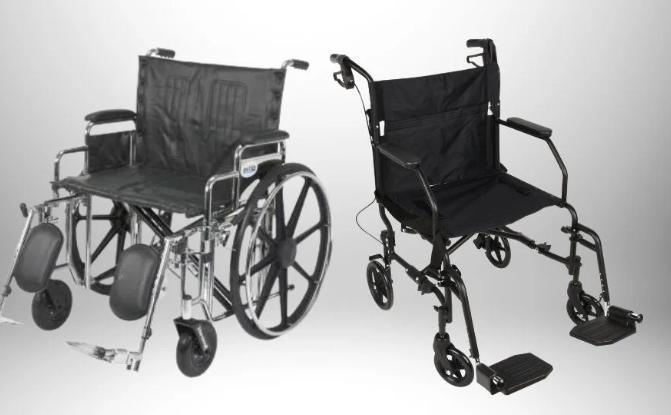
What Makes Transport Wheelchairs So Much Easier to Handle
Transport wheelchairs are built with the caregiver in mind. Every design choice targets one goal: less physical strain on the person doing the pushing.
Here’s what makes them different:
Smaller rear wheels (12–20 inches) sit below the armrests. This removes the option for self-propulsion and puts the push dynamic in the caregiver’s favor
Narrower seat width (16–18 inches / 40–45 cm) lets the chair slip through doorways, move around furniture, and fit tight spaces with little resistance
Lightweight aluminum frames keep the total weight easy to manage — the Aracent Astra, for example, comes in at just 19 lbs
Rear push handles with optional handbrakes give caregivers real control on slopes. No more fighting gravity on every incline
No handrims. No bulk. No battle.
Where Transport Chairs Fall Short
Let’s be straight here. Transport chairs don’t work for every situation.
No self-propulsion — the user depends on a caregiver at all times
Limited comfort for long sessions — padding and back support aren’t made for sitting beyond 1–2 hours
Rough terrain struggles — small wheels don’t absorb bumps the way large-diameter wheels do
Minimal accessories — don’t expect trays, specialty cushions, or adaptive add-ons
The sweet spot for a transport chair is right in the name: short-distance, caregiver-assisted mobility — mall runs, medical appointments, airport terminals, quick outdoor outings. For those uses, nothing is easier to push. For long-haul comfort or independent mobility, a lightweight manual wheelchair closes the gap fast.
Best Easy-Push Wheelchair by Use Scenario: Indoor, Outdoor, and Travel
The right wheelchair for a hospital corridor is the wrong one for a gravel park path. And neither works in an airport terminal. Your environment matters. Matching your chair to where you’ll use it is one of the fastest ways to reduce caregiver fatigue.
Here’s what works, where, and why.
Indoor Use: Tight Hallways, Small Rooms, Standard Doors
Standard interior doors in the US measure 76cm wide. That’s not much room. A chair that’s even a few centimeters too wide becomes a problem fast — scraping door frames, forcing awkward angles, and wearing out the caregiver’s arms on turns that should be simple.
For indoor use, two specs are non-negotiable:
Seat width of 40–43cm — slim enough to clear standard doorways without fighting for space
Turning radius under 100cm — closer to 85cm works best for hospital corridors and home hallways
Outdoor Use: Parks, Sidewalks, and Uneven Ground
The wrong tire choice punishes you fast outdoors. Solid hard-surface tires that feel fine indoors turn every sidewalk crack and gravel patch into a rough, heavy slog.
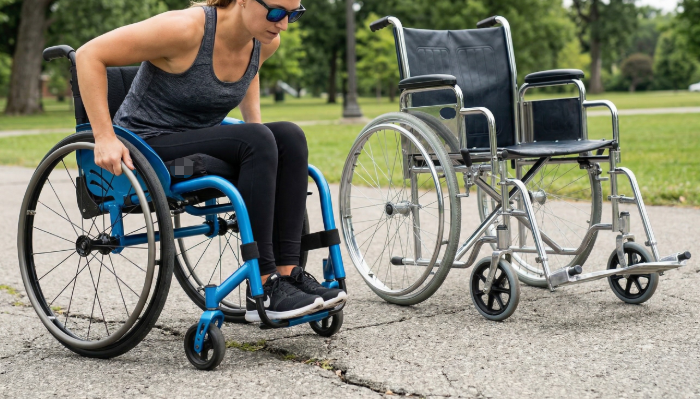
The fix is simple: larger rear wheels with pneumatic tires.
60cm+ rear wheel diameter handles 5–10° inclines and light gravel up to 2cm deep — terrain that stops smaller wheels cold
Pneumatic tires absorb 15–25% more vibration than solid tires on rough ground — this protects both the user and the caregiver’s arms from constant impact
10–12cm ground clearance clears sidewalk cracks and uneven surfaces without the chair catching or dragging
Outdoor pushing is a regular part of many routines — this is the wheel size to prioritize.
Travel Use: Airports, Car Trunks, and Gate Checks
Airport pushing comes with its own set of demands. None of them are about terrain. You need a chair that folds fast, fits under a gate desk, lifts into a sedan trunk without a struggle, and won’t slow you down at TSA.
The key specs for airline-compatible travel wheelchairs:
Folded dimensions under 80 × 30 × 75cm
Weight between 8–12kg for easy push-and-tow through terminals
Telescopic handles so you can pull the chair behind you like a carry-on bag
Wheelchair Pushing Tips for Caregivers: Reduce Strain Without Buying New Equipment
A few technique rules that protect you on every terrain:
Always push, never pull — pulling destroys your posture and your leverage
Over bumps and thresholds: press down on the push handles to lift the front wheels, then roll through with control
Uneven ground: go backward — the larger rear wheels lead the way, cutting your effort and lowering the user’s fall risk
Ramps going up: stay behind the chair, elbows locked, weight forward — use the user’s lap belt for added security
Ramps going down: back down at a steady, controlled pace — never stand in front of the chair on a descent
Conclusion
The right lightweight transport wheelchair makes a real difference.
Here’s what it comes down to: wheel size matters. Frame weight matters. How that chair fits your body matters just as much as how it fits theirs. Get all three right, and those parking lot hills stop feeling like a battle. You start enjoying the outing instead of dreading it.
So don’t settle for a chair that fights you. Browse Gracemedy‘s caregiver-friendly wheelchair collection. Compare the specs side by side. Find the one that makes pushing feel easy.