
A custom wheelchair can cost anywhere from $1,500 to over $30,000. Most people don’t learn this until they’re face-to-face with a supplier. That pricing gap isn’t random.
Frame materials, seating systems, and mobility configurations all push the price up or down. So does a maze of insurance rules.
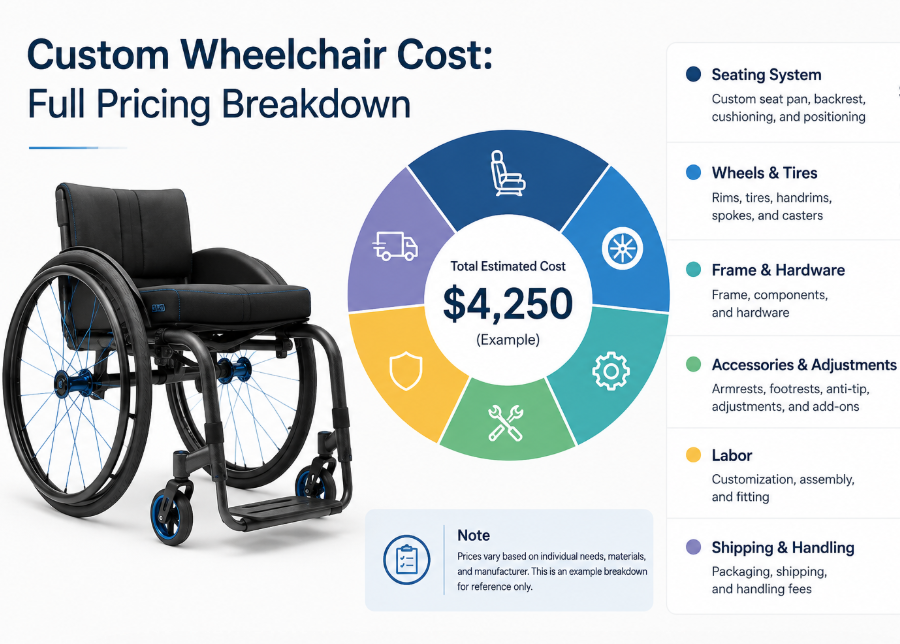
Custom Wheelchair Cost: Full Pricing Breakdown
Custom wheelchair pricing varies a lot. The final number depends on what you’re building and which features you need.
The table below gives you a clear view of current U.S. retail prices.
|
Wheelchair Type |
Price Range (U.S. Retail, 2024–2025) |
|---|---|
|
Custom manual (specialized seating/mods) |
$1,000 – $5,000+ |
|
Custom power (advanced features) |
$6,000 – $15,000+ |
|
Sports wheelchair |
$2,000 – $5,000 |
|
Tilt & recline (manual) |
$1,500 – $5,000 |
|
Standing wheelchair |
$4,000 – $10,000+ |
|
Bariatric manual (configurable) |
$1,299 – $2,979 |
|
Complex rehab / high-end power |
$10,000 – $30,000+ |
A basic non-custom manual wheelchair starts around $100–$500. Add custom seating, positioning hardware, or power functions, and costs climb fast.
Here’s how it breaks down by budget tier:
Under $1,000 — basic manual, little to no customization, standard off-the-shelf sizing
$1,000–$2,500 — standard manual with upgraded cushions, light positioning support, or entry-level recline
$2,500–$5,000 — high-end manual or lower-tier power with real customization options (tilt, bariatric capacity, one-arm drive, sports setup)
$5,000–$10,000 — advanced power bases with multiple seating functions or specialized manual systems
$10,000–$15,000+ — top-tier complex rehab power chairs with full electronics, custom molding, and multi-function seating stacks
These are real numbers, not rough guesses. Invacare’s configurable lineup shows this clearly. A tilt-in-space model runs $1,682–$4,491. A standard configurable model sits between $382–$1,702. That $1,300+ gap comes down to one thing: the tilt mechanism.
Your price tier comes down to the features you need.
What Does a Custom Wheelchair Cost? (Price Ranges at a Glance)
Three numbers tell the whole story: $100, $5,000, and $30,000.
That’s the full range of the custom wheelchair market — from a basic standard frame to a full rehab power chair built around one person’s body. The gap between those numbers isn’t random. It comes down to how much engineering went in, how many custom parts were used, and how many hours of clinical setup the wheelchair required.
Here’s what that looks like across the main categories:
|
Category |
Price Range (U.S. Retail, 2025–2026) |
|---|---|
|
Light custom manual (extra sizes, upgraded cushions) |
$800 – $1,500 |
|
Advanced custom manual (ultralight, specialized seating) |
$1,500 – $5,000+ |
|
Basic power (minimal customization) |
$1,000 – $3,000 |
|
Mid-range power (seating/config options) |
$2,500 – $6,000 |
|
Advanced custom power (complex rehab) |
$5,000 – $15,000+ |
|
Sports / performance (custom fit, camber, performance wheels) |
$2,000 – $5,000 |
|
Standing wheelchair |
$4,000 – $10,000+ |
|
Pediatric custom manual |
$1,500 – $4,000 |
|
Pediatric custom power |
$5,000 – $12,000+ |
The “custom premium” is real — and it adds up fast. A $300 standard manual vs. a $1,500 entry-level custom manual is already a +400% jump. A basic $2,000 power chair vs. a complex rehab power unit at $8,000 is +300%. That gap gets even wider at the high end.
6 Key Factors That Drive Custom Wheelchair Pricing Up
Six variables separate a $1,500 wheelchair from a $30,000 one. Knowing what they are tells you where your money goes — and whether a supplier’s quote actually makes sense.
1. Drive Type: Manual vs. Power vs. Complex Rehab
The biggest single pricing lever is how the wheelchair moves.
That’s not a pricing oddity. It’s the cost of engineering.
Complex rehab wheelchairs carry multi-position powered seating, dual-motor drive systems, high-capacity batteries, and specialized control interfaces. Each component adds parts cost and clinical labor. A standard power chair at $3,000 has none of that. A complex rehab unit at $20,000 has all of it — at once, built into a single system.
2. Frame Material: Steel, Aluminum, Titanium, Carbon Fiber
Material choice affects more than weight. It hits price hard too.
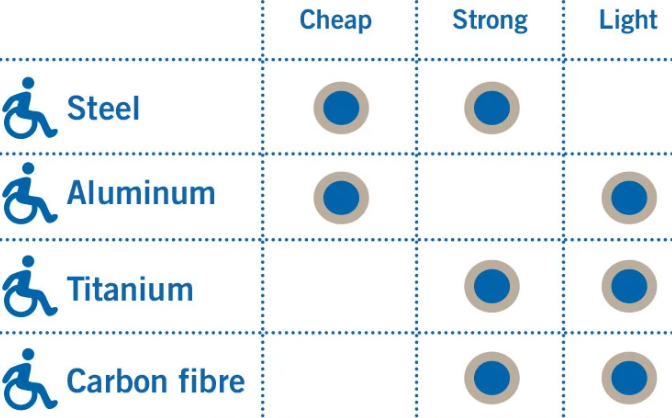
Here’s the general pricing ladder for high-end manual chairs:
Steel: $100–$800 — heavy, durable, entry-level
Aluminum: $500–$2,000+ — the mainstream choice, solid price-to-weight ratio
Titanium: 30–60% more than equivalent aluminum models. A $2,000 aluminum sports wheelchair often runs $2,600–$3,200 in titanium
Carbon fiber: adds another 20–40% on top of titanium or aluminum — a $2,000 aluminum custom wheelchair can reach $3,000–$3,500 in carbon fiber
On a $4,000–$6,000 high-end manual chair, the material upgrade alone — aluminum to titanium or carbon fiber — adds $800–$1,500. That’s about 15–30% of the total price.
On complex power wheelchairs priced at $15,000+, frame material carries less relative weight. Electronics and seating dominate the cost at that level. Still, upgrading from standard steel or aluminum to lightweight alloys adds $1,000–$2,000.
3. Seating System: Pressure Relief and Postural Support
Most buyers don’t expect how much seating costs. It adds up fast.
A standard cushion and back come bundled into entry-level pricing. Everything above that is extra:
Pressure-distributing cushion (gel, air cell, multi-layer foam): +$200–$600
Custom-molded back support or full-contact backrest: +$500–$1,500
Complete custom seating system (molded seat and back, pelvic positioning, trunk and head support): $2,000–$5,000 as a standalone package
That last item matters a lot. Add a full postural support system to a $3,000 base power chair, and the total jumps to $5,000–$6,000. That’s a 60–100% price increase from one upgrade category alone.
On a $20,000 complex rehab wheelchair, the seating stack accounts for $3,000–$5,000 of the build cost. It’s not an accessory. It’s a core medical component.
4. Control Interface: Joystick vs. Head Array vs. Eye Gaze
Standard joystick control comes included in most power chair pricing. No surcharge. Everything beyond that is an add-on — and the costs climb fast:
Head array system: +$1,500–$3,000 (sensors, control module, installation, calibration)
Chin control: +$1,000–$2,000
Sip-and-puff: +$1,500–$3,000
Eye-gaze / gaze tracking: +$5,000–$10,000 — for ALS users at advanced disease stages, the control system alone can represent 25–40% of the chair’s total cost
Stack those components, and the math gets steep. Start with a $3,000 base power chair. Add a complex rehab chassis ($8,000), an advanced head or eye-gaze control system ($5,000–$8,000), and a custom seating package ($3,000). The total lands between $16,000–$19,000. That’s 5–6× the starting price — driven almost entirely by the control interface and seating, not the frame.
5. Medical Complexity: How Diagnosis Creates Non-Linear Price Jumps
Condition severity doesn’t raise pricing in small, steady steps. It creates sudden price jumps.
A user with a lower spinal cord injury and functional hand use may need a lightweight manual chair with a quality pressure-relief cushion — total cost: $1,500–$4,000.
A user with high-level quadriplegia needs a power chair with tilt-and-recline, head or chin control, and advanced seating. That build lands at $15,000–$25,000 — about 4–8× more than the lower-complexity version.
Cerebral palsy users with high postural needs require trunk, pelvic, and head support plus multi-point restraints. The seating package alone hits $2,000–$5,000 on a manual chair. On a complex rehab power chair, the full system approaches $10,000–$20,000.
ALS is the most striking example. Early-stage users often manage with a standard power chair and joystick at $4,000–$8,000. As the disease progresses, the chair gets rebuilt around new control methods, full postural positioning, and maximum pressure protection. One upgrade cycle can add $8,000–$15,000 to the total cost, pushing it into the $20,000–$30,000 range.
6. Advanced Functions: Tilt, Recline, Standing, and Power Elevate
Powered positioning functions each carry their own price tag — and they stack.
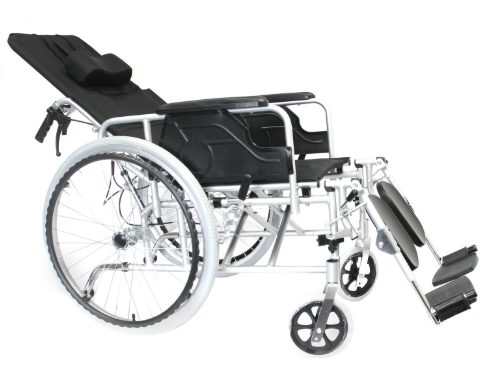
Every added axis of movement needs its own actuator, frame reinforcement, and control integration. Tilt-in-space adds $300–$800 to a manual chair. On a power wheelchair, the same feature adds $1,000–$3,000, depending on range of motion and the electronics involved.
Standing wheelchairs — which let users move from seated to upright — run $4,000–$10,000+ due to the structural engineering required. Power elevating leg rests, fully powered recline, and seat elevation (raising the user to counter-height) each add $500–$2,500 per feature.
A chair built with tilt, recline, elevating legs, and power elevation is common for complex rehab users. That single layer of positioning upgrades adds $5,000–$8,000 to the base chair cost.
That’s how a $5,000 mid-range power chair becomes a $13,000 order — without touching the frame, the electronics, or the seating system.
Custom Manual Wheelchair Cost Breakdown: What You’re Paying For
Manual wheelchairs have a reputation for being the “affordable” option. That’s partly true — and mostly misleading.
A basic off-the-shelf manual wheelchair starts under $500. A fully configured custom manual wheelchair for a complex rehab user can reach $6,000 or more. That’s not a rounding error. It shows how many separate cost layers stack up inside a single order.
Here’s what those layers look like.
The Four Cost Components Inside Every Custom Manual Chair Quote
1. Frame and chassis: $350–$2,750
2. Seating and postural support: the biggest price multiplier
3. Functional add-ons: tilt, recline, one-arm drive, bariatric capacity
4. Clinical fitting, assembly, and calibration
Conclusion
Custom wheelchair pricing isn’t complicated — no one just takes the time to explain it clearly.
The real cost drivers are simple: frame materials, seating systems, control configurations, and brand markup. Once you see those factors laid out, the numbers feel far less scary.
Here’s the bottom line: a custom wheelchair is a long-term mobility investment, not a luxury purchase. Choosing the wrong chair to save $800 upfront can cost thousands more down the road — pressure injury treatment, refittings, and early replacements add up fast.
You now have a clear picture of custom wheelchair costs and what pushes them up or down. Your next step is getting a formal ATP assessment. Then collect at least two wheelchair supplier quotes. That combination gives you real negotiating power — use it.
The right wheelchair fits your budget. You just needed the right information to find it.