
Electric Lightweight Wheelchair: How It Works And Who Needs It
A lightweight electric wheelchair is a compact, battery-powered mobility system built to weigh under 100 pounds total. Strip off the removable parts, and many models come in at 33–40 pounds.
That number matters more than most product pages admit.
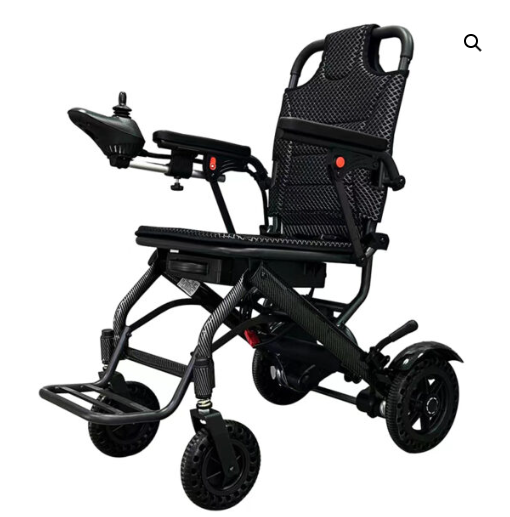
Who Really Needs One
Salespeople tend to oversell these chairs. Doctors tend to undersell them. The real answer sits somewhere in between.
Lightweight electric wheelchairs are a solid fit for:
Seniors with arthritis, COPD, heart failure, or neuromuscular disease — people who can still use a joystick but can no longer walk long distances or push a manual chair
Frequent travelers, especially those who fly — you need a frame around 35 pounds, airline-approved removable batteries, and a range of 10–23 miles to get through a full day at an airport, theme park, or new city
Users in small living spaces — a standard power chair weighs 150–200 lb and takes up real space. A folding lightweight chair collapses to suitcase-sized dimensions and fits in a regular car trunk
Caregiver-assisted users — caregivers who can’t push a manual chair all day can still handle a 30–40 lb folded frame in and out of a vehicle
What Is an Electric Lightweight Wheelchair (And Why It’s Different from a Standard Power Chair)
The industry doesn’t make this clear enough: an electric lightweight wheelchair is a battery-powered mobility chair built around one priority — portability over everything else.
Not customization. Not clinical complexity. Portability.
That combination — featherweight frame, serious load capacity — is what sets this category apart from the rest of the power chair market.
Not the Same as a Standard Power Wheelchair
A standard power wheelchair puts engineering first. It’s built for advanced customization: tilt-in-space systems, powered recline, complex seating supports, and alternative input controls. The frame is heavy because the features require it. These chairs can hit 150–200 pounds before anyone sits in one.
An electric lightweight wheelchair makes a different trade-off. It lets go of those clinical features. In return, you get something a standard chair can’t match: you can move it yourself.
Here’s how the two compare:
|
Feature |
Standard Power Chair |
Electric Lightweight Wheelchair |
|---|---|---|
|
Total weight |
150–200 lb |
27–100 lb |
|
Frame design |
Fixed, rigid |
Foldable in seconds |
|
Battery type |
Heavy lead-acid or sealed systems |
Removable lithium-ion packs |
|
Primary use case |
Clinical / rehabilitation |
Travel, daily independence, caregiving |
|
Car trunk friendly |
No — not built for it |
Yes — designed for it |
Why the Weight Number Is the Whole Story
Take an older adult getting in and out of a vehicle twice a day. The gap between a 33-pound folded chair and a 180-pound power base isn’t a spec sheet detail. It decides whether a caregiver can handle the lift alone — or can’t.
For a frequent traveler, a lithium battery that pulls out without tools lets the chair clear airline carry-on rules. A sealed lead-acid system on a standard chair won’t pass.
Lightweight isn’t a marketing label here. It’s a functional category with real engineering consequences. For the right user, it’s the category that makes everything else possible.
How an Electric Lightweight Wheelchair Works: The Core Systems Explained
Three core systems run every electric lightweight wheelchair: the drive motors, the battery pack, and the joystick controller. Each one is simple on its own. Together, they form a machine that gives independence back to people who thought they’d lost it.
Here’s what’s happening under the frame.
The Motor System: Torque From Almost Nothing
The drive system in a lightweight folding wheelchair runs on two brushless DC motors — one per rear wheel, rated at 200–300 watts each. That puts total combined output at 400–600 watts. It’s enough to carry a 220-pound user up a 6–8 degree slope without hesitation.
Why brushless? Fewer moving parts. Less heat. Higher efficiency in a small footprint. Most lightweight models use 2-pole brushless motors. These run at higher frequencies and pack more output into a smaller casing — 10–20% smaller and 10% lighter than comparable multi-pole designs. That’s not a small gain when every ounce of the frame matters.
Turning works through differential speed control — the same principle used in tracked vehicles. To turn left, the controller increases torque on the right motor and reduces it on the left. Tight turns need no mechanical linkage at all. You get a turning radius of 70–90 centimeters — small enough to pass through a standard doorway or hospital corridor. Near-zero-degree pivoting is possible on firm surfaces, which is a real advantage in a small apartment.
The Battery System: Why Lithium Changed Everything
Lead-acid batteries store 30–40 Wh per kilogram. Lithium-ion cells store 120–180 Wh per kilogram. That three-to-four-times difference is what makes a truly lightweight folding chair possible.
A 24V/12Ah lead-acid pack weighs around 10–12 kg. The equivalent lithium pack weighs 2–3 kg. Switching battery chemistry alone cuts up to 10 kg from the total chair weight — before any frame engineering is involved.
In real-world use, a single 24V/10–12Ah lithium pack delivers around 10 miles of range for a 155–175 lb user on flat ground. Dual-battery setups — two 24V/10Ah packs wired in parallel — push that to 20–23 miles per charge.
Four variables cut into that range more than any others: user weight, road grade, start-stop frequency, and temperature. Cold weather is worth a close look. Below freezing, lithium cells can lose 10–20% of their rated capacity. That’s a meaningful drop for anyone commuting outdoors in winter months.
The Joystick System: From Fingertip to Wheel
The joystick isn’t just a switch. It’s a precision sensor.
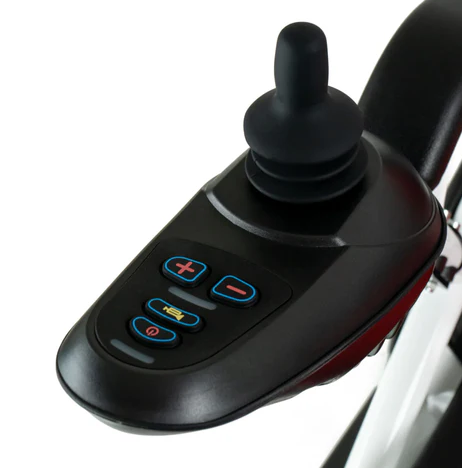
The interface gives the rider direct control. Most models offer 3–5 speed settings. The top speed on the highest setting runs 4–6 km/h — safe for outdoor paths and indoor corridors. Lower settings cap movement at 2–3 km/h, useful for new users or tight spaces. The battery indicator — a 5–10 bar LED display on most models — shows remaining charge based on real-time voltage. Some controllers apply a simplified discharge-correction model to prevent false low-battery warnings under heavy load.
The horn does double duty: standard audible alert, plus fault code output. Specific blink or beep sequences point to distinct error types — low voltage, motor fault, overcurrent. A technician can diagnose a problem without a laptop.
The Brake System: Safe by Default
Every drive motor carries an integrated electromagnetic brake — a spring-loaded, normally-closed design. Without power, the spring clamps the brake disc against the motor shaft. The wheel can’t roll.
A drive command triggers a two-step sequence. First, the controller energizes the brake coil at 24V, releasing the clamp. Then it drives the motor. The joystick returns to center, and the sequence reverses: motor current drops, the drive cuts, the brake coil loses power, and the spring clamps again. The full stop sequence takes milliseconds.
The battery dies mid-use or a protection circuit triggers — the brakes engage on their own. No input from the rider needed. The chair stops and holds position on a ramp, on a slope, anywhere.
The Folding & Portability Mechanism: How It Fits in Your Car Trunk or Overhead Bin
There are two ways to build a portable electric wheelchair. One collapses as a single unit. The other breaks apart into pieces. Both solve the same problem — getting a motorized chair into a car trunk or an airplane overhead bin. But they solve it in different ways, and that difference matters based on who’s doing the lifting.
Two Design Philosophies, One Goal
One-piece folding wheelchair keeps the entire frame intact. A hinge system collapses the chair along a preset axis. The trigger is either a button on the handlebars or a pull strap under the seat. The result is a rectangular block you can drag like a rolling suitcase or lift as a single unit. Folded dimensions on travel-class electric wheelchairs land between 60–85 cm long, 50–60 cm wide, and 30–45 cm tall. Most compact sedans can fit that without dropping the rear seats.
The trade-off is clear. You’re lifting the whole thing at once — 15–20 kg — in one controlled motion. For a caregiver loading an SUV with a high cargo lip, that puts real strain on their lower back and grip strength.
Modular quick-release works the opposite way. The chair separates into parts: the main drive chassis, the battery module, and the seat. Each piece is light enough to carry on its own.
Pulling the seat and battery before sliding the chassis into a trunk isn’t extra effort. For a shorter caregiver, or someone lifting into a high cargo bay, it’s the difference between loading the chair and not loading it at all.
Step-by-Step: What Each Method Looks Like
One-piece fold (caregiver’s sequence):
1. Engage the brake and power off
2. Clear the footrests and seat surface
3. Find the fold trigger — button, lever, or pull strap
4. Press the trigger while pushing the frame forward or downward. Hold it until the frame locks with an audible click
5. Grip the center handle and lift or roll the folded chair into the trunk
Two actions. One heavy lift. Fast when it works, tough when the load is awkward.
Modular quick-release (caregiver’s sequence):
1. Engage the brake and power off
2. Remove and set aside the lithium battery — this is the first step, not the last
3. Unlock and lift the seat straight up. Carry it to the side
4. Fold the main chassis using the fold handle or release latch
5. Load each part into the trunk in order — chassis flat, seat upright, battery tucked into a gap
More steps, but no single lift goes above 8–12 kg. For caregivers with limited upper body strength, three easy lifts beat one hard lift. That’s not a compromise — it’s the smarter approach.
The Overhead Bin Problem
Car trunks are forgiving. Overhead bins are not.
Standard carry-on rules on most international carriers cap baggage at 55 × 35 × 25 cm with a weight limit of 7–10 kg. Narrow-body aircraft aisles run 48–51 cm wide. The usable interior height of most overhead bins sits between 23–27 cm.
Standard foldable electric wheelchairs — even light ones — don’t clear those limits. A folded travel wheelchair comes in at 60–75 cm long, 55–65 cm wide, 30–40 cm tall, weighing 15–23 kg with batteries. That goes in the cargo hold or gets gate-checked. Not overhead.
Wheelchairs that do fit overhead bins belong to a different engineering category(airplane wheelchair).
A foldable electric wheelchair built for overhead bin use has to hit strict targets: length ≤ 55 cm, width ≤ 35–40 cm, height ≤ 25–30 cm, total weight ≤ 8–10 kg. Most power chairs can’t meet all four numbers at once. The ones that do tend to give up load capacity or battery range to get there.
What This Means for Your Actual Decision
Loading into a sedan trunk twice a day? A one-piece folding design is faster and simpler — as long as the caregiver can handle the full weight in one lift. Trunk access is awkward or upper-body strength is limited? Modular quick-release gives you more control at the hardest point of the transfer.
Flying a lot? Skip the overhead bin idea for most electric models. Plan around gate check or cargo hold procedures instead. Pull the lithium battery packs before boarding — they go with you in the cabin no matter what. The chair frame goes below. That’s the real workflow for a travel electric wheelchair. Knowing it ahead of time saves a lot of airport confusion.
Who Really Needs an Electric Lightweight Wheelchair: A Condition-by-Condition Breakdown
A light electric chair is not for everyone. You might feel exhausted after a 50-meter walk. This chair fills that gap. Pushing a manual frame can make your arms ache in minutes. An electric model solves this issue. One hand operates the simple joystick. That keeps your movements secure.
Your health dictates your exact choice. People with MS or Parkinson’s save huge amounts of energy with these chairs. Doctors check walking stats for older adults and heart patients. You might struggle with a six-minute, 200-meter walk test. A power chair fits this exact need. Older users fall less often with this support. Plus, your caregivers get a break. They can lift these light frames straight into a car trunk.
Stroke or brain injury patients follow a clear rule. One working arm runs the joystick right. Basic focus keeps the drive smooth and secure.
Spinal cord injury needs depend on the damage level. People with lower-level injuries handle manual chairs fine. A light power chair stops long-term shoulder wear, though. You earn independence every day without the heavy strain.
Conclusion
Mobility shouldn’t feel like a trade-off between independence and practicality. A well-chosen electric lightweight wheelchair shows it doesn’t have to be.
This guide covered more than mechanics and motor specs. It gave you a clear picture of what real freedom looks like. It fits in your car trunk. It runs a full day on one charge. It responds to the lightest touch of a joystick.
Your next step is simple:
Review what you’ve learned — weight capacity, battery life, folding design
Match those details against your daily needs
Browse Gracemedy’s range of portable electric wheelchairs
You won’t be guessing. You’ll be choosing with confidence. That’s a different feeling — and it makes all the difference.