
With a patient on the table and a procedure about to begin, everything hinges on proper surgical lighting. Walk into a dermatology clinic, a dental office, or an outpatient surgical suite, and you will find different lighting setups, but each requires precision without shadow interference. Whether you are evaluating a shadowless surgical light for a cosmetic procedure room or weighing mobile options against ceiling-mounted systems for a multi-specialty practice, that decision shapes everything from diagnostic accuracy to patient safety. This guide explains how different clinics use surgical lighting so you can match equipment to your actual clinical demands.
Core Functions: Why Surgical Lights Are Essential in Clinical Settings
Under IEC 60601-2-41, surgical light illumination must fall between 40,000 to 160,000 lux in the central field. The upper cap exists to prevent visual fatigue and tissue heat damage, making it a mandatory baseline every medical grade lighting system must clear before entering an operating room.
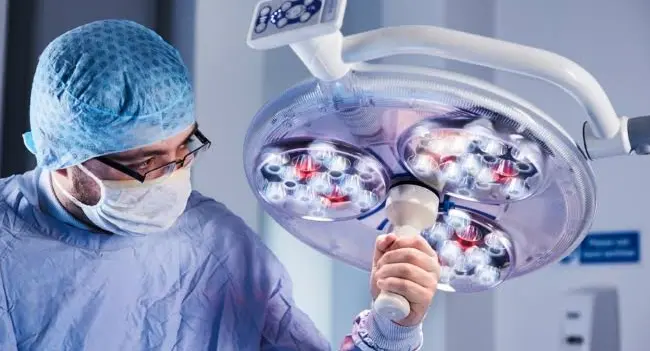
Illumination Quality Goes Beyond Brightness
Central lux only tells part of the story. The standard requires a CRI above 85 so surgeons can distinguish tissue, blood vessels, bleeding points, and lesion margins. Poor color rendering leaves a surgical team operating blind to subtle variations.
High-end LED surgical light systems reach Ra≥95 across a 22,000 to 160,000 lux range. Many also include adjustable color temperature surgical light settings between 3,800 and 4,800 K, allowing surgeons to tune the field to specific tissue types or surgical phases.
Total CRI can be misleading. Traditional halogen lights score in the mid-90s for overall CRI, but their R9 value for red tissue rendering often drops near 70. Modern LED systems optimize the red spectrum directly, giving surgeons clearer visibility across blood, perfused tissue, and red-toned structures. When evaluating clinic lighting equipment, check R9, color temperature range, and illumination uniformity alongside peak lumens.
Multi-Head LED Design Tackles the Shadow Problem
Hands, heads, and surgical instruments constantly obstruct overhead beams, casting shadows directly across the incision. Shadowless surgical light technology addresses this by using multi-head LED systems with independent modules angled toward the surgical site. If one beam is blocked, the others maintain illumination across the field.
As a result, shadows do not follow the surgeon’s hands, and deep cavity visibility stays consistent during repositioning. When shopping for operating room lighting, look for dual or multi-head configurations, adjustable spot diameter, deep-cavity modes, and sterile handle controls that overcome beam occlusion from multi-person teams.
Stacking multiple light heads increases total irradiance alongside coverage, making thermal management critical.
LED Technology Cuts Heat Exposure Significantly
Efficiency is where LED surgical lights deliver their main thermal advantage. LED fixtures produce 100 lm/W compared to halogen’s 10 lm/W. Reaching the same lux level requires roughly one-tenth the power of halogen, cutting wasted heat output at the source.
Heat risk does not vanish entirely. IEC guidance caps total irradiance at 700 W/m² to protect exposed tissue. In ECRI testing, two light heads focused at maximum intensity on one site generated 1,200 W/m² and raised surface temperatures to 47°C (117°F), which can cause tissue burns within 30 minutes. Proper surgical light maintenance and automatic intensity regulation remain necessary across any operating suite.
Surgical Light Applications by Clinic Type
No two clinics light a room the same way. A dermatology suite removing a mole needs a different setup than an ASC running back-to-back surgeries. Choosing illumination based on clinical routine rather than peak brightness determines whether the fixture earns its place.
General & Family Clinics
Routine procedures like wound debridement, suturing, incision and drainage, and biopsies do not need the wattage of a full operating theater. Exam areas run around 1,000–1,500 lx, while general rooms sit closer to 500–750 lx. Keep CRI at 90 or above, with color temperature between 3,800–5,300 K. A single adjustable-height, long-arm mobile light with a 300–500 mm head covers most small procedure areas. Sterile handles, detachable sterilizable covers, and fast repositioning matter more here than raw lux output.
Incision and drainage work calls for focused beams rather than broad washes. Aim for 50,000–100,000 lx, CRI ≥90, 4,000–5,000 K, with a 200–400 mm depth zone. Position the articulated arms from the head or side so they stay clear of the operator’s hands.
Dermatology Clinics
Lesion removal, biopsies, and laser or light-based treatments demand sharp color accuracy over sheer brightness. Most procedures run well at 1,000–50,000 lx, though CRI ≥90 is essential to distinguish erythema, bleeding, and tissue margins. Low-heat LED heads with adjustable color temperature work best, and mobile units let staff swap between treatment chairs without reinstalling hardware.
Dental Practices
Dental workspaces target roughly 1,000 lx and ambient areas 500 lx, with chair-mounted lights peaking between 9,000–21,000 lx and Ra ≥90. Glare remains the primary engineering hurdle because patients lie flat, looking directly upward. Keep upward luminance near 1,000 cd/m² or lower, and focus the beam tightly on the oral cavity rather than the patient’s eyes. Both chair-mounted fixtures and ceiling-balanced arms work well; glare control matters more than how the unit is mounted.
Ophthalmology Clinics
Precision beats power in ophthalmic work. Exam rooms sit around 1,000 lx, while ophthalmic surgical lights range from 40,000–100,000 lx with small, tightly focused spots and soft-start activation. Glare control outranks peak brightness, as fixtures positioned directly over the patient’s line of sight interfere with slit-lamp and microscope examinations.
ENT Clinics
Ear, nose, and throat procedures require deep-cavity reach. A setup delivering 80,000–120,000 lx, 4,000–5,000 K, CRI ≥90, and an illumination depth of 200–400 mm covers most ENT work. Light heads must clear endoscopes, exam chairs, and the physician’s shoulder by swinging in from the side or overhead.
Ambulatory Surgical Centers (ASC)
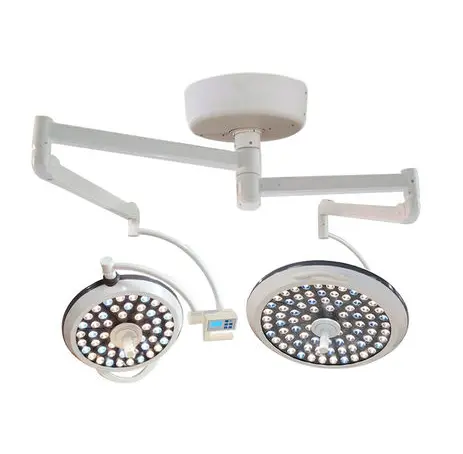
The full IEC range applies here: 40,000–160,000 lx, 3,000–6,700 K, and Ra 85–100. Main ORs benefit from dual-head ceiling-mounted surgical light systems, where one light covers the primary incision while the second eliminates deep or lateral shadows. Independent dimming, separate positioning arms, sterile handles, integrated cameras, and battery backups complete the installation.
Aesthetic Medical Centers
Surgical procedures like liposuction and excisions call for 60,000–120,000 lx, CRI ≥90. Injectables and energy-based treatments drop to 1,000–50,000 lx using adjustable mobile units. A hybrid setup works best across a full service mix: install fixed dual-head lights in primary surgical suites and pair them with mobile units in recovery and treatment bays.
Emergency & Treatment Rooms
Mobile lights here require charging docks, clear battery indicators, and automatic switching during power failures. Treatment zones run at 1,000+ lx, while trauma cases and minor procedures scale up to 50,000–100,000 lx with high CRI. Reliable wheel locks and rapid bedside repositioning are direct operational requirements.
Resource-Limited or Shared Rooms
Mobile LED units delivering 20,000–80,000 lx, CRI ≥90 with a built-in low-brightness mode handle rotating caseloads better than fixed ceiling mounts. Check battery runtime, charge cycles, and surface disinfection compatibility before buying, since these units move between rooms constantly.
LED Surgical Light vs Mobile vs Ceiling-Mounted: Which Fits Your Clinic
Picking the wrong surgical lighting costs money and compromises surgical precision. Mobile LED surgical lights, ceiling-mounted systems, and LED examination lights each address distinct clinical demands. None is universally superior; they are engineered for different workflows.
Mobile LED Surgical Light
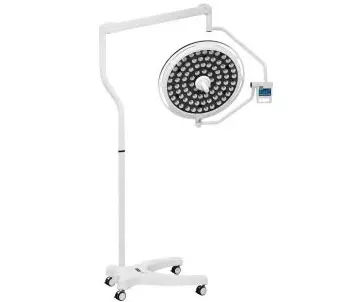
Commercial mobile units deliver 120,000–140,000 lux at 1 m, a CRI of ≥95–96, color temperatures from 3,000–5,000 K, dimming from 1–100%, and LED lifespans of ≥60,000 hours. Most supply about 2.5 hours of battery backup, though select lithium-ion systems run for 4–8 hours depending on the operating mode.
Choose mobile units when:
One light must serve multiple rooms, satellite clinics, or leased space.
Procedures are intermittent and permanent ceiling infrastructure is unwarranted.
The facility requires backup lighting during power interruptions.
Room layouts shift or relocation is planned.
Before buying, confirm that the light head clears doorways and table paths, as large heads measure 490–670 mm in diameter. Designate a parking spot so the base does not block traffic or sterile fields. Check battery levels before every procedure, keep a charging log, and budget early for replacement cells. Locking casters, a low-profile base, sealed disinfectant-resistant surfaces, and manual override controls separate dependable units from troublesome ones.
Ceiling-Mounted LED Surgical System
Fixed systems provide 100,000–160,000 lux at 1 m, CRI above 95, adjustable color temperatures near 3,500–5,000 K, illumination depth beyond 1 m, and LED life exceeding 40,000 hours.
Ceiling mounts suit dedicated operating theatres handling high daily case volume, deep-cavity or abdominal procedures where shadow control is essential, and rooms requiring integration with video systems or dual surgical heads.
The trade-offs are higher expense and permanent placement. Support columns measure 6–10 inches in diameter and often demand structural steel rated for 200–500 lb. Suspended ceilings cannot support this weight alone, making a structural evaluation necessary before purchasing. Your total budget must account for structural reinforcement, engineering reviews, ceiling repairs, system commissioning, and facility downtime alongside the luminaire itself.
LED Examination Light
Examination lights deliver 20,000–40,000 lux for routine assessments and scale to 60,000–100,000 lux for detailed minor procedures. They handle physical exams, dressing changes, injections, suturing, and minor dermatology or ENT procedures requiring a shallow, narrow field.
These units lose effectiveness during deep-cavity work, whenever staff or surgical tools cast shadows across the incision, or during lengthy cases that require sustained, balanced light distribution.
The Efficiency Numbers Behind the Decision
A PNNL review showed average rated efficacy around 1,848 lux/W for LED surgical luminaires compared to 699 lux/W for halogen, an advantage of roughly 2.6 times. Standard LED modules are rated for 25,000–40,000 hours, and modern surgical fixtures reach 45,000–60,000+ hours, compared to 1,000–3,000 hours for conventional lamps.
Select mobile LEDs for shared spaces and procedural flexibility, ceiling-mounted systems for dedicated surgical suites with high turnover, and examination lights for superficial outpatient care where deep-field illumination and shadow reduction are not safety factors.
Conclusion
Match your surgical light to how your clinic operates. A dermatology practice does not need what a surgical center needs, and a mobile unit that serves a multi-specialty clinic well might fall short in a dedicated OR.
Shadowless, consistent illumination protects diagnostic accuracy and patient safety across any LED surgical light, mobile surgical light, or ceiling mounted surgical light setup. Base your choice on color temperature, maneuverability, and long-term maintenance costs alongside upfront price.
Clinics see the best ROI when they audit their procedure volume, room layout, and staff workflow before purchasing. Don’t skip that step.
Explore Gracemedy’s surgical lighting lineup and talk to a specialist who can map your clinic’s specific needs to the right configuration before you commit to equipment that will shape your operating room for the next decade.