Core International Standards Every Operating Room Must Meet
Four standards govern whether your operating room equipment is safe—not four hundred. Miss any of them, and you risk a patient’s life on the table.
ISO 13485: The Foundation of Medical Device Quality
ISO 13485 forces manufacturers to build traceable systems around design, sourcing, production, installation, and after-sales support. Risk control gets baked into every step.
For your procurement team, this comes down to one question: can this vendor prove consistency batch after batch?
IEC 60601-1 and IEC 60601-1-2: Electrical Safety and EMC
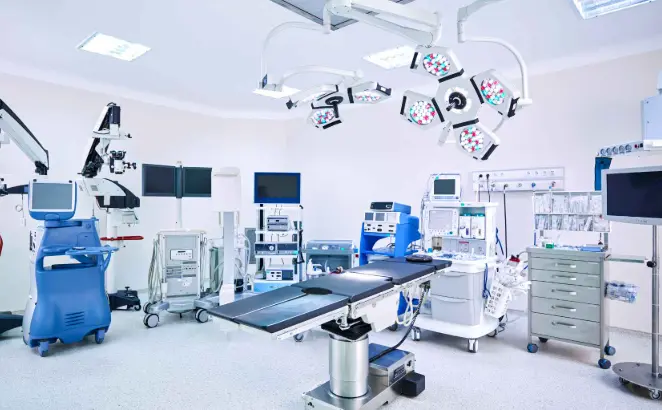
IEC 60601-1 is the baseline safety standard for medical electrical equipment. The FDA recognizes it as “Medical electrical equipment – Part 1: General requirements for basic safety and essential performance.”
It covers anesthesia machines, monitors, infusion pumps, electrosurgical units, powered operating tables, and endoscopy towers. When evaluating equipment, focus on leakage current and grounding protection, insulation integrity and mechanical strength, temperature rise under sustained use, and safety performance under single-fault conditions.
CE Certified vs. FDA Approved: Know the Difference
This trips up more procurement teams than it should. CE certified operating room equipment means legal market access within the EU/EEA. It’s proof the product can be sold there, nothing more.
FDA approved surgical equipment follows a different regulatory path—typically 510(k), De Novo, or PMA authorization. FDA clearance isn’t a stamp on a product. It’s a regulatory pathway, and it doesn’t transfer to European markets any more than CE transfers to American ones.
If you’re purchasing for a European facility, demand the CE/MDR evidence chain. If you’re buying for U.S. operations, verify the FDA pathway and recognized standards instead. Don’t mix the two up.
ISO 7396-1: Medical Gas Pipeline Systems
Often overlooked, frequently critical. ISO 7396-1 governs the design, installation, and testing of medical gas and vacuum systems—oxygen, nitrous oxide, medical air, carbon dioxide, and surgical tool-driving gases.
Operating Table & Surgical Lighting: Are They IEC-Certified?
A surgeon leans on the table during a four-hour spine procedure. The frame doesn’t buckle. That’s not luck—it’s IEC 60601-2-46 doing its job. This standard governs every operating table and transfer trolley with or without electrical components, and it’s stricter than most procurement teams assume.
Operating Table Specifications: What the Standard Demands
The core test is Safe Working Load (SWL). But passing SWL once isn’t enough. In normal position, the table must withstand 2.2 times its rated SWL without failure or permanent deformation. That’s the real stress test manufacturers can’t fake.
Beyond load capacity, four other checkpoints matter:
Water resistance — Tables must hit at least IPX4 protection. Fluids happen in surgery. Equipment that isn’t rated for it shouldn’t be in the room.
Transfer safety — For tables with movable tops, the design has to minimize injury risk while staff move patients and prevent the tabletop from separating accidentally.
Mobility stability — On a tilted-plane test, initial displacement from elastic deformation, creep, or castor rotation can’t exceed 50 mm. If a mobile table can’t safely clear obstacles, the manufacturer must say so in writing.
Grounding resistance — Resistance between accessible parts and the equipotential terminal must stay under 200 mΩ. This is basic electrical safety, and it’s non-negotiable.
Rejection during acceptance testing usually traces back to one of these: failed static load tests, permanent deformation under the 2.2× load, missing IPX4 rating, or excessive movement during tilt testing.
Surgical Lighting Standards: Illuminance, Radiance, Color
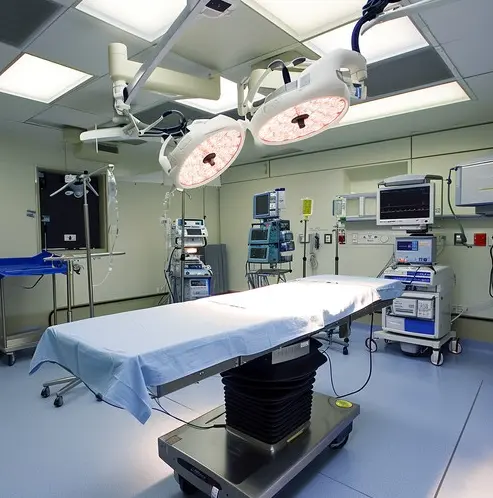
IEC 60601-2-41 covers both surgical luminaires and diagnostic lights. The goal is simple on paper—enough light, without cooking tissue.
Three numbers define compliance:
Central illuminance must reach at least 40 klx, typically ranging up to 160 klx depending on configuration.
Total irradiance at the light field’s center, measured at maximum illuminance distance, cannot exceed 700 W/m². Cross this line, and you’re generating unnecessary thermal load on exposed tissue.
Color temperature should fall between 3,000 K and 6,700 K—outside this range, surgeons lose accurate tissue color perception mid-procedure.
Lights get flagged during acceptance most often for central illuminance below 40 klx, irradiance exceeding 700 W/m², or color temperature drifting outside spec.
The Documentation You Should Request
Don’t take a supplier’s word for it. Ask for the full paper trail: IEC 60601-2-46 test reports, IPX4 certification, the 2.2× SWL test results, IEC 60601-2-41 test reports, illuminance/irradiance/color temperature test pages, and CE Declaration of Conformity if you’re sourcing for EU markets.
Gracemedy’s engineering teams build documentation packages around this checklist—because a table or light that can’t produce these records shouldn’t be in your OR to begin with.
Essential OR Equipment Checklist: What’s Missing in Your Suite?
Walk into any operating room and count the crash carts. Better yet, check when someone last tested them. Half the compliance gaps we see involve equipment sitting there, unused, untested, forgotten until a code blue exposes the hole.
Basic Emergency Equipment: The Non-Negotiables
Every OR needs a working emergency call system. That’s step one, and it’s shockingly easy to overlook once the “urgent” installation projects get priority. Beyond that, the baseline emergency package includes:
Cardiac monitoring
Defibrillator and crash cart
Suction equipment
Ambu bag
Backup oxygen cylinder
Miss the airway extras and you’re gambling on outcomes. Stock an LMA, a Cook stylette, and a needle cricothyrotomy kit. Add a malignant hyperthermia (MH) box or cart; when MH hits, you don’t have time to search for supplies.
Anesthesia Machine Standards: The Daily Pre-Check That Gets Skipped
Anesthesia machine standards demand more than plugging the unit in and hoping. A proper daily pre-check verifies:
Backup oxygen cylinder pressure is adequate
Central gas supply holds at least 50 psig
Suction reaches the negative pressure needed to clear an airway
Monitors are complete, with alarms functioning correctly
Low-oxygen alarm calibration is current
Breathing circuit has no leaks, and flowmeters/vaporizers work properly
Scavenging system is operational
Skip any line item and you’re risking more than a bad audit. You’re risking a patient mid-procedure.
The anesthesia supply cart matters too. IV supplies, emergency drugs, local anesthetics, and a stethoscope should all be standardized and checked, not assembled ad hoc before each case.
Sharps and Waste: The Overlooked Infection Control Line
Sharps containers belong near the anesthesia zone and the surgical field, close enough for immediate disposal, not across the room. Waste streams (infectious, sharps, general) need clear separation with defined paths inside the suite. Cross-contamination during waste handling is a preventable failure, and inspectors know exactly where to look.
Imaging and Interventional Capability: Do You Actually Need Hybrid OR?
If your facility runs cardiovascular or trauma cases, flat-panel fluoroscopy and a radiolucent table are baseline requirements. Hybrid ORs need enough clearance to prevent equipment collisions, plus a floating tabletop for multi-directional adjustment. FGI guidelines put minimum clear floor area at roughly 600 sq ft for hybrid configurations.
But if your hospital handles routine general surgery or orthopedics, skip the full hybrid build. A mobile C-arm paired with a radiolucent table gets you 80% of the capability at a fraction of the cost.
Self-Assessment Framework: 6 Questions to Test Your OR’s Compliance
Six questions. That’s all it takes to separate a compliant OR from one running on assumptions.
Question 1: Are Your Certificates Complete and Consistent?
Question 2: Do Installed Models Match What You Approved?
Question 3: Is Your Installation and Acceptance Trail Complete?
Question 4: Does Your EMC Report Apply to Your Equipment?
Question 5: Are Environmental Parameters Continuously Tracked?
Question 6: Is Your Emergency Equipment Ready?
Conclusion
Most operating rooms fail accreditation because of small, overlooked details that stack up. A surgical light that isn’t IEC 60601-certified. An anesthesia machine three years past its calibration window. This is the norm in facilities that haven’t run a proper compliance audit in years.
The self-assessment checklist we’ve walked through acts as an early warning system. Run through it and you’ll know your standing before an accreditation body does.
If your OR equipment is ISO 13485 medical equipment certified and CE-marked, you are ahead of most facilities. If not, treat it as a starting point.
Check Gracemedy’s internationally certified operating room solutions, or contact our team for a compliance consultation.