What are the different types of surgical lighting
Walk into any OR supply catalog and you’ll hit a wall of options: ceiling-mounted surgical light systems, mobile units, LED versus halogen light sources, single-dome and dual-dome configurations.
We’ll walk through the different types of surgical lighting by installation method, light source, and head structure, then stack them side by side in a comparison table covering cost, performance, and best-fit scenarios. By the end, you’ll know which configuration fits your facility’s surgical volume, room layout, and budget.
What Is Surgical Lighting and Why Classification Matters
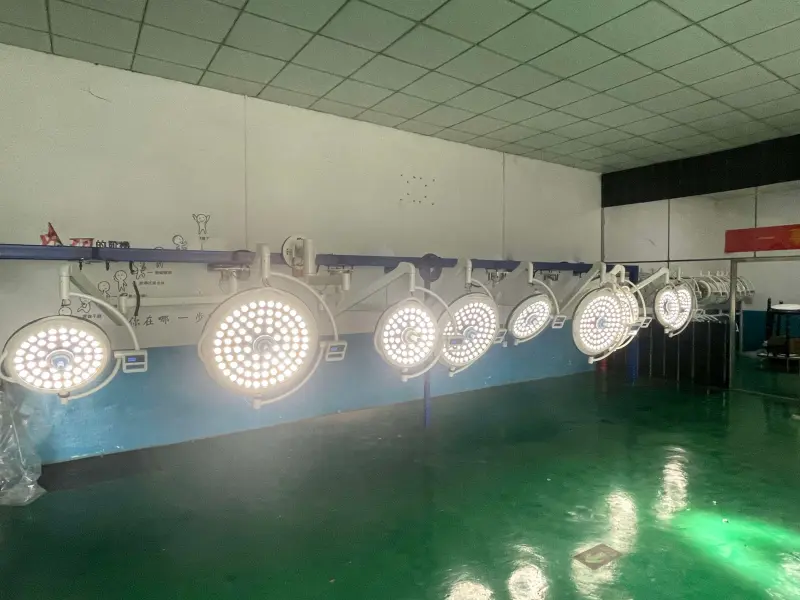
Surgical lighting is a specialized medical device that lights the incision and surgical field with high intensity, minimal shadow, and accurate color rendering, but its real job is simpler: give the surgeon a clear view of tissue, blood vessels, and sutures, no matter how many hands, instruments, or heads block the beam.
Three things every surgical light needs to deliver:
Shadowless illumination
Accurate color rendering (CRI)
Consistent standardized illuminance
Classification matters because procurement mistakes rarely come from buying a bad light. They come from mismatching a light’s specs to the room. A ceiling-mounted unit that is brilliant but requires ceiling height and load capacity your OR doesn’t have is a wasted purchase. A halogen light chosen for its lower price tag but installed in a high-volume OR racks up heat and maintenance costs fast.
The most common blind spot is fixating on peak lux numbers while ignoring CRI, light field uniformity, and edge falloff. A center that’s blinding bright with a dim, uneven periphery still creates visibility problems where it counts: at the margins of the surgical field.
Surgical Light Types by Installation/Mounting Method
Where a surgical light gets bolted, hung, or wheeled in determines cost, reach, and how much it disrupts your ceiling. Installation method is the first decision for any manufacturer, and it shapes your budget before you even look at bulb type.
Ceiling mounted surgical light systems are the default for dedicated ORs. They clear the floor for staff and equipment, offer the widest positioning range, and increasingly come with dual-head or camera-integrated setups. The tradeoff is structural: these units weigh 100–400+ lb, so you need a ceiling-height check and reinforced support before installation even starts. Ceiling mounts make the most sense for primary ORs and larger procedure rooms where the arm can swing across the full table footprint.
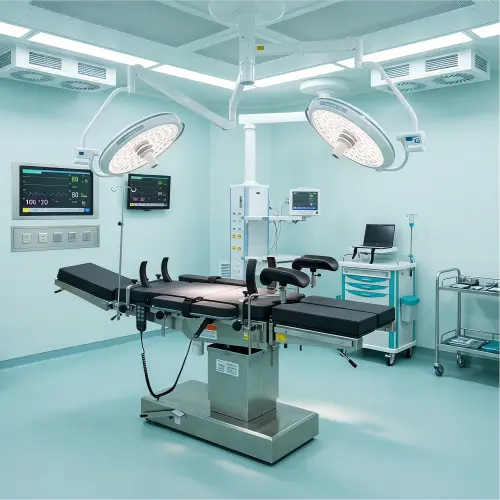
Wall mounted surgical light units fit where ceilings are crowded or structurally limited. You’ll find them in small ORs, outpatient facilities, dental suites, ED trauma bays, and ICUs. They save space and are simpler to retrofit, but the swing radius can’t match a ceiling arm’s reach. Many facilities use them as supplementary lights rather than the primary OR light.
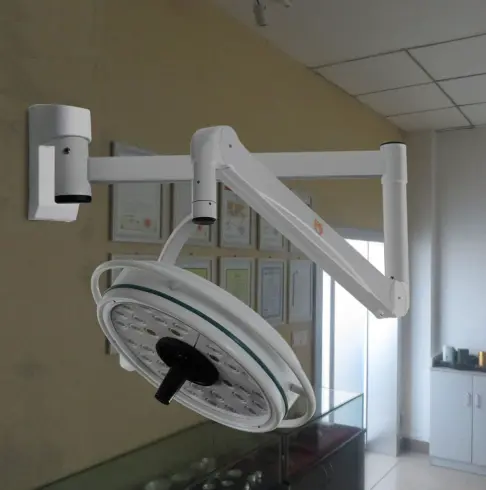
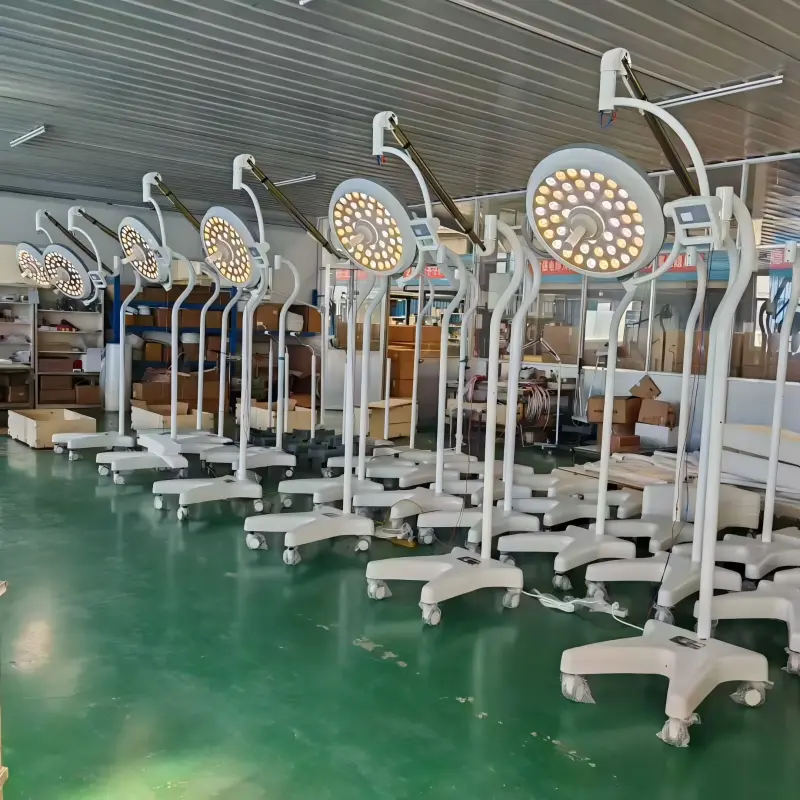
Mobile surgical light systems are the most flexible option. Wheel them between rooms, reposition on demand, deploy for overflow cases. Entry-level mobile LED domes start around $10,000, with basic exam-grade units sometimes priced under $200. The catch is stability: mobile units need repeated adjustment and lack the fixed reliability of ceiling or wall systems, so they work best as auxiliary or backup lighting for complex procedures.
Surgical Light Types by Light Source (LED vs Halogen)
The bulb inside the head matters more than the housing around it. Light source determines heat output, bulb life, color accuracy, and how much you’ll spend keeping the light running over a decade of use.
LED surgical light systems have become the default for new installations.
Halogen surgical light units still show up in older facilities, but the economics haven’t aged well.
The math rarely favors halogen long-term. Bulb replacement costs alone, tallied over a fixture’s life, can equal or exceed the price of a full LED system. HID and metal halide units follow a similar pattern — still found in legacy inventories, but absent from new builds.
Cost-Benefit Snapshot
Retrofitting a halogen ceiling system to LED runs 40–50% of full replacement cost and pays for itself in 3–5 years. Facilities report 55–65% energy savings per luminaire, translating to $1,200–1,800 in annual operating savings per suite. On the higher end, that’s $8,000–15,000 in electricity savings plus $4,000–8,000 in reduced cooling costs per OR, since less heat output means less HVAC load.
Surgical Light Types by Head Structure (Single vs Dual)
One dome or two changes everything about shadow control. A single-head surgical light uses one adjustable light source and works fine for small-field procedures where room lighting can fill in the gaps. It’s the budget pick: less ceiling infrastructure, lower install complexity, and it fits minor surgery rooms, outpatient clinics, and exam rooms without forcing a full OR-grade buildout.
The limitation shows up fast in bigger cases. One light source means one angle. When a surgeon’s head or an instrument blocks the beam, there’s nothing compensating for it.
Dual-head surgical light systems solve that by running two independently adjustable heads that overlap their light fields. If one head gets blocked, the other fills the gap. That’s the shadow-dilution principle in action.
That depth matters for cardiac surgery, neurosurgery, and major general surgery: anywhere the surgical field sits deep and narrow and multiple surgeons work simultaneously.
Beyond Overhead Lights: Other Surgical Illumination Methods
No overhead fixture, however advanced, reaches every angle a surgeon needs. That gap is why four other illumination tools exist alongside ceiling-mounted and mobile systems.
Surgical headlights and illuminated loupes fix the “my hands are blocking the light” problem. Worn on the head and aligned with the surgeon’s line of sight, they deliver a tight, shadow-free spot exactly where attention is focused.
In-cavity lighting goes where overhead beams can’t: deep inside body cavities during minimally invasive procedures. These lights mount independently, clip onto an instrument outside the sterile field, or run through fiber optics to keep heat down.
Lighted retractors hold tissue open and light it at the same time.
Operating microscopes with integrated illumination dominate neurosurgery and microsurgical fields. Coaxial lighting keeps the beam aligned with the optical axis, eliminating shadow during delicate dissection under magnification. Handheld retractors can’t match that.
Surgical Light Types Compared: Pros, Cons & Use Cases
Numbers settle arguments that spec sheets can’t. Here are the classifications from this guide side by side, with the price ranges procurement teams see on quotes.
|
Dimension |
Type |
Pros |
Cons |
Best Use Case |
Price Range |
|---|---|---|---|---|---|
|
Installation |
Ceiling-mounted |
Widest coverage, supports multi-head configs |
High install/structural cost |
Standard ORs, specialty suites |
Single-head $2,000–$10,000; dual-head $7,000–$40,000; triple-head $20,000–$45,000 |
|
Installation |
Wall-mounted |
Saves floor space, simple retrofit |
Limited swing radius, less coverage |
Small ORs, exam/treatment rooms |
Below ceiling-mount pricing |
|
Installation |
Mobile |
High flexibility, multi-room use |
Weaker stability, power/battery management needed |
Outpatient, ED, field/disaster response, ICU bedside |
$8,000–$25,000 |
|
Light Source |
LED |
Low heat, low energy use, minimal maintenance |
Higher upfront cost |
High-frequency, long-duration surgery |
$3,500–$10,000 single-head; full systems $12,000–$89,000 |
|
Light Source |
Halogen |
Cheaper upfront, mature color rendering |
High heat, short bulb life, frequent replacement |
Budget renovations, low-frequency rooms |
$2,000–$6,000 single; $7,000–$25,000 dual; $20,000–$35,000 triple |
|
Structure |
Single-head |
Lowest cost, simple structure |
Limited coverage for complex cases |
Minor surgery, outpatient |
LED $3,500–$10,000; halogen $2,000–$6,000 |
|
Structure |
Dual-head |
Better shadow control, redundancy |
Higher cost and install complexity |
General/ortho/long-duration surgery |
LED $8,000–$40,000; halogen $7,000–$25,000 |
|
Structure |
Triple/multi-head |
Maximum shadow management |
Highest price, most complex maintenance |
Neurosurgery, cardiac, high-acuity OR |
LED $30,000–$45,000; halogen $20,000–$35,000 |
Budget-constrained renovations favor halogen single or dual-head ceiling or wall units. High-acuity, high-frequency ORs favor LED dual or multi-head ceiling systems. Flexibility-driven departments (outpatient, ED, ICU) favor mobile LED units. Anyone optimizing for 10-year TCO lands on LED regardless of head count.
How to Choose the Right Surgical Light for Your Facility
Start with three questions: how big is the room, how complex are the procedures, and what’s the maintenance budget. Answer those and the right configuration picks itself.
Entry-level is a single-head LED, wall-mounted or compact ceiling — good for clinics and minor procedures.
Mid-range is a dual-head LED ceiling mount — covers most general ORs.
High-end is a dual-head or double-dome with independent control, camera and monitor integration — for complex, high-acuity suites.
Conclusion
Choosing the right surgical light depends on how your facility is built, how your team works, and how much you’re willing to invest upfront versus over time. Ceiling mounted lights provide unmatched stability for high-volume ORs, while mobile units bring flexibility to multi-purpose spaces. The shift from halogen to LED continues to reshape expectations around heat, energy use, and color rendering. The right option fits your room size, case mix, and maintenance capacity.
That’s exactly why classification matters before you ever request a quote. Understanding these categories turns a confusing spec sheet into a clear decision framework.
Ready to move from research to real options? Browse Grace medy’s surgical lighting lineup or reach out to our team for a tailored recommendation based on your facility’s layout and surgical volume. No guesswork required.