Safety of LED Surgical Lights vs Halogen Heat Output Safety
A Led surgical lights does more than illuminate the operating field. Heat output can affect patient comfort, tissue moisture, and surgeon comfort. It can also affect the overall operating room environment. This makes LED surgical lights vs halogen heat output an important safety consideration for hospitals. LED surgical lights provide strong illumination with less unwanted heat. However, buyers should look beyond lux output. Measurable data on heat and irradiance also matters.
LED Surgical Lights: Heat Output and Safety Explained
Halogen lights generate a large amount of heat. Their light source operates at a high temperature. Some of this energy reaches the surgical field as infrared radiation.
LED surgical lights work differently. They use semiconductor light sources. They can provide high illumination with less unwanted heat. This makes them well suited for long procedures and modern operating room lighting systems.
Lux is not the only factor to consider. Buyers should also check total irradiance. The relationship between irradiance and illuminance is also important.
The source article uses IEC 60601-2-41 as the main safety reference. Earlier editions noted a 1000 W/m² regulatory ceiling. Newer guidance uses 700 W/m² as a practical safety reference. The goal is simple. Provide enough light while limiting unnecessary thermal load.
For example, a light head can produce 160,000 lux at 3.6 mW/m²·lx. This equals about 576 W/m² of irradiance. Two heads at the same intensity can create a much higher combined value. The risk increases if their fields overlap.
Single-head specifications do not always show the full safety picture.
Surface Temperature Matters
Surface Temperature Matters LED light heads can also have lower surface temperatures. Heat is managed inside the fixture. Less heat is directed toward the surgical field.
The source article gives ≤35°C as a surface-temperature target under a stated test condition. It also notes that thermal management is closely related to long-term LED performance.
A well-designed surgical operating light should therefore provide both strong illumination and stable thermal performance.
Quick Reference: Core Safety Parameters
| Parameter | Industry Benchmark |
|---|---|
| Regulatory irradiance ceiling | 1000 W/m² (IEC 60601-2-41) |
| Practical safety threshold | 700 W/m² |
| Recommended single-head limit | ≤500 W/m² |
| Common LED color temperature | 3500K–5600K |
| Lamp head surface temp target | ≤35°C |
| Rated LED lifespan | 50,000+ hours |
These figures should be treated as reference points rather than universal specifications for every product. Actual performance depends on the light design, test conditions, working distance, and applicable standard.
IR-Free Does Not Mean Heat-Free
LED surgical lights are often described as producing little or no infrared and ultraviolet radiation. This is an important advantage over traditional halogen technology.
However, IR-free does not mean heat-free.
LEDs still create thermal energy, and some of that energy reaches the surgical field as irradiance. Buyers should therefore avoid evaluating a product only from statements such as “low heat” or “IR-free.”
Ask suppliers for actual thermal and irradiance data.
This is especially important when comparing different surgical light safety designs.
LED vs. Halogen: The Key Safety Differences
The most useful comparison is not simply “LED is cooler.” Procurement teams should compare measurable safety factors.
LED vs. Halogen — Safety Dimensions at a Glance
| Dimension | LED surgical lights | Halogen | Sourcing Takeaway |
|---|---|---|---|
| Heat output at lighthead | Typically stays under the 700 W/m² safety threshold | Runs hotter, historically carried shorter lamp-life ratings under IEC classification | Confirm compliant irradiance in writing |
| Non-visible irradiance load | Lower ratio, less radiative burden per lux | Averages 3.2 mW/m²·lx | Request the mW/m²·lx figure, not just lux |
| Tissue drying risk | Reduced, by design intent behind the 700 W/m² ceiling | Elevated, especially in long procedures | Prioritize low-irradiance heads for extended cases |
| Burn/thermal injury margin | Clear safety margin under standard use | Historically narrower margin | Critical for pediatric or high-risk patients |
The 3.2 mW/m²·lx figure in the source material is particularly useful when comparing heat output. It shows why two lights with similar lux levels may not create the same thermal load.
For procurement teams, the lesson is simple: do not compare led surgical lights using lux alone.
Also compare irradiance, working distance, surface temperature, and test conditions.
Why Light Overlap Can Change the Safety Picture
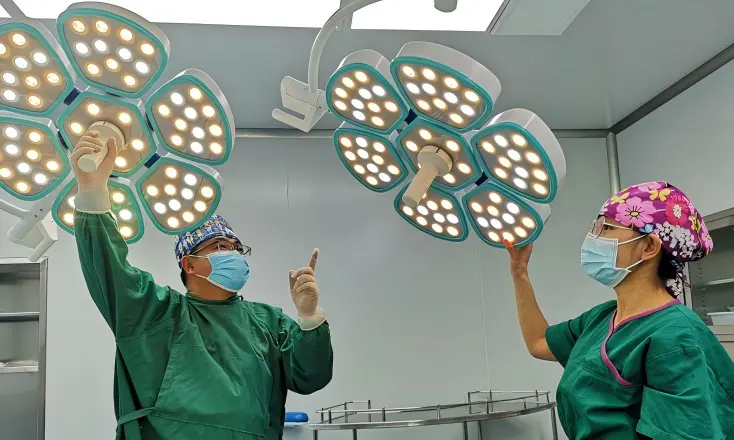
Multiple surgical lights are common in modern operating rooms. They provide better coverage and can reduce shadows.
But overlapping fields also require attention.
A light head may be safe on its own. The thermal load can increase after another light is focused on the same area.
This applies to LED systems as well as older technologies.
The source article highlights several manufacturer operating rules for high-intensity systems. These include reducing the intensity of a second overlapping head. They also recommend avoiding high-intensity overlap between multiple heads.
Hospitals should always follow the operating instructions supplied with their LED operating lights.
Positioning Tips for Multiple Light Heads
When using two or more surgical lights:
- Use one primary light at high intensity and reduce the output of the secondary light when needed.
- Avoid placing two high-intensity focal points directly on top of each other.
- Increase the working distance when appropriate, while remembering that distance alone does not remove thermal risk.
- Adjust the angle between light heads. Keep their focal centers from stacking unnecessarily.
The basic principle is straightforward: reposition first, then increase brightness.
LED Energy Efficiency Also Reduces Heat Load
Heat output is not only a patient-safety issue. It also affects the operating room environment.
The source article estimates that LED can reduce connected load by roughly 50% compared with equivalent halogen systems.
For example, a 400 W halogen head could be replaced by a 200 W LED head. Four heads could reduce connected load from 1,600 W to 800 W.
Less connected power also means less heat added to the room. The HVAC system then has less heat to remove.
Energy efficiency is an important part of modern operating room equipment planning.
LED technology can also reduce maintenance needs. Its rated service life is much longer than traditional halogen bulbs.
What Should Buyers Ask Surgical Light Suppliers?
Before selecting a surgical lights manufacturer, procurement teams should request measurable data rather than relying on marketing descriptions.
At minimum, ask for:
- Total irradiance at the specified working distance
- Irradiance-to-illuminance ratio in mW/m²·lx
- Connected load per light head
- Surface temperature under stated test conditions
- Applicable IEC 60601-2-41 compliance information
- Performance data for multiple light heads operating together
It is also useful to request the actual photometric test conditions. Lux values can look very different when suppliers use different measurement distances or test methods.
A good comparison should therefore include surgical lighting system performance, safety, installation, maintenance, and operating conditions.
LED Surgical lights
Recommended Video
YouTube placement: Add a short video demonstrating an LED surgical light in an operating-room environment.
Suggested video topic: LED Surgical Light Demonstration / Operating Room Surgical Light
Use the video as a visual demonstration of lighthead movement, illumination, positioning, and operating-room use. It should support the article visually rather than be used as evidence for specific thermal or regulatory claims.
How Grace Medy Approaches LED Surgical Light Safety
Grace Medy supplies surgical lights designed for modern operating-room applications, with attention to illumination, color performance, heat management, and practical positioning.
For buyers comparing different suppliers, the most useful approach is to request the same technical data from every manufacturer. This makes it easier to compare products on performance rather than marketing claims.
You can also review related operating room lighting solutions and explore the broader range of operating room equipment for complete OR planning.
Conclusion
The main safety advantage of LED surgical lights over halogen systems is their ability to provide strong illumination with lower unwanted heat.
Lower heat can improve comfort for surgical teams. It can also reduce unnecessary thermal exposure at the surgical field. LED systems can reduce connected power and maintenance needs as well.
But LED should never be treated as completely risk-free.
Multiple high-intensity light heads need careful positioning. Their irradiance can add together. Intensity control is also important.
For procurement teams, the best approach is to compare measurable data. Look beyond lux and ask about irradiance, thermal performance, surface temperature, power consumption, and multi-head operation.
When comparing LED surgical light suppliers, request documented test data and compliance information before making the final decision. A safer surgical lighting system is not simply the brightest one. It is the one that provides the required visibility while keeping thermal exposure under control.