
Basic Overview Of How Surgical Lights Work
Surgical lights are important medical devices in every operating room. They provide bright, clear light so surgeons can see the treatment area during an operation. Unlike ordinary lights, surgical lights are designed to reduce shadows, show tissue colors clearly, and control heat.
But how do surgical lights work? The answer comes from several parts working together. Light sources produce the light, lenses and reflectors guide it, and adjustable arms help staff position the light correctly.
Modern LED surgical lights have become a popular choice for hospitals. They offer long service life, lower heat output, and flexible light settings. Understanding these features can help hospital buyers, medical equipment distributors, and healthcare teams choose the right equipment.
1. How Do Surgical Lights Produce Light?
The first step is generating light. Most modern surgical lights use LED technology. Older models may use halogen bulbs.
LED stands for light-emitting diode. Inside an LED, electrical energy is changed into light. The light source contains many small LED units that work together to provide enough brightness for the surgical area.
An LED driver controls the power supplied to these units. It helps keep the light stable and allows users to adjust brightness. Many models also include protection features to support safe operation.
Halogen surgical lights work differently. They pass electricity through a thin wire inside a bulb. The wire becomes very hot and produces light. However, much of the energy also becomes heat. This can increase the temperature around the surgical field.
LED surgical lights are more energy-efficient and usually last much longer than halogen models. Many LED light sources have a rated life of around 40,000 to 60,000 hours, depending on the product design and operating conditions. A longer service life can reduce the need for frequent light source replacement.
2. Why Are Surgical Lights Called Shadowless Lights?
A normal lamp often creates a dark shadow if an object blocks its light. This can be a problem during surgery. A surgeon’s head, hands, or instruments may block the light and make part of the treatment area difficult to see.
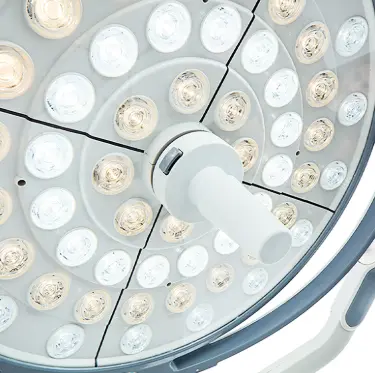
A shadowless surgical light solves this problem by using many light sources at different angles. These sources direct light toward the same working area.
Imagine a surgeon’s hand blocking light from one side. Other light sources can still reach the area from different directions. Their light helps fill the shadow and keeps the surgical field clearer.
The word “shadowless” does not mean that all shadows disappear completely. It means the light is designed to reduce shadows as much as possible.
The number and arrangement of light sources affect this result. A well-designed light head combines many beams to provide even illumination. Some systems also use two light heads to improve coverage from different angles.
This feature is especially useful during long procedures. It helps the surgical team maintain a clear view even as people and instruments move around the operating table.
3. How Lenses and Reflectors Guide the Light
Producing bright light is only part of the job. The light must also reach the correct area without creating strong dark spots or uneven brightness.
Lenses and reflectors help control the direction of the light. A lens guides and focuses light toward the surgical field. A reflector redirects light so it reaches the target from a useful angle.
Each light source covers part of the working area. The beams overlap to create a more even field of illumination. This design also helps reduce shadows caused by hands and instruments.
The shape of the light head supports this process. Many surgical lights have a round head with LED units arranged in a ring or in several sections. Each unit is positioned to direct light toward the target area.
The combined beams need to provide enough light at both the surface and deeper areas of the surgical site. This is why buyers should consider more than the number of LEDs. The lens design, beam direction, light head structure, and overall performance also matter.
A good optical design helps the team see details clearly without relying on brightness alone.
4. Key Surgical Light Specifications Explained
Hospital buyers often compare surgical lights by reading product specifications. Some figures may look difficult at first, but each one describes a practical feature.
Illuminance, measured in lux, describes how much light reaches a surface. Surgical lights often provide adjustable brightness. Many models offer a central illuminance range of about 40,000 to 160,000 lux, depending on the design and applicable requirements.
Higher brightness is not always better. The light needs to be strong enough for clear viewing but must also meet the product’s safety limits. Good lighting should avoid unnecessary glare and excessive heat.
Color temperature, measured in Kelvin (K), describes whether light looks warmer or cooler. Many surgical lights offer adjustable settings within a range such as 3,000K to 6,700K. The useful range depends on the model. Adjustable color temperature lets the team select a setting that suits the procedure and personal preference.
Color Rendering Index (CRI) shows how accurately a light source displays colors compared with a reference source. This is important because surgeons need to distinguish different tissue colors. A higher CRI generally supports more accurate color viewing. Many quality LED surgical lights offer a CRI of 90 or above, with some models reaching 95 or higher.
Buyers should also review the light field diameter and illumination depth. These figures help explain how widely the light covers the area and how well it reaches deeper parts of the surgical site.
5. Why Heat Control Matters
Heat is another important difference between LED and halogen surgical lights. Halogen bulbs release a large amount of energy as heat. This can increase the temperature around the surgical field and make the operating room less comfortable.
LED surgical lights generally produce less heat in the light beam. Their electronic parts still generate heat, so the light head needs a suitable cooling design. Heat sinks and other cooling parts help move heat away from the LEDs.
Good heat control supports stable operation and helps limit unwanted warming around the surgical area. It can also improve comfort for the surgical team during long procedures.
When comparing products, buyers should ask suppliers for clear specifications on heat output and operating conditions. They should not rely only on general claims such as “low heat.” Actual product data provides a better basis for comparison.
6. Main Types of Surgical Lights
Surgical lights come in different designs. The right type depends on the room layout, procedure, and available installation space.
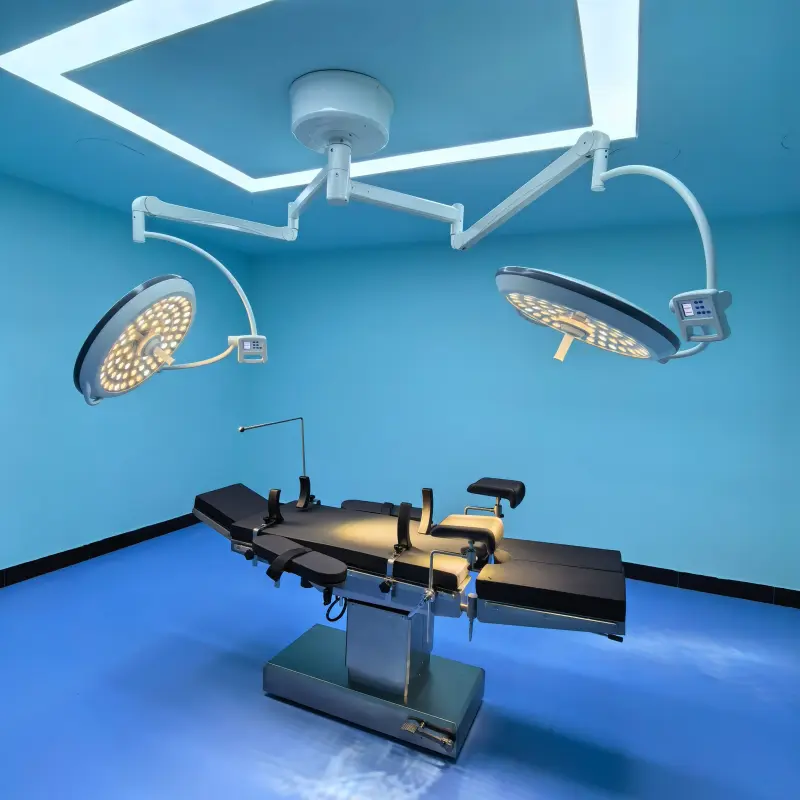
Ceiling-mounted surgical lights are common in operating rooms. Their support arms allow staff to move the light head into position. Since the system is attached to the ceiling, it keeps the floor clear and allows flexible positioning. Single-head and double-head options are available.
Mobile surgical lights use a wheeled base. They can move between rooms and may be useful in emergency areas, smaller treatment rooms, or as backup lighting. Buyers should check the base stability, wheel brakes, power supply, and ease of movement.
Examination lights are often used for routine checks and minor procedures. They may be mounted on a wall, ceiling, or mobile stand. They are designed for examination and treatment tasks rather than every type of major surgery.
Hospitals should choose a light based on its intended use. A compact examination light may suit a clinic, but a large operating room may require a ceiling-mounted system with two light heads and a wider range of adjustments.
7. Positioning and Daily Operation
Correct positioning helps a surgical light perform as intended. Staff should place the light head so that the beams cover the surgical field. The light may need adjustment as the procedure changes or as staff move around the patient.
Many models use balanced support arms. These arms help the light head move smoothly and stay in the selected position. Sterile handles allow the team to adjust the light while following the room’s infection-control procedures.
Some advanced models include a camera near the light head. This can support surgical recording, teaching, or remote consultation, depending on the system.
Before use, staff should follow the manufacturer’s instructions. They should check the light head, handles, movement, controls, and brightness settings. Regular cleaning and maintenance are also important.
Conclusion
Surgical lights work by combining light sources, lenses, reflectors, and adjustable support systems. Multiple light sources help reduce shadows, while optical parts guide the beams toward the surgical field. LED technology also offers long service life and lower heat in the light beam compared with traditional halogen lighting.
For hospital buyers, the most important step is to compare the full product specification with the needs of the operating room. Brightness, color accuracy, heat control, positioning, and maintenance support all deserve attention.
A suitable surgical light helps the surgical team maintain a clear view of the working area. Choosing a reliable surgical lights manufacturer and confirming product details before ordering can also support long-term use and easier maintenance.