Every watt you save on operating room lighting is a watt you can reinvest in better patient care, staff comfort, or your budget’s bottom line. But finding surgical lights that are energy efficient and still bright and reliable? That’s where procurement teams get stuck, sifting through vague specs and even vaguer sales pitches.
This guide cuts through that noise. We’ll cover what separates a smart upgrade from an expensive mistake — wattage, lifespan, color rendering, the whole list. Then we’ll show you trusted surgical light manufacturers and break down how LED operating room lights compare against traditional halogen in real terms: energy use, heat output, maintenance costs, and total cost of ownership.
By the end, you’ll know what to look for and where to find it.
Dräger
Lübeck, Germany is home to Drägerwerk AG & Co. KGaA, and it’s here that some of the most refined surgical lighting on the market gets engineered. Dräger treats surgical illumination as precision instrumentation.
The Polaris series includes four models: Polaris 50, 100, 200, and 600. Each model is built for a different OR need, but all share the same focus on efficiency and clinical performance.
Polaris 100: 40,000–120,000 lux, color temps at 4,400K/5,000K/5,600K, Ra 95, R9 93, and roughly 50,000 hours of LED life
Polaris 200: Same color temperature range, but pushes to 160,000 lux for deeper cavity work
Polaris 600: Adjustable from 20,000–160,000 lux, adds a 3,800K option, and edges up to R9 94
Newest Polaris platform: Selectable temperatures from 3,200K to 5,600K, intensity up to 160,000 lux, and LED lifetime exceeding 60,000 hours
That lifespan number matters. Longer-lasting LEDs mean fewer replacements, less downtime, and lower total cost of ownership, exactly what procurement teams evaluating surgical light suppliers should be tracking.
Dräger also builds in safety features you won’t find on generic hospital lighting solutions. Their Light Guard function caps skin and surgical-field irradiance at 700 W/m², reducing thermal risk during long procedures. Sterile touch control lets surgeons adjust settings without breaking sterility, and select Polaris 600 configurations support camera-upgradable light heads for integrated documentation.
If your specification sheet calls for 120,000–160,000 lux, Ra 95-97, and 50,000+ hour LED life, compare against Dräger’s Polaris line.
Grace Medy Group
Not every OR needs European price tags. Sometimes you need a surgical lights manufacturer who can build to spec, ship fast, and skip the markup that comes with a famous name.
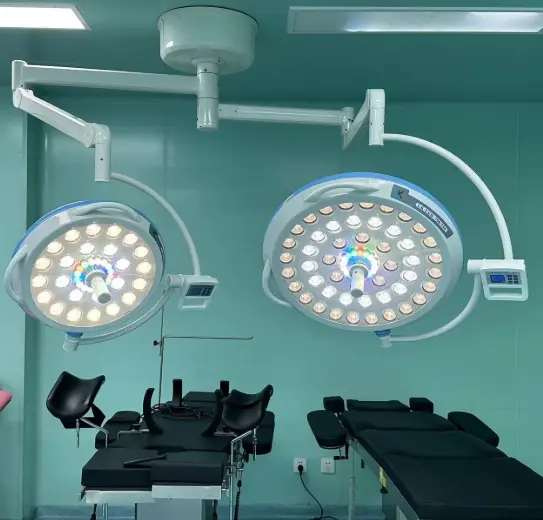
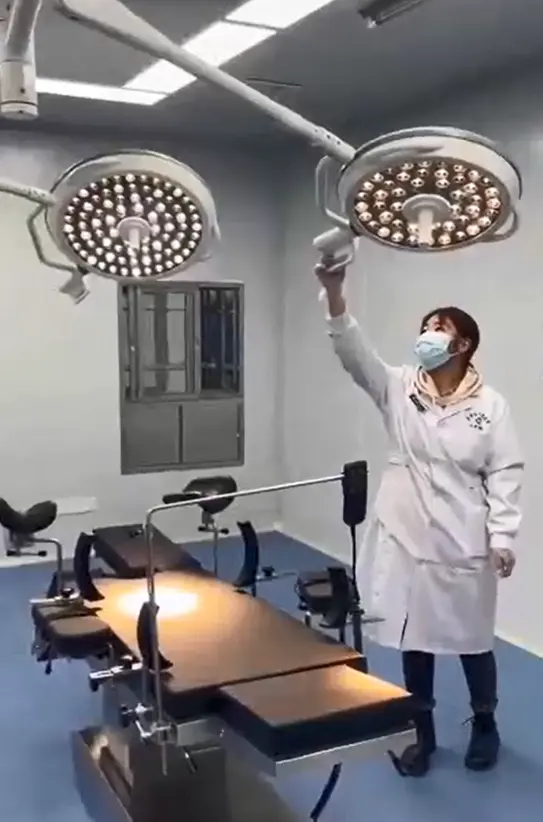
Grace Medy, based in Hengshui City, Hebei Province, builds full OR ecosystems: surgical tables, medical pendant systems, and shadowless surgical lights sold as an all-in-one package.
Their surgical-light lineup includes LED operating lights, LED shadowless surgical lights, portable/mobile units, and examination lights. Three core surgical-light entries sit inside a broader 134-product catalog. The headline spec is precision LED operating room lights rated above 200,000 lux, backed by a 5-year warranty and CE/ISO certification. ISO 13485:2016 certification also avalible. FDA references also appear across their operating-room category pages.
What sets them apart for procurement teams is OEM and bulk-order programs for distributors who need customization, 24-hour expert support for RFQ turnaround, and single-unit hospital orders that are usually workable, though custom branding or ceiling configurations require a negotiated MOQ.
No public pricing exists yet. Request quotes broken down by lighthead, suspension arm, mobile base, camera, and installation. That’s the standard structure for this supplier category.
Getinge
Getinge’s OR portfolio runs deep. Maquet surgical lights sit at the center, alongside ceiling-mounted operating room lights, mobile units, surgical tables, and fully integrated operating theatre systems. These aren’t standalone fixtures — they’re ecosystems.
Standout Models
Two models worth flagging for your spec sheet:
Maquet PowerLED II — features an electronically adjustable light patch from 13 cm to 27 cm, letting surgical teams shrink or expand the beam to match the surgical site and cut peripheral glare.
G8 Evolution — delivers 150,000 lux central illuminance in concentrated beam mode, with a d10 diameter of 20 cm (7.8 in).
On safety, Getinge caps vertical-axis illuminance at 160,000 lux and aligns with IEC 60601-2-41 Ed.3. The Maquet Ezea line adds visual indicators that flag high-irradiance risk when overlapping light fields stack up — a smart failsafe for multi-light setups.
What to Request in Your RFQ
There’s no fixed MOQ. Getinge prices by project — one full OR installation per quote — bundling lights, suspension arms, controls, integration, and commissioning into a single systems sale. Budget accordingly: this sits in premium project-pricing territory, not lighthead-only cost comparisons.
Stryker
Kalamazoo, Michigan is an unexpected hub for surgical innovation. Stryker Corporation runs its global headquarters from 2825 Airview Boulevard, and its surgical lighting lineup reflects decades of American medical device engineering.
The portfolio includes SLX628 Surgical Lights, Visum II LED Surgical Light, Visum LED Surgical Lighting System, and the Chromophare F Generation/Oculan platform. You can mount them on the ceiling, wall, or a mobile cart. Ceiling setups come in single, dual, or triple configurations, with optional monitor arms.
Beam Technology and Specs
Both the SLX628 and Chromophare F Generation use 650 overlapping beams that create a continuous light column, minimizing shadows during procedures.
The Visum II LED delivers 160,000 lux, 4400K ±200 color temperature, CRI ≥90, and an LED lifetime L70 of 50,000 hours. It pulls under 110W without a camera attachment. Field size ranges 8.5–12.9 inches, with 41 inches of depth-of-field and full 360° rotation.
Older Visum filings show intensity ranging from 50,000 to 160,000 lux in one FDA submission, and 75,000 to 135,000 lux in another. Historical Visum data also lists CRI 93, R9 around 70, and heat radiation under 33 W/m² beyond 700nm. Those are useful benchmarks if you’re comparing thermal output against other surgical lighting options.
Control choices include sterile-field touch, wall-mounted panels, and Stryker Switchpoint integration. Compliance references cite IEC 60601-1, IEC 60601-2-41, FDA Surgical Lamp Guidance, and AAMI ST37 sterility standards for handles.
Procurement Notes
Stryker sells project-by-project with no published MOQ. Pricing is premium North American hospital-grade. For your RFQ, gather room drawings, ceiling load specs, power requirements, camera needs, and preferred color temperature range. Request itemized quotes covering lightheads, booms, installation, training, and warranty terms. EU buyers should confirm current CE/MDR documentation through local Stryker representatives.
Skytron
Grand Rapids, Michigan doesn’t get much credit as a medical device town, but Skytron has been quietly building operating room ecosystems there since 1972. This privately owned company, based at 5085 Corporate Exchange Blvd. SE, sells more than surgical lights — think tables, booms, video integration, and full hybrid-room builds. But the lighting portfolio is worth a closer look.
The Aurora Four LED Surgical Light is the flagship. It hits 160,000 lux per light head, with CRI 95–96 and selectable color temps at 4100K or 4500K. Full 360° rotation on all axes, 110° vertical travel, and a 24-inch light head diameter round out the specs. Ceiling clearance runs between 8’9″ and 10’3″, so measure your OR before you fall in love with this model.
For exam rooms, the Spectra LED delivers 51,000 lux at one meter, CRI 96, and 40,000 hours of LED life. It also includes an optional sterilizable handle and a six-inch homogeneous light spot.
Skytron’s shadow-reduction approach relies on vertically segmented reflectors, producing that clean, even spot surgeons actually want during long procedures.
Procurement Notes
Skytron sells by quote, not catalog. There’s no fixed MOQ. Expect equipment-only, installed, or full-project pricing depending on scope. For an accurate RFQ, specify room type, ceiling height, target lux, color temperature preference, and whether you need camera integration.
LED Surgical Lights vs Traditional Halogen Lights: Energy Use, Lifespan, Heat, and Total Cost
Numbers don’t lie, and these numbers make the case fast. Switch from halogen to LED operating room lights and you’re looking at 50–80% less electricity use. One technical scoping study measured it precisely: about 82 watts saved per lighthead when comparing equivalent fixtures.
Power draw tells the same story. LED fixtures typically pull 20–50W. Halogen units draw 150W for similar output. Scale that up to full OR systems, and you’re comparing 150–200W LED setups against 400–500W halogen rigs. That gap compounds daily, every case, every year.
Annual savings land between $2,000 and $15,000 per operating room, depending on utilization rates and local electricity costs. Multiply that across a hospital with a dozen ORs, and energy saving medical lighting stops being a nice-to-have.
Lifespan and Heat: Where the Real Cost Difference Lives
Medical-grade LEDs run 40,000–60,000 hours, with some rated up to 80,000. Halogen bulbs? 1,000–2,500 hours, sometimes as low as 600. At typical OR usage of 2,000–2,500 hours annually, that LED fixture could last 16–30 years. Halogen bulbs need swapping every few months to a couple years.
Heat output matters too. Halogen wastes nearly 80% of its energy as heat. LED surgical lights produce minimal heat at the surgical field, easing HVAC load and keeping staff comfortable during six-hour procedures.
Conclusion
The overhead fixture is the difference between a surgeon squinting through shadows and one working with total clarity. That’s the real stakes.
We’ve covered a lot of ground. LED operating room lights slash energy costs by up to 80% compared to halogen. They run cooler, last longer, and pay for themselves faster than most procurement teams expect. Reputable surgical light manufacturers—from Dräger and Stryker to Grace Medical—each offer different strengths in customization, pricing, and support.
Request quotes and ask suppliers hard questions about lumen output, color rendering, and warranty terms. Compare total cost of ownership, not just sticker price.