
Basic Wheelchair Parts List: Names and Uses Explained
Knowing the names of wheelchair parts can make wheelchair selection much easier. It can also help with daily use and basic maintenance.
You may be buying a wheelchair for yourself, a family member, a hospital, or a care facility. You may also need to order replacement parts. In all these cases, knowing the correct part names is useful.
A wheelchair has many parts. Each part has a specific job. The frame supports the chair. The wheels provide movement. The seat and backrest support the user. Brakes and anti-tip wheels add safety.
This guide explains the main wheelchair parts names and uses in simple language. It covers both manual and power wheelchairs.
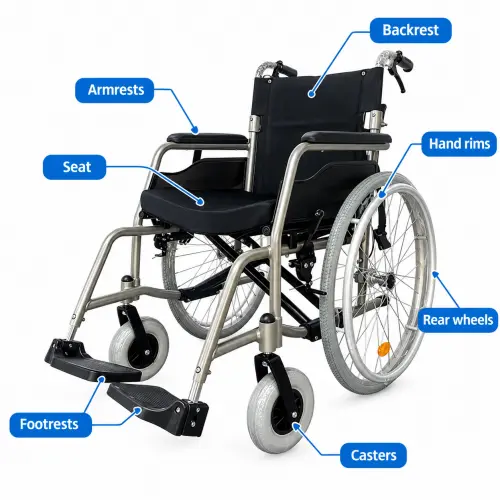
What Are the Main Wheelchair Parts?
A wheelchair can be divided into several basic areas.
The frame forms the main structure. The wheels and hand rims help with movement. The casters help with steering. The seat, backrest, armrests, and footrests support the user. Wheel locks and anti-tip wheels provide extra safety.
Here is a simple basic wheelchair parts list:
|
Wheelchair Part |
Main Use |
|---|---|
|
Frame |
Supports the whole wheelchair |
|
Rear wheels |
Provide movement |
|
Hand rims |
Help users move a manual wheelchair |
|
Front casters |
Help with steering |
|
Wheel locks |
Keep the wheelchair still |
|
Seat and cushion |
Support the body |
|
Backrest |
Supports the back |
|
Armrests |
Support the arms |
|
Footrests |
Support the feet and lower legs |
|
Anti-tip wheels |
Help reduce backward tipping |
These names are also useful for replacement parts. A clear part name helps buyers communicate with suppliers.
For example, saying “I need a new front caster” is more useful than saying “I need a new small wheel.”
You can also use this knowledge when comparing different [Internal Link: wheelchair manufacturers].
Manual Wheelchair Parts and Their Functions
A manual wheelchair moves through user or caregiver effort. The user can push the hand rims. A caregiver can also push the chair from behind.
Manual wheelchairs have a simple structure. Each part still has an important role.
1. Wheelchair Frame
The wheelchair frame is the main structure. Most other parts connect to it.
Common frame materials include steel and aluminum.
Steel frames are strong and usually more affordable. They are also heavier. Aluminum frames are lighter. They are common in many everyday wheelchairs.
Folding wheelchairs have a cross brace under the seat. It usually has an X shape. The brace allows the frame to fold.
A folding design can save storage space. It can also make transport easier.
For B2B buyers, frame material is an important point. It can affect the total weight, strength, and daily use of the wheelchair.
When comparing manual wheelchair models, check the frame along with the user’s needs.
2. Rear Wheels and Tires
The rear wheels are the large wheels on a manual wheelchair. They provide most of the movement.
Many standard adult wheelchairs use 24-inch rear wheels. Other sizes are also available.
Wheelchair tires usually have two basic designs.
-
Pneumatic tires are filled with air. They can provide a smoother ride. They need regular air pressure checks.
-
Solid tires do not need air. They are easy to maintain. The ride can feel firmer.
Some wheelchairs also have quick-release rear wheels. The user can remove the wheel with a simple release mechanism.
This feature is useful for transport and storage.
3. Hand Rims
Hand rims are the rings attached to the outside of the rear wheels.
A manual wheelchair user holds the hand rims and pushes them forward. The chair then moves in the same direction.
Hand rims can be made from different materials. Some have a smooth surface. Others have a coated surface for better grip.
Grip is important for users who have limited hand strength.
If you are researching wheelchair accessories, hand rims are worth checking. They have a direct effect on wheelchair control.
4. Front Casters and Caster Forks
The small wheels at the front are called casters.
Casters help the wheelchair turn. They rotate as the chair changes direction.
The caster fork connects the caster to the frame.
Small casters can work well on smooth indoor floors. Larger casters can be useful on outdoor surfaces.
The best caster size depends on the wheelchair design and its main use.
5. Armrests
Armrests support the user’s arms. They can also help during transfers.
Common designs include fixed, removable, and flip-back armrests.
Full-length armrests provide more arm support. Desk-length armrests are shorter. They leave more space under a table or desk.
Removable and flip-back armrests can also create more space beside the seat. This can help with transfers to a bed, toilet, or another chair.
Armrests are not only comfort parts. They can also affect how easily the user gets in and out of the wheelchair.
6. Footrests and Leg Rests
Footrests support the user’s feet. They also help keep the lower legs in position.
Swing-away footrests can move to the side. This creates more space during transfers.
Some wheelchairs have elevating leg rests. These allow the lower legs to move into a raised position.
Heel loops can also be added to the footrests. They help stop the feet from sliding backward.
For buyers looking at medical wheelchairs, footrest design is an important detail.
Seating Parts: Seat, Cushion, and Backrest
The seating system includes the seat, cushion, and backrest.
These parts affect comfort and sitting position. They also matter for people who spend many hours in a wheelchair.
The seat cushion supports the body. It can also help spread body weight across the seat.
Different cushions use different materials. Some are firm. Others are softer. The right choice depends on the user and the intended use.
The backrest supports the back. A higher backrest can provide more support. A lower backrest can leave more room for shoulder movement.
Seat width is another important point.
A seat that is too narrow can feel uncomfortable. A seat that is too wide can make it harder to reach the hand rims.
Seat depth also matters. The user’s leg position should remain comfortable.
These measurements are especially important for hospital wheelchairs.

Wheelchair Safety Components
Safety parts are often small. Their role is still important.
Common safety-related wheelchair components include wheel locks, anti-tip wheels, heel loops, calf straps, and seat belts.
Wheel Locks
Wheel locks keep a wheelchair still when it is parked.
They are useful during transfers. They can also help keep the chair stable during daily activities.
A wheel lock is not designed to control the speed of a moving wheelchair.
Users should not use the parking brake as a substitute for proper speed control on a slope.
Regular checks are also important. Look for loose parts, worn brake blocks, or a brake lever that does not work correctly.
Anti-Tip Wheels
Anti-tip wheels are small wheels placed behind the main rear wheels.
Their job is simple. They help reduce the risk of the wheelchair tipping backward.
They can be useful on slopes. They can also help if the user leans back too far.
Correct positioning is important.
If the anti-tip wheels are too high, they may not provide enough protection. If they are too low, they may touch the ground during normal movement.
Heel Loops, Calf Straps, and Seat Belts
Heel loops help keep the feet on the footplates.
Calf straps help support the lower legs. They are often placed between the two leg rests.
Some wheelchairs also include seat belts or lap belts. These can help keep the user’s pelvis in a stable position.
The belt should fit correctly. It should not be too loose or too tight.
For more information, see wheelchair safety features.
Power Wheelchair Parts
Power wheelchairs use motors and batteries. They do not rely on the user to push the rear wheels.
Their main components include the frame, motors, battery, controller, joystick, wheels, and seating system.
Motors and Drive Wheels
The drive motors provide movement.
Most power wheelchairs use two motors. Each motor controls one drive wheel.
The position of the drive wheels can vary. Some models use front-wheel drive. Others use mid-wheel or rear-wheel drive.
Each design has different handling characteristics.
The right choice depends on the main use of the wheelchair. Indoor users may have different needs from users who spend more time outdoors.
Battery
The battery supplies power to the motors and other electrical parts.
Battery capacity affects travel distance. User weight, road conditions, and weather can also affect range.
Lead-acid batteries are common on some power wheelchair models. Lithium batteries are also used.
Always follow the manufacturer’s charging instructions. Use the correct charger for the battery system.
Joystick and Controller
The joystick is the main control on many power wheelchairs.
Push it forward and the wheelchair moves forward. Move it backward and the chair moves backward. Move it left or right to change direction.
The controller receives these commands. It then sends the correct signals to the motors.
Some power wheelchairs also use the controller for lights and powered seating functions.
If you are researching electric wheelchair options, check the control system along with the motor and battery.
How Wheelchair Parts Work Together
A wheelchair works as a complete system.
The frame supports the main structure. The wheels provide movement. The casters help with steering. The seating system supports the user.
Manual wheelchairs use hand rims for self-propulsion. Power wheelchairs use motors and electronic controls.
Safety parts also work as part of the whole system. Wheel locks keep a parked chair still. Anti-tip wheels help reduce backward tipping.
Armrests and footrests also affect daily use. They can make transfers easier. They can also improve user comfort.
A change to one part can affect the way the wheelchair feels or works.
This point is important for wheelchair parts suppliers. Suppliers need to understand part compatibility. Buyers also need to provide the correct wheelchair model and specifications.
Grace Medy is also a wheelchair supplier. The company provides wheelchair products for medical equipment buyers and distributors.
What Should You Check When Buying Wheelchair Parts?
Start with the wheelchair model. Then identify the exact part you need.
Check the part size. Check the mounting method. Check the material. Most importantly, check compatibility.
The use environment also matters.
An indoor wheelchair may need different casters from a wheelchair used outdoors. A transport wheelchair may focus more on low weight and easy folding.
Power wheelchairs need extra attention. Check the battery, charger, motor, and controller.
B2B buyers have more points to consider. Product consistency is important for hospitals and distributors. Replacement parts are also important.
Ask suppliers about available spare parts. Ask about customization options. Ask about quality control and after-sales service.
You can also explore wheelchair manufacturer and supplier for more information.
Simple Wheelchair Parts Buying Guide
The main wheelchair parts are easy to remember.
The frame provides the structure.
The wheels, hand rims, casters, motors, and controller handle movement.
The seat, cushion, backrest, armrests, and footrests support the user.
The wheel locks and anti-tip wheels add safety.
Start with these basic parts. Then look at special features based on the user’s needs.
Always check the wheelchair model and measurements before ordering replacement parts.
For hospitals and distributors, product compatibility is especially important. Stable supply is also important. Good after-sales support can make future maintenance easier.
Conclusion
A wheelchair has many parts. Each one has a clear job.
The frame supports the chair. The rear wheels and hand rims provide movement on a manual wheelchair. The casters help with steering.
The seat, cushion, backrest, armrests, and footrests support the user.
Wheel locks keep the chair still. Anti-tip wheels help reduce backward tipping.
Power wheelchairs have more components. Motors provide movement. Batteries supply power. Joysticks and controllers manage the chair.
Knowing these wheelchair parts names makes product selection easier. It also helps users and buyers communicate with suppliers.
For hospitals, distributors, and other B2B buyers, the right part knowledge can also make purchasing easier.
Always check the part name, size, specifications, and compatibility before placing an order.