
Minor Surgical Light Vs Exam Light Comparison
Is there some difference between minor surgical light vs exam light? A clinic manager unboxes a brand-new lighting fixture, only to discover mid-procedure that it can’t deliver the shadow-free precision a minor surgical task demands. That costly mismatch happens often, and it comes down to whether you need an LED exam light or surgical procedure lighting.
The two look similar on a spec sheet, but their lux output, color rendering, and beam control are built for different jobs. Get the choice wrong, and you’re either overpaying for capability you don’t need or under-equipping a procedure room that deserves better.
We’ll break down where these lights diverge: brightness thresholds, shadowless performance, focal depth, and mounting practicality so you can match the right fixture to your actual clinical setting, not the marketing claims on the box.
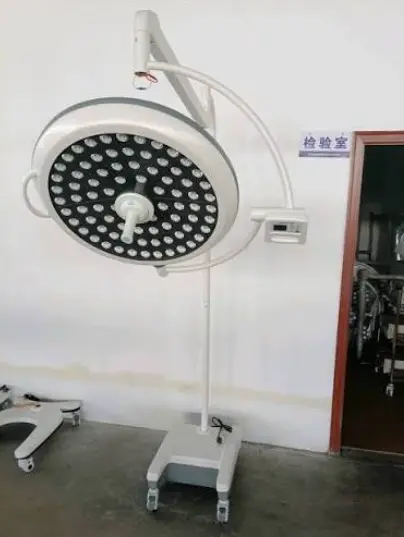
Minor Surgical Light Vs Exam Light: Core Parameter Comparison Table
Numbers don’t lie, and here’s where the gap actually shows up.
| Parameter | Minor Surgical Light | Exam Light |
|---|---|---|
| Lux output | 50,000–100,000 lux @ 1m | 30,000–70,000 lux @ 1m (typically 50,000) |
| Color temperature | 3,700–4,500K (some 5,800K) | 4,500K common; 3,700K available |
| CRI | Ra 95–97 | Ra 95–96 (industry minimum: 85) |
| Beam diameter | 13–19cm, up to 30.5cm on larger units | 13–18cm, tighter focus |
| Depth illumination | ~240cm (94.5 in) | Rarely specified; typically shallower |
| Dimming | 1%–100% continuous, or 2–3 steps | 2-step common |
| LED count | 12–36 LEDs | 12–19 LEDs |
| Lifespan | 50,000+ hours (some 60,000+) | ~50,000 hours |
| Mounting | Ceiling track, wall, mobile, pendant | Wall, mobile, exam-room arm |
The bottom line: exam lights hit 30,000–50,000 lux at 0.5m for close-range viewing. Surgical procedure lighting pushes 60,000–100,000 lux at a full meter, with deeper penetration and stronger shadow suppression—critical for suturing, debridement, and minor incisions where visibility can’t waver.
Functional Positioning Differences Between Minor Surgical Light VS Exam Lights
Strip away the spec sheets for a second. What separates these two fixtures comes down to purpose.
An LED exam light helps a clinician see during routine assessment. Think dermatology checks, wound observation, general physical exams. IEC reference standards set the baseline as low as 1,000 lux, though real-world LED exam lamps typically deliver 15,000–40,000 lux @1m. That’s plenty for seeing well.
Minor surgical light serves a different job: suturing, incisions, debridement, biopsy work. These procedures demand shadow control and color accuracy right under the clinician’s own hands, which is why output climbs into the 60,000–100,000+ lux range.
Exam light prioritizes flexible, basic visibility. Minor surgical light prioritizes high CRI, low shadow, and stable field illumination for hands-on procedures.
Lux Levels vs. Surgical Light Lux Requirements
Lux numbers only mean something when you know the standard behind them. IEC 60601-2-41 and CIBSE’s SLL Lighting Guide 2 are the references most manufacturers cite, and they draw a hard line between ordinary room lighting and true surgical light lux requirements.
Ordinary indoor task lighting sits around 500–1,000 lux. Step into an operating room, and ambient background lighting jumps to 1,000–2,000 lux, enough to keep the room usable but not enough for the surgical field itself.
The surgical field is a different category entirely. The IEC 60601-2-41 standard and CIBSE’s SLL Lighting Guide 2 cite 40,000–160,000 lux at 1m as the operating range, and treat 160,000 lux as an upper cap on the central beam. Some guidance sets a 100,000 lux minimum for major OR luminaires; others allow 40,000 lux depending on device class.
Uniformity matters as much as raw output. Clinical lighting guidance recommends keeping luminance ratios within 3:1 between the operating cavity and surrounding field, and 5:1 between the cavity and instrument table. A fixture that spikes brightness but ignores these ratios creates glare—something worth checking before you sign a purchase order.
Medical Light Color Temperature vs. Color Rendering
Ra and color temperature only tell half the story. The spec sheet number that actually matters in a surgical field is R9, and most manufacturers bury it.
Medical color temperature runs 3000K–6700K across clinical settings, but 4000K–5000K is the sweet spot for high-visibility work. IEC 60601-2-41 pins diagnostic lighting at 3000K–6500K with Ra 90–100, and surgical zones typically pair 5000K with Ra ≥90 for maximum tissue contrast.
Here’s the catch: Ra only averages eight color samples (R1–R8). It skips deep reds entirely. A fixture can score Ra 95 and still hit R9 of just 20—blood and muscle look flat and hard to distinguish, even though the “official” rating looks great.
R9 measures deep-red rendering specifically. For a surgeon identifying bleeding tissue mid-procedure, that’s not a nice-to-have. Aim for R9 > 40 as an absolute floor; quality minor surgical light units hit R9 85–97.
Purchasing Priority for Clinical Lighting
When comparing specs, weight them this way: R9 > Ra > color temperature. Color temp and Ra work fine for basic screening. R9—and TM-30 data when available—decides whether red tissue reads correctly under the light.
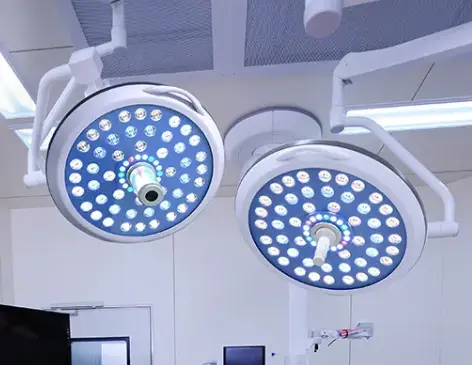
Shadowless Surgical Light vs. Regular Exam Lights: Shadow-Free Performance
Shadow-free performance is about whether brightness holds up when something blocks the light. Raw brightness alone doesn’t tell you that.
Shadowless surgical lights use multi-LED arrays in ring or dome layouts, with beams overlapping at different angles to compensate when hands, instruments, or heads block the field. Exam lights run single-head, fewer-source designs. They cut shadows fine for surface work but lose ground fast in deep cavities or multi-person procedures.
Shadowless surgical lights hit 60,000–200,000 lx at 1m and draw roughly 120W. Their color temperature runs 3,500 to 5,700K. Hybrid exam-surgical units for outpatient, dental, ENT, and gyno work reach 60,000 lx at 70cm. High-brightness exam lights claiming ≥110,000 lx with 1,700mm illumination depth and 130–160mm spot adjustment edge into near-surgical territory but still get benchmarked against surgical-grade shadow standards, not exam-light ones.
Shadowless surgical light means staying bright after obstruction. Exam light means getting the target area lit in the first place.
Illumination Depth, Spot Size, and Focal Distance Compared
The optics that decide whether your light forgives a shaky hand or punishes it rarely make it onto a spec sheet. Illumination depth scales with the square of spot size, and spot size tracks with f-number. A bigger f/# gives you a bigger spot and deeper illumination, but less precision.
Distance changes the math too. Work close to the target, and light depth shortens fast; brightness falls off within a tight zone. Pull back, and depth stretches out, with light decaying more gradually across the field.
Selection logic is simple. Want a smaller spot? Increase NA and cut f/#. Want more forgiving depth for varied procedure heights? Increase f/# and loosen focus. For minor surgical work where hand position shifts constantly, prioritize depth over the smallest possible spot.
Mounting Options, Mobility, and Exam Room Space Fit
Room dimensions decide the mount before you ever touch a spec sheet. Accessibility codes require 30 × 48 inches (about 76 × 122 cm) of clear floor beside the exam table for wheelchair transfer, plus door openings near 37.5 inches (95 cm) wide. A ceiling-mounted surgical light with a wide swing arm eats into that clearance fast if the room’s tight.
Mobile clinics face a different math. A 26 ft van-conversion unit runs 26 ft × 8 ft × 11 ft 8 in, single-room layout, and deploys in 5–10 minutes—wall or portable mounts work better here than fixed ceiling tracks. Dental/multi-service trailers (25–44 ft) allow more room for pendant-style fixtures.
Fixed procedure rooms favor ceiling or wall mounts; mobile and outreach setups need lightweight, quick-deploy fixtures that don’t fight the transfer space.
The Purchasing Decision Matrix: Minor Surgical Light Vs Exam Light
Skip the guesswork. This matrix turns spec confusion into a purchase order.
| Dimension | Minor Surgical Light | Exam Light | Buying Rule |
|---|---|---|---|
| Lux @ 1m | 50,000–90,000 (some to 110,000) | 3,000–12,000 (high-end to 45,000 @0.5m) | Any suturing/incision task → surgical light |
| CRI | 95–96 | Visual-check grade, rarely surgical-tier | Tissue color ID needed → surgical light |
| CCT | 4,300–4,500K | Fixed cool white, product-dependent | Surgical-observation match → 4,300–4,500K |
| Spot size | Adjustable, 130–250mm | Fixed or narrow | Need uniform, adjustable field → surgical light |
| Power draw | ~16W, 24VA | ~6.5–8W | Low-power, checks-only → exam light |
| Mount | Ceiling/wall/roll stand (~26.5 lbs) | Mobile, floor, flexible arm | Fixed treatment room → surgical light; roaming clinic → exam light |
Three quick rules: Checks and screening only → exam light, 3,000–12,000 lux, 8W-class, mobile. Debridement, suturing, foreign-body removal → surgical light, 50,000+ lux, CRI ≥95. Need both in one room → look at hybrid Minor Surgery and Exam Light lines at the 50,000 lux tier.
RFP-ready specs: Surgical light: 50,000–90,000 lux @1m, CRI ≥95, CCT 4,300–4,500K, LED life 50,000h. Federal minor-procedure specs cite 20,000 or 50,000 lux tiers, 12-inch working distance minimum, 4-inch spot minimum, shadow reduction required.
Common Procurement Questions About Minor Surgical Lights vs. Exam Lights
Budget questions dominate every procurement call. Here’s what actually shows up on invoices.
How much does a minor surgical light cost? Entry-level units run $999–2,200, mid-tier $1,480–2,980 FOB. The Welch Allyn Green Series 600 lists at $1,339.82–1,462.61; the 900-series jumps to $3,976.90–4,024.22. Dual-ceiling surgical setups reach $8,260.
What specs should I confirm before ordering? Target 50,000–60,000 lux, CRI ≥95, 4300–5000K, wall or portable mount, 50,000-hour LED life. The MSE wall-mount hits that range: 50,000 lux, Ra >95, 4300K, priced around $2,700.
Conclusion
An exam light and a minor surgical light aren’t interchangeable, no matter how similar they look on a shelf. The real difference comes down to lux output, shadow control, and focal precision. Exam lights are built for quick, well-lit assessments; minor surgical lights are engineered to meet surgical light lux requirements and deliver true shadowless performance during incisions or sutures. Get this wrong, and you’re either overpaying for features you don’t need or under-equipping a procedure room that demands more.
So don’t guess; match the light to the task. Pull out your procedure list, check your lux and color rendering needs against the comparison table above, and use the decision matrix to narrow your options. If you’re still weighing choices, Grace Medy‘s product specialists can walk you through the fit for your specific clinic setup.