How To Find A Professional Surgical Operation Table Factory
Certifications tell you more than any sales pitch ever will. A legitimate operation table factory holds ISO 13485 at minimum, plus CE marking for the EU market. Established exporters stack on ISO 9001, ISO 14001, and ISO 45001 too. You’ll see those listed right on their factory pages, not buried behind a “request more info” form.
Start With The Paper Trail
Before you evaluate anything else, pull three documents:
ISO 13485 certificate number: verify it with the issuing body.
CE declaration or test report: specific to the exact model you’re quoting, not a generic company-wide claim.
Business registration and factory address: a real medical device manufacturing plant will list this without hesitation.
Trading companies often skip step two entirely. They’ll show you a CE logo on a PDF but can’t produce the report tied to your specific table model.
Read The Price Band Like A Map
Pricing tells its own story. Entry-level tables sit around US$380–450, sometimes creeping toward US$1,299 depending on features. Mid-market electric and electro-hydraulic models (the sweet spot for most hospital equipment factory buyers) run US$2,060–6,580 per set. Premium electro-hydraulic fluoroscopy tables climb to US$10,086–19,999.
If a supplier’s quote lands wildly outside these bands with no explanation, that’s a flag. Real surgical table production facilities can justify their number with spec sheets: drive type, load capacity, tilt range, Trendelenburg positioning.
Case Study: How Grace Medy Demonstrates Factory Credibility
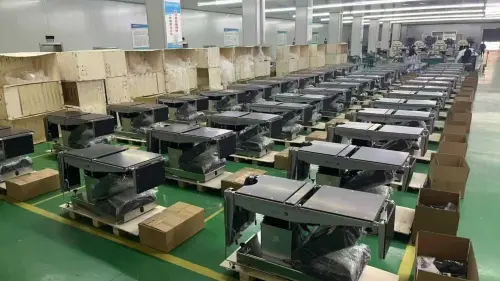
Founded in 2009, Grace Medy operates out of Zaoqiang County, Hebei Province, China, a location it doesn’t hide behind vague “China-based” language. The company runs a 32,000㎡ intelligent workshop with an in-house R&D team, so it functions as a full research-production-sales operation.
Certification Claims and How to Check Them
Grace Medy states it holds 100 technology patents and 32 international certifications, with products meeting CE, ISO 13485, and FDA standards. They cite export reach at 150+ countries on one page (other pages reference 120+ or 80+, so treat the number as approximate). Grace Medy tells buyers to request the certificate or declaration tied to the exact operating table model. Cross-check the certificate’s product name, model number, manufacturer details, and validity date against your quote. If those fields don’t match what you’re ordering, the certificate is decorative.
A Verification Framework in Their Sales Process
Grace Medy structures its purchasing inquiry into four categories: Surgical Use, Technical Needs, Accessories, and Documents. This works as a credibility test.
Surgical Use: Buyers specify department and positioning needs (lithotomy, prone, lateral). A supplier who can answer these questions well is engineering tables.
Technical Needs: Load capacity, table movement range, imaging access, battery performance – engineering specifics a middleman rarely masters.
Accessories: Headrests, traction systems, arm and leg supports. Compatibility depth shows systematic design capability.
Documents: Certification, specifications, warranty terms, installation details delivered at the model level.
Pre-Order Document Checklist for Buyer Protection
Nine document types separate you from a costly sourcing mistake. Wire a deposit before checking them and you’re gambling on trust alone. Ask for them upfront, and you create a paper trail that either confirms a real medical bed manufacturer or exposes a middleman fast.
The 9 Documents Every Buyer Should Request
Business License: Check the company name, registered address, business scope, and incorporation date. The scope should list “manufacturing” — not just “trading.”
ISO Certificates: ISO 9001 is baseline. ISO 14001 and ISO 45001 matter when environmental or workplace safety compliance applies to your market.
CE Certificate / Declaration of Conformity: The certificate number, applicable directive, and model list must match the factory information you’ve already collected.
Product Datasheet: Get the version tied to your exact model — dimensions, tolerances, materials, performance specs, packaging standards.
Test Reports: Third-party lab reports beat internal ones. Confirm the sample model, test parameters, standard number, date, and a signed conclusion page.
Warranty Terms: Check the written warranty period, RMA process, spare parts availability, and after-sales response time.
OEM Capability Statement: Does the electric operation table factory support custom molds, printing, and labeling? What is the minimum order for customization, and the sample turnaround time?
Recent Shipping Proof: Ask for bills of lading, packing lists, shipment photos or videos, and anonymized client references.
Factory Capability Package: Request production capacity figures, equipment list, QC process, key staff counts, and floor plan or workshop photos.
How To Verify Each Document
Cross-check every field against the company name, email domain, and quotation letterhead. Any mismatch, even small, deserves a follow-up question before anything else moves forward.
For ISO and CE certificates, run the certificate number through the issuing body’s database or IAF CertSearch. Match by number, not just company name; name searches can miss impostors using similar branding. If the registry shows an expired, suspended, or scope-mismatched certificate, treat that as a hard stop.
For test reports, verify the lab is genuinely independent. Check page numbering, sample photos, standard version, and issue date. Ask for the original PDF. Screenshots hide edited fields too easily.
When To Escalate To Third-Party Verification
Order size decides how far you need to go:
Under $2,000: Desktop review plus a video call covers most risk.
$2,000 to $20,000: Add document review, sample testing, and pre-shipment inspection.
Above $20,000: Commission a third-party factory audit.
Factory audits run $300 to $1,500; pre-shipment inspections average around $300, depending on region and scope. For a first-time order with a surgical equipment export company, that cost is cheap insurance against a much larger loss.
Conclusion
A real operating room table manufacturer and a middleman pretending to be one differ in three ways: a verifiable location, documented production capacity, and certifications that hold up under scrutiny. Skip any of those checks, and the surgical table you receive might be a liability with a shipping label attached.
Grace Medy’s factory profile isn’t something special. It’s the standard every serious buyer should expect. Use the pre-order checklist. Cross-reference the ISO certifications. Request a video walkthrough if the photos look too curated.
If a supplier passes every item on that list, move forward. If they avoid even one, that’s your answer — and your reason to leave.
Ready to see how a real ISO-certified surgical table factory operates end-to-end? Call Grace Medy for a factory verification and get the documentation your procurement team needs before the next PO goes out.