You’re staring at a practice test question asking you to spot the one task that doesn’t belong in a surgical room clean up, and every step you thought you knew starts blurring together. Is wiping down the anesthesia cart part of terminal cleaning, or does that fall somewhere else? This mix-up trips up even experienced surgical techs. Operating room disinfection is a layered system of between-case cleaning, terminal cleaning, and instrument decontamination, each with its own rules and its own owner. Below, we’ll break down exactly what belongs on your OR turnover cleaning checklist, expose the exam traps that catch students off guard, and clarify who’s responsible for each step, so you walk into your CST exam (or your next shift) knowing where the line is drawn.
Understanding “Not Part Of” — Quick Answer Framework
Split every answer choice into two buckets before you read the question twice. Bucket one is environmental cleaning — wiping surfaces, floors, light handles, doorknobs, carts, anything you can physically touch and disinfect with an EPA-registered hospital-grade product. Bucket two is clinical or device processing — sterilizing instruments, prepping medications, labeling specimens, positioning patients. If an answer choice belongs in bucket two, it’s your “Not Part Of” answer for a surgical room clean up question.
This isn’t guesswork. CDC and AORN guidelines draw this exact line: environmental cleaning reduces microbial load on surfaces to cut indirect transmission risk. It doesn’t touch sterilization, medication prep, or clinical care — those live in separate chapters, handled by SPD, nursing, or anesthesia teams.
Three questions turn confusion into clarity:
-
What’s the object? (Instrument = processing. Floor = cleaning. Patient = clinical.)
-
What’s the goal? (Sterile-ready = processing. Disinfected surface = cleaning.)
-
What’s the exam actually asking? (OR turnover cleaning vs. overall team workflow.)
Run every option through these filters, and the “Not Part Of” answer stops hiding.
The 3 Phases of Surgical Room Clean Up (OR Cleaning Protocol)
AORN and CDC don’t treat operating room disinfection as one big task. They split it into three distinct phases, each with its own clock, task list, and owner. Miss that structure, and you’ll misplace tasks on your terminal cleaning checklist every time.
Phase 1: Before First Case
This happens once per day, before the first scheduled procedure — often an hour before start time. Night-shift or early-shift EVS typically handles it, sometimes alongside perioperative staff, in 20–40 minutes per OR.
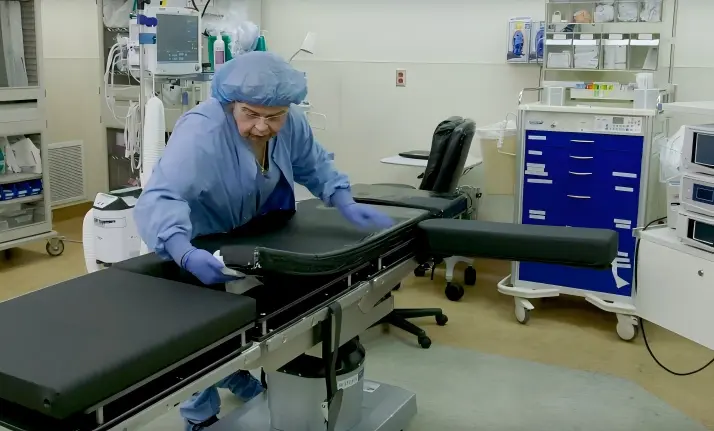
The job here is baseline cleanliness, not decontamination. Staff damp-dust every horizontal surface — Mayo stands, back tables, overhead lights, monitors — using a microfiber cloth and EPA-registered disinfectant, working high to low to avoid recontaminating cleaned areas. Floors get a three-bucket treatment: detergent-water, rinse, then disinfectant. No patient fluids exist yet, so this phase skips case-specific contamination entirely.
Phase 2: Between Cases (OR Turnover Cleaning)
This is the phase most exam questions target. AORN requires cleaning after every single procedure, and most ORs benchmark turnover time at 10–20 minutes.
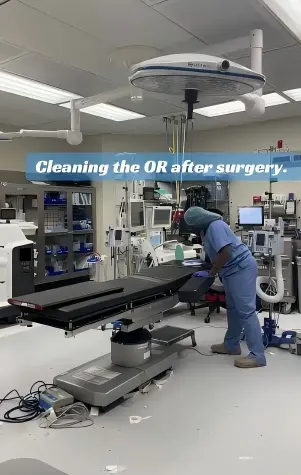
The surgical team removes instruments, linens, and drapes; EVS handles trash, suction canisters, and sharps containers near ¾ full. Together, they disinfect high-touch surfaces — table rails, anesthesia machine exteriors, IV poles, door handles — moving high to low, clean to dirty. Floor disinfection stays targeted: roughly a 1–2 meter radius around the patient zone, not the whole room. If the prior patient had C. diff or another MDRO, staff switch to sporicidal disinfectant and widen the scope to include walls within 3 feet of the patient area.
Phase 3: Terminal Cleaning
Once daily, after the last case, EVS-led teams perform the most exhaustive phase — 30–60 minutes per OR. Furniture moves to the center of the room. Walls, ceiling fixtures, and vents get high-dusted. The entire floor, including areas under and behind equipment, gets the full three-step treatment. Waste containers are emptied and cleaned inside and out.
|
Phase |
Frequency |
Duration |
Floor Scope |
Lead |
|---|---|---|---|---|
|
Before First Case |
Daily, once |
20–40 min |
General mop |
EVS + periop |
|
Between Cases |
Every procedure |
10–20 min |
Patient-zone only |
Periop + EVS |
|
Terminal Cleaning |
Daily, once |
30–60 min |
Entire room |
EVS-led |
What IS Part of Surgical Room Cleanup — Complete Checklist
A legitimate surgical room cleanup checklist has six zones. Steps outside these zones are exam traps.
OR Table and Mattress
Collect every linen item—sheets, pads, pillowcases—without shaking, straight into a designated linen bag. Wipe visible blood or body fluid with a disposable cloth first, then disinfect the entire surface, including side rails and attachments, with an EPA-registered intermediate-level product. Contaminated spots need at least one full minute of wet contact time. Wipe head-to-foot, clean-to-dirty, never the reverse.
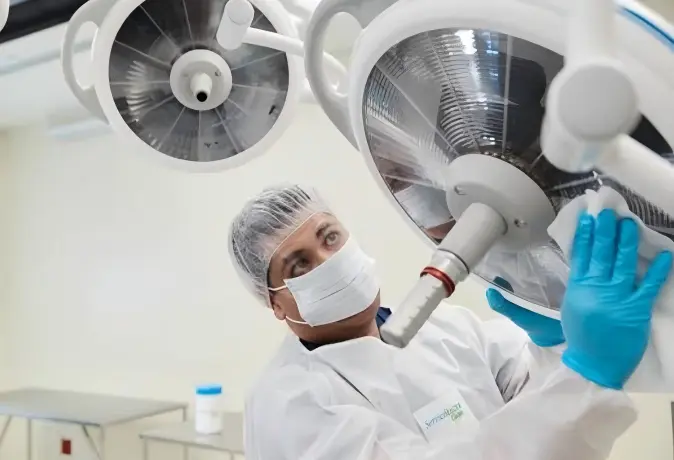
Start at the highest, farthest point and work inward. Clean the light arms first, then the head, then the outer lens. Rotate the fixture so you catch every side. Pay extra attention to handles and adjustment knobs because they’re touched constantly between cases.
Anesthesia Cart and Machine
Wipe the panel, drawer handles, control knobs, oxygen switches, and monitor housing with intermediate-level disinfectant. Never use a harsh high-level agent near electronics. Apply the same clean-to-dirty approach: start with the display frame and dry countertop, then move to areas near breathing circuit connections, where contamination risk is highest. Discard disposable circuit parts and filters per anesthesia protocol as part of waste handling; do not save them for reuse.
Mayo Stand and Instrument Tables
Instruments go into steel trays for central sterile processing. Nothing gets reprocessed inside the OR itself. Sharps containers at ¾ capacity get swapped immediately. Wipe surfaces center-to-edge, top-to-bottom, including the base and wheels.
Floors
Spot-clean visible fluid first, then run the full sequence: detergent-water mop, clean-water rinse, then disinfectant (commonly 1% sodium hypochlorite). Work from the far corner toward the exit. Never backtrack over a cleaned area. During terminal cleaning, equipment moves so the floor underneath gets the same treatment.
High-Touch Points
Door handles, light switches, control panels, keyboards, and wall-mounted oxygen or suction panels get wiped after every single case, not just at terminal cleaning.
Waste and Linen — Often Overlooked, Always Required
|
Item |
Requirement |
|---|---|
|
Sharps containers |
Replace at ¾ full |
|
Waste bags |
Fill to ⅔–¾ capacity, double-knot |
|
Suction canister fluid |
Solidify per policy before disposal |
|
Contaminated linen |
Bag without shaking; launder at ≥71°C for ≥25 minutes |
What Is NOT Part of Surgical Room Cleanup — Common Exam Traps
Four categories consistently show up as wrong answers dressed up as right ones. Know them, and you’ll spot the trap before you even finish reading the question.
Instrument Reprocessing Belongs to CSSD, Not the OR
Anything involving semi-critical or critical instruments — scrubbing, ultrasonic cleaning, packaging, loading a sterilizer, checking sterilization indicators — happens in Central Sterile Processing (CSSD/SPD), not the operating room. Recovery water temps run 40–60°C to remove organic material without cooking protein onto the metal. Steam sterilization for critical instruments hits 121°C for 15–30 minutes or 134°C for 3–10 minutes, depending on the unit’s cycle. Heat-sensitive items get ethylene oxide or low-temperature hydrogen peroxide plasma instead. If an exam option mentions “cleaning and sterilizing instruments” as part of terminal cleaning, that’s your wrong answer — it’s a CSSD task, full stop.
Patient Care Tasks Aren’t Cleaning Tasks
Positioning the patient, prepping surgical skin with chlorhexidine or iodine, performing surgical hand antisepsis, and administering anesthesia drugs — none of that is environmental cleaning, even though it happens in the same room, often minutes apart. The confusion is understandable: surgical hand scrub and room prep often overlap on the clock. But skin antiseptics aren’t surface disinfectants, and checking a pressure point after positioning isn’t the same as wiping down a bed rail. When a question pairs “clean anesthesia machine exterior” with “administer induction medication,” only the first belongs on your infection control operating room checklist.
Administrative and Engineering Work Stays Out of the Room
Restocking sutures, gloves, or anesthesia supplies is inventory management — it’s not cleaning. HVAC maintenance, filter replacement, and internal servicing of electrosurgical units belong to facilities engineering, running on their own maintenance schedule, not tied to every case or terminal clean. The only overlap: wiping the exterior of an air intake grille counts as terminal cleaning; swapping the filter inside it doesn’t.
Misusing High-Level Disinfectants on Surfaces
This one’s a classic scenario question. A nurse wipes the OR floor and walls with glutaraldehyde during terminal cleaning, calling it “extra protection.” Wrong. High-level disinfectants are reserved for semi-critical instruments like endoscopes — never for bed rails, tabletops, or floors. Environmental surfaces need EPA-registered intermediate-level (tuberculocidal) or low-level disinfectants instead. Using glutaraldehyde on a wall adds toxicity risk and cost with zero infection-control benefit.
Cleaning vs Sterilization vs Patient Care — Side-by-Side Comparison Table
Five categories keep showing up on exams, and they blur together fast if you don’t pin down the technical differences. Here’s the breakdown that separates them.
|
Category |
Counts as “Cleaning”? |
What It Actually Involves |
Who Owns It |
|---|---|---|---|
|
Environmental cleaning |
Yes. Removes visible soil, dust, blood, and secretions; reduces microbial load ≥1 log CFU |
Bedside tables, rails, floors, counters |
EVS, with OR staff on critical zones |
|
Instrument processing |
Yes, but only as a pre-step. Items must be clean before HLD or sterilization |
Enzymatic wash before scoping instruments through high-level disinfection |
CSSD primarily; OR staff handle initial decon and handoff |
|
Patient care |
Partially. Skin prep and bed changes are cleaning-adjacent; antisepsis is not cleaning |
Preop skin prep, oral care, linen changes |
Nursing / OR staff |
|
Administrative work |
No, unless it’s decontaminating a physically soiled document |
Scheduling, records, supply logs |
Admin / infection control management |
|
Engineering/facilities |
Usually no. Covers HVAC, negative pressure, and water systems |
Filter servicing, equipment repair |
Facilities engineering, coordinating with EVS when contamination’s involved |
Sterilization targets total microbial kill, including spores, at a ≥10⁶ log CFU reduction. High-level disinfection kills everything except some spores. Think 0.55% OPA for 12 minutes, 2% glutaraldehyde for 20–90 minutes, or 400–450 ppm chlorine for 10 minutes. Low-level disinfection handles noncritical items like BP cuffs, with a minimum 1-minute contact time. Cleaning itself never claims a specific microbial kill rate; it’s mechanical removal, not disinfection.
Who Is Responsible for Each Cleaning Task (Role Breakdown)
Three roles share the OR floor, and each one owns a different slice of the surgical room clean up. Blur those lines on an exam, and you’ll pick the wrong answer every time.
Surgical Technologist stays inside the sterile field. Before the case, they wipe down the instrument table and drape it sterile, no floor work, no wall work. During the case, they clear blood and fluid from the surgical site with sterile gauze and drop used sharps straight into the sharps container. After the case, they route every reusable instrument back to CSSD by tray and hand off the table to EVS for final wipe-down. The boundary is the sterile field only.
Circulating Nurse coordinates without executing full cleans. Pre-case, they check the floor for hazards, confirm bins are empty, and quickly wipe high-touch points like door handles if turnover is tight. Mid-case, if fluid hits the floor, they flag EVS immediately, or place an absorbent pad if EVS can’t respond in the typical 5-minute window. Post-case, they verify sharps containers stay under 75% full, sign off on the turnover checklist, and pre-wipe visible blood off the anesthesia machine before EVS’s final pass.
EVS (Environmental Services) owns floors, walls, restrooms, and waste, full stop. Turnover cleaning targets 12–20 minutes per OR, with 100% bin and linen replacement. Terminal cleaning follows a strict clean-to-dirty mop sequence, keeping cross-contamination under 20% of the previously mopped zone. High-touch point compliance gets benchmarked at 90–95% via ATP testing, and turnover delays should stay below 10%.
For heavy-contamination cases, trauma, MDRO patients, a senior EVS specialist handles extended cleaning, sometimes running 25–30 minutes longer with UV or peroxide fogging added.
Conclusion
The distinction is simple: cleaning tasks belong to the OR team. Sterilization and patient-care duties belong somewhere else. Get that boundary straight, and the exam traps stop being traps.
The three-phase protocol—between-case, terminal, and turnover cleaning—is the infection control backbone that keeps surgical suites safe every single day. Master the checklist and know your role, and you’re not just passing a CST exam question. You’re protecting patients from preventable HAIs.
Print the checklist. Walk through it during your next OR shift and see where your facility’s protocol lines up (or doesn’t). If you’re building training materials or auditing sanitation SOPs, bookmark this guide. Your certification exam and your patients will both thank you for the diligence.