
Every second under the operating lights matters—and outdated halogen fixtures can quietly work against surgical precision. Dim hot spots, yellow-tinted illumination, and heat radiating too close to the surgical field aren’t just inconveniences; they’re variables that affect visibility, team comfort, and even patient safety during long procedures. That’s why hospitals worldwide are shifting toward LED surgical lighting.
This guide breaks down the real, measurable advantages driving that shift—from color rendering index performance that reveals true tissue color, to dramatic reductions in surgical light heat emission and energy consumption. We’ll also look at how shadowless surgical lamp designs, focusable beam control, and sterile-friendly builds are reshaping modern operating rooms. Whether you’re evaluating a full OR retrofit or comparing ceiling mounted versus mobile LED surgical light options, understanding these core benefits will help you make a confident, evidence-based decision.
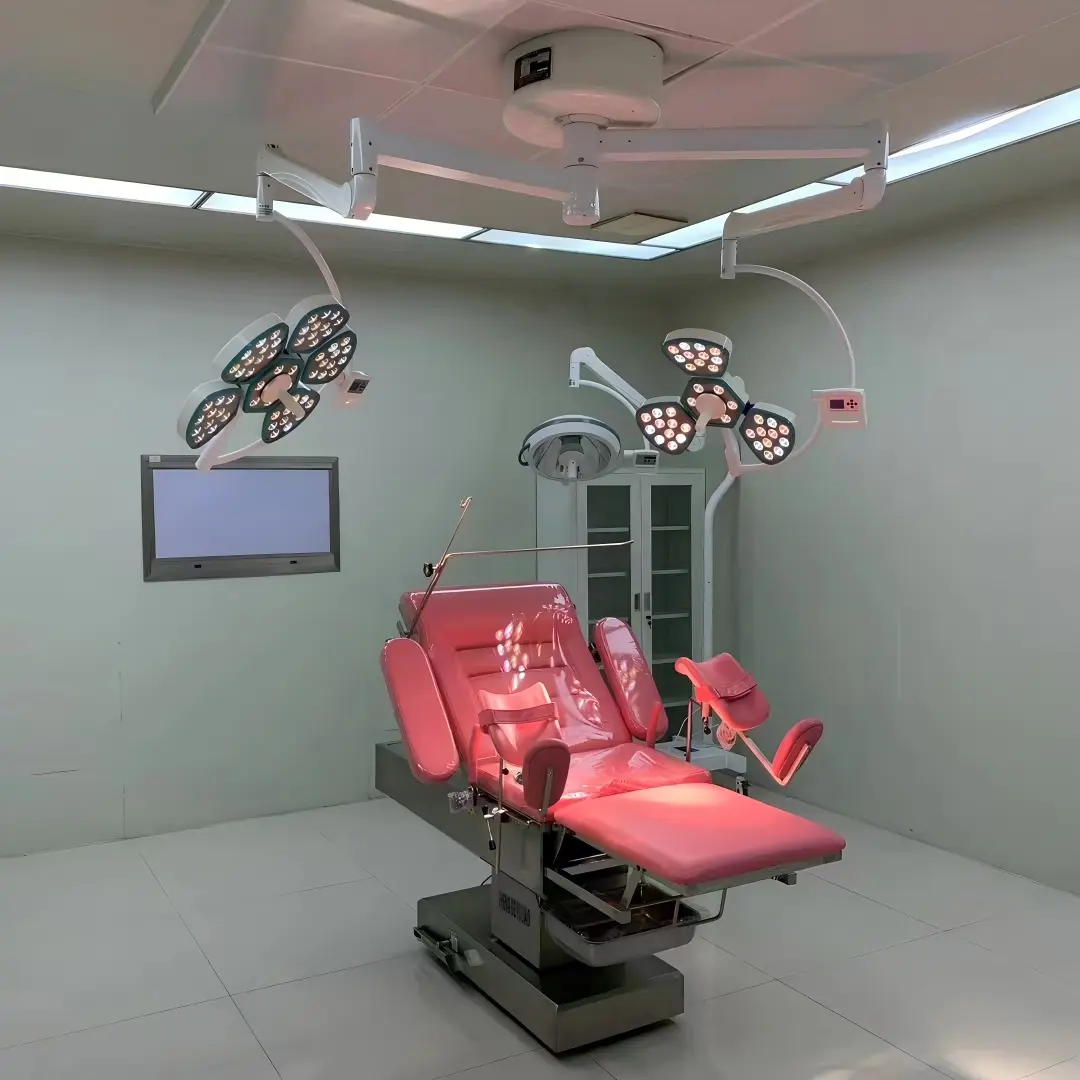
Shadowless Design Through Multi-Source Arrays
Instead of one bulb, modern LED heads pack 40 to 50+ individual LEDs per dome, each angled to overlap at the surgical site. When a surgeon’s hands or head block one beam, dozens of others fill the gap, keeping illuminance above 60% of central EC even during obstruction. The IEC standard formalizes this with a D50/D10 ratio requirement (D50 ≥ 50% of D10), mandating a wide, even light field rather than a single hot spot surrounded by shadow.
Color Accuracy Where It Counts
Surgical light color temperature ranges from 3,000 to 6,700K, with adjustable systems letting teams dial in daylight-balanced tones. Paired with a color rendering index surgical light rating above 90, surgeons can distinguish subtle tissue variations (ischemia, perfusion changes, nerve versus ligament) that lower-CRI halogen units wash out as bulbs age and yellow over time.
Color Temperature & Color Rendering Index (CRI) for Accurate Tissue Visualization
Red doesn’t lie under the right light—but push color temperature too cool, and it starts to fade fast. That’s the problem with 5,000 to 6,500K settings: they wash out red tones exactly when surgeons need them most. Drop into the 4,000 to 4,500K range instead, and tissue color snaps back into focus. Clinical sourcing guides consistently flag this narrower band as the sweet spot for general surgical tasks, where you can’t wait for a second look to tell healthy tissue from compromised.
Why R9 Matters More Than Standard CRI
Standard CRI scores average color accuracy across a spectrum, but they often skip deep red—the exact tone that signals blood, vascularity, and hemoglobin-rich tissue. That’s where R9 comes in. Procurement teams increasingly demand R9 above 80, with premium systems pushing past 90. A surgical light with CRI 95+ but weak R9 can still misrepresent bleeding or ischemic tissue. Pairing high CRI with strong R9 gives you the full picture.
Specialty-Driven Preferences
-
Plastic surgery: Prioritizes adjustable color temperature near 4,000–4,500K to preserve skin tone and subcutaneous blood supply visibility—critical for flap and fat layer assessment.
-
Vascular surgery: Leans on CRI 95+ and elevated R9 to judge blood flow, vessel wall contrast, and fill state accurately.
Adjustable color temperature isn’t a comfort feature anymore. It’s a procurement checklist item, letting surgical teams tune illumination to procedure type and personal preference without sacrificing color fidelity.
Reduced Heat & Better Thermal Management
Halogen bulbs burn hot because most of their input power becomes infrared radiation, not visible light. LEDs do the opposite. They emit far less infrared and essentially zero UV, so the surgical field gets dramatically lower irradiance and thermal load. This means less tissue drying, less unintended heating during long procedures, and a cooler environment overall.
Where the Heat Goes
LED thermal management uses engineered heat paths: conduction moves heat away from the source, and convection or liquid cooling carries it to ambient air. Advanced systems put cooling closer to the LED array itself, sometimes using liquid cooling for higher heat-flux designs. Evaporative membrane cooling systems have removed over 800 W/cm² in testing, showing how much heat you can move with the right design.
Why This Matters Clinically
Lower radiant heat exposure supports perioperative normothermia, with a clinical target of core temperature ≥36.0°C. Less extra thermal burden from overhead lighting makes that target easier to hold during extended cases. It also reduces reliance on aggressive HVAC compensation because when equipment emits less heat, operating room systems can maintain stable temperatures with less overcooling and lower energy draw. This makes energy-efficient OR lighting upgrades more attractive.
Energy Efficiency & Long-Term Cost Savings
A halogen bulb burns around 50W. Its LED replacement runs closer to 20W. That’s roughly 60% less power draw per fixture, and it’s the baseline number hospitals build their energy-efficient OR lighting business case around. Broader industry figures push the savings even higher—LED lighting cuts energy costs by 50% to 80% depending on usage patterns and facility age.
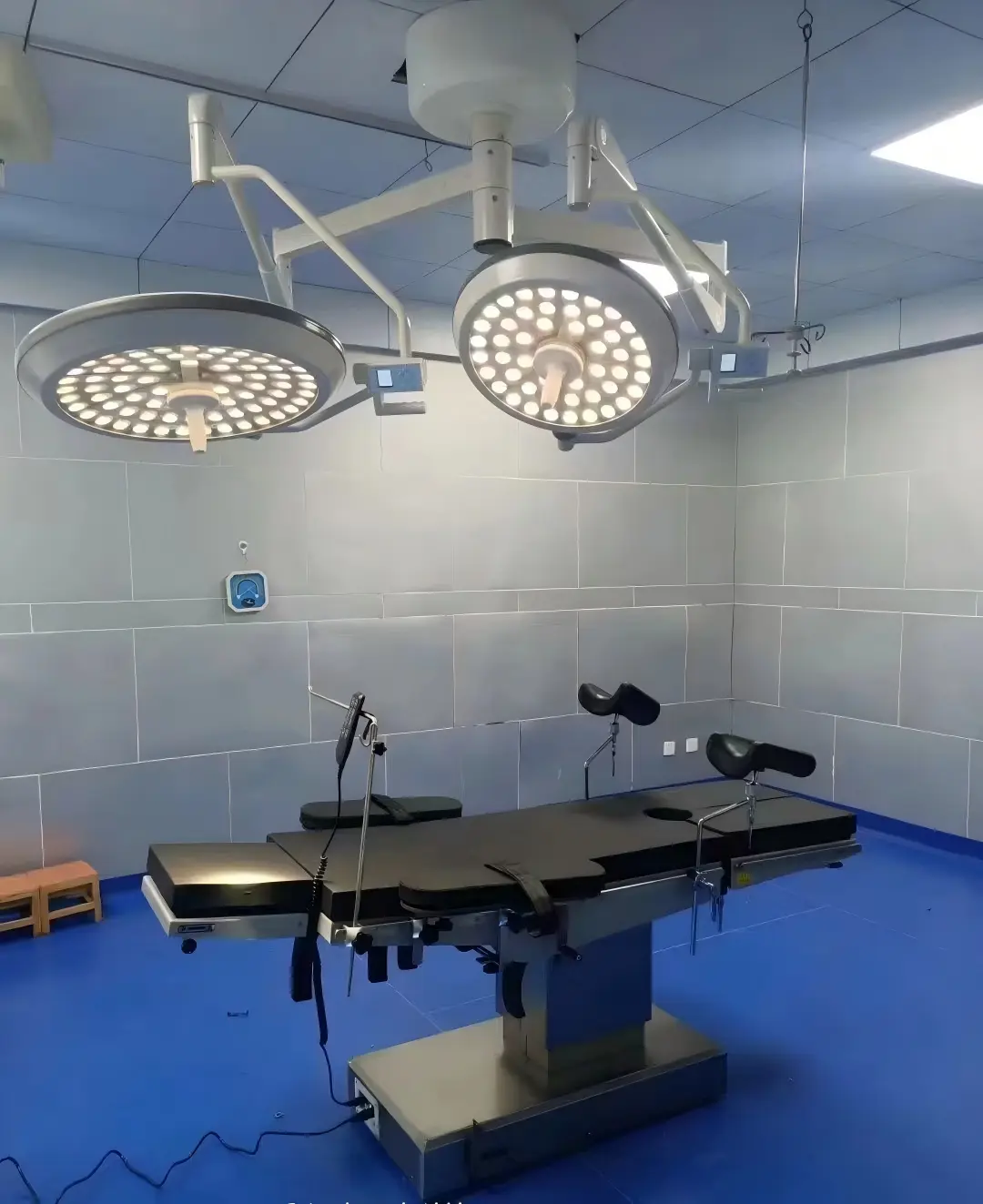
Lifespan Changes the Maintenance Math
Halogen bulbs last about 500 hours. LED surgical lights routinely hit 50,000 hours, with some manufacturer specs reaching 60,000. That’s a roughly 100x improvement. Fewer bulb swaps mean fewer maintenance calls, less OR downtime, and lower parts spend over a decade of use.
Cooling Costs Drop Too
LED fixtures run about 40°C cooler than halogen units and produce no radiant heat. For a room running HVAC around the clock, that lower thermal load takes pressure off cooling systems—less compensation, less electricity spent fighting heat that shouldn’t be there in the first place.
The Bigger Picture
Add it up: lower wattage, longer lifespan, reduced cooling demand. A five-year total cost of ownership comparison in high-volume clinical settings shows LED systems coming out ahead every time. There’s also a compliance angle—LEDs skip the mercury and heavy metals found in halogen bulbs, which matters for hospitals tightening green procurement standards. High-frequency, all-day surgical suites see the fastest payback. Lower-volume rooms still save, just over a longer horizon.
Extended Lifespan and Lower Maintenance
Bulb failure in an OR shouldn’t be a surprise. Yet halogen fixtures fail because filaments fatigue unpredictably, so a bulb rated for 2,000 hours might blow at 500 or limp to 2,500. LEDs behave differently. They follow L70 depreciation curves, fading gradually rather than snapping out mid-procedure. Most units lose only 5–15% of lumen output through their first 10,000–20,000 hours, giving facilities managers a predictable replacement window instead of a guessing game.
Fewer Swaps, Lower Labor Spend
Over 30,000 hours, halogen needs roughly 15 bulb changes; LED needs one or two. That’s a 10–30x drop in replacement frequency. Factor in labor, each swap averaging $10 in technician time, and halogen racks up $150 in maintenance labor versus $20 for LED, an 87% reduction. Specify L70 ≥50,000 hours, backed by LM-80/ISTMT test data, so the rated lifespan holds up in daily surgical use.
Shadow Control, Beam Quality & Flicker-Free Dimming
A shadow is a control failure. Modern shadowless surgical lamps solve this by splitting the LED array into 8 to 16 sectors, each on its own PWM channel. Built-in sensors, 4 to 8 per head, sample the surgical field over 10 times per second. When any point drops below 90% of target illuminance for more than 100ms, the system boosts that sector’s output by 5 to 20% within 200 milliseconds. That’s fast enough that surgeons never notice the correction. Some microsurgical setups push further by running dual opposing heads on separate axes, so crossbeam coverage fills whatever gap one angle misses. This holds illuminance fluctuation inside ±10%.
Beam Geometry
Beam angle (FWHM) runs 8 to 20° for microsurgery and 20 to 40° for general work, always with a soft-edge transition beyond 5° to avoid the harsh bright-center, dark-ring effect cheaper fixtures produce. Field uniformity across a 20cm surgical zone should hold at least 60 to 70% of peak intensity at its dimmest point. Premium focusable surgical light heads reach above 80%.
Infection Control & Sterile-Friendly Design
Bacteria don’t need much room to hide. A 0.5mm seam gap is enough. That’s why premium surgical light housings now hold panel gaps under 0.5–1.0mm, sealed with continuous, gap-free adhesive that blocks moisture and debris from settling into joints.
Surface and Seal Engineering
Housing surfaces target Ra ≤0.8μm—matching surgical-steel hygiene standards—to resist biofilm attachment. Edges use rounded corners (R≥3–5mm) instead of sharp angles or grooves, so there are no “can’t-scrub-there” zones that trap contamination. LED modules carry IP54–IP65 ratings, which keeps blood, fluid, and cleaning agents out of internal cavities. O-ring and foam gaskets seal the power compartment and handle connections. Detachable handle sleeves withstand 121–134°C autoclave cycles and are rated for 100 or more sterilization runs without cracking.
Why Lower Heat Matters for Sterility
Cooler operation is a contamination control factor, not just a comfort one. LED heads run at 40°C or lower surface temperature, compared to 45–60°C on older halogen units. That gap matters because high-heat, high-humidity cycling breeds condensation, and condensation on housing surfaces creates a microenvironment bacteria exploit. Sustained thermal cycling also fractures plastics and coatings over time, producing microcracks that resist standard wipe-down disinfection.
Ergonomic Benefits & Enhanced Surgical Team Performance
Surgeons feel bad lighting before they consciously notice it. Squinting, shoulder tension, a dull headache by hour three—these are the body’s response to glare, heat, and awkward viewing angles stacking up under the drapes. LED surgical lighting attacks that fatigue at the source, and the data behind it is specific enough to build a procurement case around.
Glare, Heat & Visual Fatigue
A Unified Glare Rating below 19 is the benchmark for comfortable visual environments. Endoscopic screen brightness should stay within a 3:1 contrast ratio against ambient light to limit eye strain. Traditional halogen setups routinely blow past both thresholds. Switching to LED cuts radiant heat by 60–80% at equivalent illuminance, removing the sweating, facial discomfort, and attention drift that come with sitting under a heat lamp for four hours straight.
Screen position matters too. Keeping laparoscopic monitors positioned for roughly 20° of neck flexion, rather than forcing surgeons to crane upward, combined with glare-free LED output, drops self-reported visual fatigue scores by 20–30% across multi-site workstation ergonomics studies, with no measurable increase in operative time.
Microbreaks Compound the Benefit
Pairing comfortable lighting with structured microbreaks of 1.5 minutes of stretching every 20–40 minutes gives real results: 57% of surgeons reported improved physical performance, 38% reported sharper mental focus, and total OR time stayed flat. Ergonomics training programs push this further. After targeted coaching on table height, screen placement, and lighting setup, 88% of surgeons changed their habits, and 74% reported reduced physical strain. These outcomes translate into fewer sick days and less material waste over time.
Compact Light Heads, Better Workflow
The fixture’s footprint is as important as the beam. Low-profile LED heads shrink footprint and shadow-casting area by 20–40%, freeing space for endoscopy, anesthesia, and navigation displays overhead. Maintaining at least 30 cm of vertical clearance above the field, plus 60–90 cm walkways and 10–15 cm arm-to-arm spacing, cuts collision and repositioning events. 3D layout simulations show 10–20% workflow gains from compact-head designs alone.
When scrub nurses have unobstructed sightlines to the surgeon, instrument handoffs speed up and rely more on eye contact than verbal cues. Combined with system-wide ergonomic improvements, hospitals report roughly 21% fewer lost workdays from strain-related injury.
Industry Standards & Compliance for LED Surgical Lighting
Regulatory paperwork rarely excites anyone—until a failed inspection halts a purchase order. For LED surgical lighting, the compliance stack starts with IEC 60601-1 for general medical electrical safety, then narrows to IEC 60601-2-41, the standard for illuminance, color temperature stability, and shadowless surgical lamp field uniformity. China’s market layers on YY 9706.241-2020 and YY 0627-2008, both enforced alongside GB 9706.1-2020 during registration review.
The Numbers Procurement Teams Check
Illuminance: ≥140,000–160,000 lux for main lights, ≥115,000 lux for secondary
Color temperature: 4000K–5000K standard, extending to 3000K–6700K in flexible specs
CRI (Ra): ≥85, often ≥90 in premium units
Beam uniformity: center-to-edge variance under 20%
LED lifespan: ≥50,000 hours
Irradiance ratio: capped at ≤6 mW/(m²·lx)
EMC and Photobiological Safety
YY 0505-2012 and GB/T 17743-2017 cover electromagnetic compatibility. Photobiological hazard evaluation runs through IEC/EN 62471, which replaced the older IEC 60825 pathway for LED sources after 2009. EN IEC 60601-2-41:2021 typically imposes stricter glare and light-safety limits than its Chinese counterpart—useful backing for export documentation.
What Wins Tenders
The strongest procurement language specifies compliance with IEC 60601-1, IEC 60601-2-41, EMC and photobiological safety testing, and FDA/CE documentation. Grace Medy’s LED surgical light series is built to this exact compliance profile: 160,000 lux, 4000–5000K, Ra≥90, 50,000-hour rated, with full CE/FDA documentation ready for review.
Conclusion
Every hour an operating room runs on outdated halogen fixtures wastes energy, generates excess heat, and compromises visual precision. LED surgical lighting changes that. A high color rendering index surgical light delivers true-to-life tissue differentiation, a modern shadowless surgical lamp cuts heat output by up to 80%, and bulb lifespans stretch past 50,000 hours. That means lower energy bills, fewer maintenance calls, and safer sterile fields.
For hospital administrators and procurement teams, this upgrade delivers better outcomes, leaner budgets, and compliant infrastructure.
If your facility is still weighing the switch, compare the specs yourself. Explore Grace Medy‘s LED surgical lighting lineup, request technical documentation, or connect with our team for a tailored OR lighting assessment.