Top LED Surgical Light Brands for Hospital Operating Rooms in 2026
Eight brands dominate the conversation around shadowless surgical lights right now, and each one plays a different game.
STERIS sits at the top of the pack with its HarmonyAIR, Harmony, and XLED series. These systems push illumination intensity as high as 160,000 lux and hold color temperature steady at 4400K±300K (adjustable versions offer 3500K/3900K/4400K/5100K). They deliver a CRI up to 96, with R9 up to 98, and LED lifespan runs 50,000–60,000 hours. Add 4K/HD surgical field camera integration, and you’ve got a system built for complex specialty procedures in large hospitals.
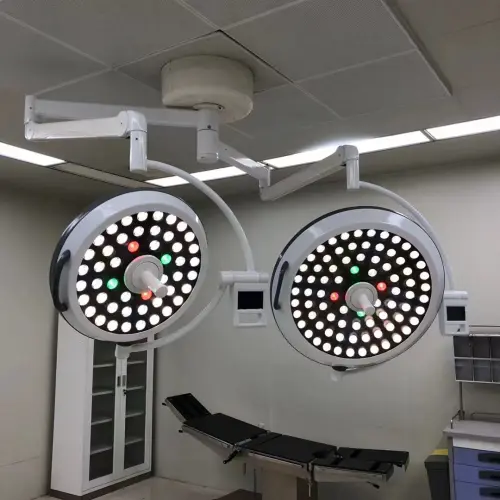
Getinge takes a similar high-end approach. The Maquet Volista series advertises center illumination between 10,000–160,000 lux and is marketed around shadow-free, true-color output. It’s a favorite for hospitals that integrate lighting into their full OR workflow systems.
Below that tier, budget-conscious buyers have more interesting options:
|
Brand |
Best For |
Core Strength |
|---|---|---|
|
Sunoptic |
Mobile surgical units, ASCs |
Lightweight, flexible mounting |
|
Inspital |
Government/regional hospitals |
CE-certified, modular heads, economical |
|
Sanyang Medical |
Secondary hospitals, OEM projects |
High output, fast delivery, low cost |
|
Etkin Elite Series |
Specialty ORs |
High CRI, stable color temp, modular arms |
|
Medical Illumination |
North American ASCs |
Reliable channel support, stable field light |
|
Synergy Medco |
Tender projects, distributors |
Customizable, project-packaged pricing |
Across the industry, illumination intensity runs from 50,000–160,000 lux and color temperature spans 3500K–5000K. Premium CRI configurations hit 96+. CE certification dominates export markets; ISO 13485 matters most for tender-driven procurement.
Grace Medy built its lineup to sit right in this competitive zone—matching STERIS-level specs on illumination and color rendering while beating the OT light price point that mobile units and secondary hospitals actually need. That combination covers large hospitals, specialty suites, and mobile surgical setups without forcing a compromise on any of them.
Key Technical Specifications: What Makes a Surgical Light “Best-in-Class”
Specs on a data sheet don’t mean much until you know which numbers actually move the needle in the OR.
Surgical light illumination intensity ranges from 40,000 to 160,000 lux across the market, but the number you need depends on the procedure. Standard surgeries (general, ortho, gynecology) typically run at 50,000, 65,000, or 90,000 lux settings. Deep-cavity, multi-team, or complex procedures push toward the 140,000–160,000 lux ceiling that’s become the industry benchmark for “best-in-class” output.
Color temperature matters more for tissue accuracy than most buyers realize. Look for an adjustable range of 3,500K–5,000K (some units extend to 5,100K). Warmer settings help identify tissue types; cooler settings sharpen contrast during microscopic work.
CRI and R9 are the specs that determine what surgeons see. Top-tier lights hit CRI Ra 95+ and R9 95+. That R9 number is easy to overlook, but it’s the one governing how accurately blood, inflamed tissue, and microvasculature render under light. Getinge calls R9 ≥80 “excellent”—industry guidance says surgical lighting needs at least R9 95.
Spot diameter and depth of illumination determine usability in deep or narrow fields. Best-in-class units maintain D50/D10 ratios near 70% for field uniformity, with adjustable spot diameters from 140–320mm and depth-of-illumination performance exceeding 90cm at 20% intensity.
Shadow dilution —multi-source overlap that compensates for blocked light—separates good lights from great ones. Single-obstruction dilution around 77% (±10%) and double-obstruction around 47% (±10%) is standard; premium units claim up to 100% shadow dilution, critical for crowded, multi-hand procedures.
LED efficiency rounds out the picture: LEDs deliver roughly 1,848 lx/W versus halogen’s 699 lx/W, translating to 50%+ lower connected load, less heat, and reduced infrared output in the OR.
Ceiling-Mounted vs Wall-Mounted vs Mobile LED Surgical Lights: Which Fits Your OR?
|
Dimension |
Ceiling-Mounted |
Wall-Mounted |
Mobile |
|---|---|---|---|
|
Best fit |
Dedicated ORs, laminar flow rooms, dual-head setups |
Converted rooms, ceiling-restricted spaces |
ER, temporary units, shared rooms |
|
Install cost |
Highest ($30K–$100K, dual-head) |
Lower than ceiling |
Lowest, no fixed install |
|
Space impact |
Minimal floor use, ceiling-dependent |
No floor use, needs wall clearance |
Highest floor footprint |
|
Maintenance |
Centralized, needs access catwalk |
Easy access, good for retrofits |
Most flexible, parts swap easily |
|
Future flexibility |
Moderate, costly to reconfigure |
Moderate-low |
Highest, cross-room deployable |
How to Choose the Right LED Surgical Light for Your Hospital
Skip the spec sheet marketing and start with three numbers: how many ORs you’re equipping, what procedures dominate your caseload, and what budget you’re actually working with. Everything else in this guide builds off those three answers.
Start with your operational reality. Before comparing surgical light manufacturers China or elsewhere, add these to your requirements list: cleaning frequency, whether the light gets shared across departments, whether you need backup power for outages, and how often you’re realistically budgeting for maintenance. Skip this step and you’ll end up with a light that’s technically impressive but wrong for your workflow.
Match Specs to Procedure Type
Different surgeries demand different combinations. Write your specification sheet around:
– Central illuminance and adjustable range
– Spot diameter and depth of illumination
– Color rendering and shadow suppression
– Radiant heat output
– Arm reach/drift on articulating heads
– Control interface (wall panel, sterile handle, touchscreen)
– Backup power and sterilizable handle systems
Per Maquet/Getinge’s own technical guidance, DMI (illumination-related output) shouldn’t exceed 160,000 lux. Anything above that is a red flag.
Dimming, Infection Control, and IP Rating
Dimming that’s poorly engineered introduces visible flicker, harmonic distortion, and electromagnetic interference, exactly what you don’t want near sensitive OR equipment. Quality LED surgical lights dim without color shift or flicker, full range, no exceptions.
For medical LED lighting in a clinical environment, cleanability matters as much as brightness. Look for smooth, seamless housings that tolerate frequent wipe-downs and disinfectant exposure without degrading. On IP protection, IP65 is the baseline for most operating theatre lighting, dust-tight and resistant to moderate water jets. High-wash-frequency rooms should push for IP66.
Service Network and Spare Parts
Ask for local service coverage, response time commitments, and annual calibration plans. High-use ORs should negotiate 4–24 hour response windows and require local stock of critical spares—light heads, drivers, power supplies, handle systems. Request a spare parts list with lead times, unit pricing, and replacement models for discontinued parts before finalizing OT light price negotiations.
Procurement sequence: room size → procedure type → illumination/CRI/shadow requirements → dimming stability → cleaning/IP rating → EMI → certifications → service/spares → total cost of ownership. Compare brands only after locking this order.
Cost Analysis: LED Surgical Light Price Range and Value for Money
A surgical light’s sticker price hides most of what you’ll pay over its life.
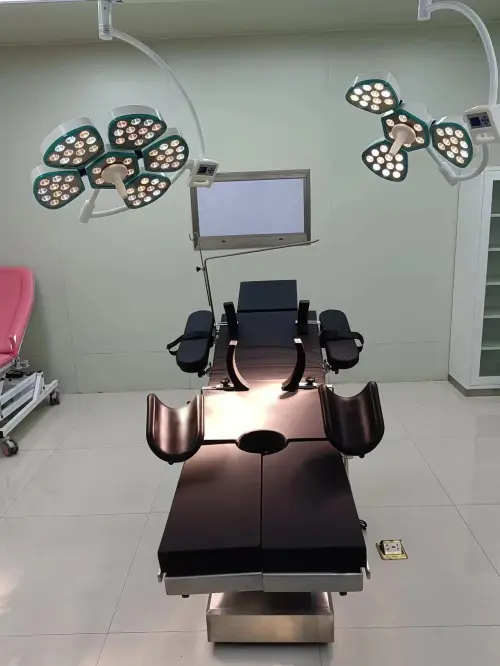
Chinese/domestic manufacturers post the lowest entry costs. Single-head ceiling units run $630–850, dual-head configs land at $990–1,200. Higher-spec platform versions climb to $1,250–1,400, $2,360–2,460, and $3,300–3,640, depending on arm design, panel quality, and illumination output. Grace Medy’s single-head units sit in this range while delivering 60,000–160,000 lux, which covers standard clinical requirements without the premium markup.
Mid-tier channel brands price single-head units at $1,559–2,300 and dual-head at $2,199–2,600. High-spec dual-head models reach $2,499–2,999 before promotional pricing brings them down to $2,199–2,499.
Western/premium systems run $12,000–89,000 for full LED setups. You’ll find plenty of listings between $8,549–24,557 and entry single-arm units starting around $2,995. For comparison, halogen predecessors ran $2,000–37,000.
Frequently Asked Questions About Surgical Lighting Systems
Procurement teams ask the same handful of questions before signing a purchase order. Here’s what matters.
What’s the minimum illumination intensity for surgical lighting?
IEC 60601-2-41 sets the floor at 40,000 lux measured at one meter. Anything below that isn’t fit for OR use. Write ≥50,000 lux into your spec sheet if you want margin, and push toward 120,000–160,000 lux for deep-cavity procedures.
How long do LED surgical lights actually last?
Expect 40,000–60,000 hours, rated at L70 (70% of original brightness). At 2,000–2,500 OR hours per year, that’s a theoretical 16–30 year lifespan. Most hospitals still budget replacement around 15–20 years, factoring in color temperature drift.
Ceiling-mounted or mobile?
Base it on ceiling load capacity, procedure type, room clearance, and whether you need camera integration. Dual-head systems suit larger, high-volume ORs; single-head fits tighter budgets and smaller rooms.
How do I verify a manufacturer’s credentials?
Request the legal manufacturer name, production site, IEC 60601-1 and IEC 60601-2-41 test reports, and independent lab certification tied to the exact model number—not a general product line.
What response time should I demand from surgical light manufacturers China or elsewhere?
Get a written commitment for a 4-hour initial response, 24-hour remote diagnostics, and 48–72 hour on-site arrival. Verbal promises don’t hold up during a mid-surgery failure.
Does OT light price drop with volume?
Orders of 10+ units typically unlock 15–30% discounts. Single-head units run $630–1,400; full dual-head systems with camera integration can reach $110,000–140,000 installed.
Conclusion
Match illumination intensity, color temperature, and mounting design to how your operating room actually runs day to day. A ceiling mounted surgical light for a high-volume OR or a mobile surgical light for flexible procedure rooms both need to provide consistent shadowless illumination so surgical teams stay focused instead of fighting glare or shadows mid-procedure.
Shortlist two or three manufacturers from this guide, request detailed spec sheets and OT light price quotes side by side, and ask pointed questions about warranty terms and local service support before you sign anything.
Grace Medy’s engineering team has spent years solving exactly these tradeoffs for hospitals worldwide. If you’re ready to compare real numbers instead of marketing claims, reach out for a custom quote.