Two surgical light quotes sit on your desk. One manufacturer wants $5,400. Another wants $19,800. Same category. Wildly different numbers. You’re the one who has to explain that gap to your CFO without sounding like you just guessed.
Operating light pricing isn’t random, and it isn’t transparent. LED chip quality, light head count, CRI ratings, certification paperwork, installation labor—each one moves the number, sometimes by thousands of dollars, sometimes by a rounding error dressed up as a “premium feature.”
This guide breaks down where your money goes, flags line items that quietly inflate quotes, and gives you the language to push back with data the next time a surgical light supplier tries to justify a number that doesn’t add up.
Operating Light Price Bands:
What a $150 Mobile Unit, $12,000 Single Dome, and $20,000+ Integrated System Include
Forget the $150 figure. It doesn’t exist in any legitimate operating theater lighting quote. The real market floor for a mobile operating light sits at $800–$2,000, with entry-level listings showing ₹19,000–₹45,000 for portable or single-dome units. At this tier you get a wheeled stand, one LED light head, manual focus, and basic intensity control. No frills.
Single-dome units climb to $1,000–$2,500 internationally. Specs cluster around 60W, 220V, one dome, 4000–5000K color temperature. That’s fine for procedure rooms and minor surgery, less fine for anything demanding deep-cavity visibility.
The $12,000 tag is misleading. No standard single-dome light legitimately costs that. If a supplier quotes you $12,000 for “a single dome,” you’re paying for a premium branded system with better optics, bundled installation, and extended service contracts.
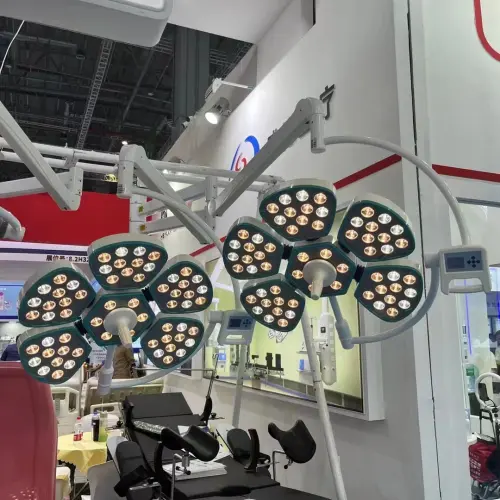
Integrated systems above $20,000 include multi-head configurations, ceiling mount arms, touch controls, shadow-reduction optics, and sometimes camera integration.
Know which band you’re shopping in before you compare surgical light manufacturer quotes.
Light Head Quantity and Mounting Structure: The Largest Hardware Price Difference
Head count and mounting complexity are where quotes really start to diverge.
Hardware benchmarks across the industry make this obvious. A single light head with a basic wall or ceiling mount costs $13–$26 in raw hardware—simple clamp, simple bracket, done. Add a second head, and you need a proper dual-head yoke or bracket. That jumps to $280–$500. Three heads require a rigid yoke structure to hold everything steady without sag or wobble. Budget around $1,000 for that alone. Four heads push the cost to $450–$1,200+, depending on build quality and who’s selling it.
That’s just the metal and mechanics holding everything in place—not the light heads or LED engines.
Why Ceiling Mounts Cost More Than Mobile Stands
A mobile operating light with a single head and a wheeled base needs the simplest mounting structure available—minimal engineering, minimal cost. A ceiling mounted surgical light with dual or triple heads needs a suspension arm system engineered to hold real weight, rotate smoothly, and stay stable through years of daily repositioning. That structural engineering is where your quote balloons.
Bulk head count changes the math. Installations with 4–6 fixtures total $420–$2,220 combined. Installations with 8–12 fixtures often drop to $90–$150 per head, because labor and material costs scale down as volume goes up.
LED Source, Illuminance, and LED vs. Halogen Operating Light Cost
Put 40,000 lux on your purchasing checklist. That’s the minimum central beam illuminance for a legitimate surgical light under IEC/EN-style guidance. Anything below that, and you’re buying an expensive desk lamp.
Real specs cluster between 40,000 and 160,000 lux at 1 meter. Background operating-theatre lighting sits around 1,000 lux. The task lighting over the table needs to be dramatically higher, scaling from 10,000 up to 160,000 depending on procedure depth.
Why LED vs. Halogen Surgical Light Price Aren’t Close
LED engines run at 100 lm/W. Halogen limps along at 10 lm/W. Same illuminance, one-tenth the power draw.
That gap compounds over time. A 50W halogen bulb costs about $0.0075–$0.012 per hour to run. A 7W LED delivering comparable output costs $0.001–$0.0017 per hour—an 85–90% reduction in energy spend. Multiply that across years of daily surgeries.
Yes, LED units cost 20%–30% more upfront. But halogen bulbs die after 1,000 hours—about 4–5 months at 10 hours/day. LEDs run 50,000+ hours. Do that math on replacement labor alone, and halogen stops looking like the budget option.
Non-negotiable spec sheet: 40,000–160,000 lux, CRI ≥ 95, LED life ≥ 50,000 hours, dimmable. Anything less isn’t a discount—it’s a deferred cost.
CRI, Color Temperature, Beam Control, and Shadow Reduction
Color accuracy determines whether a surgeon sees true tissue tone or guesses.
CRI 90+ is the floor. For surgical, inspection, or cosmetic work where color discrimination actually matters, push that to CRI 95+. Anything lower, and subtle tissue distinctions blur together under the light.
Color temperature matters just as much. 4000–4500K is the clinical standard for neutral-cool. It’s cited across healthcare procurement guides. Some daylight-style sources run 4800–5100K, but for operating rooms, stick to that 4000–4500K band. Standardize CCT and CRI across the whole workspace, or you’ll get inconsistent color rendering table to table.
Beam control shapes shadow quality. Narrow beam angles throw sharp, defined shadows. Wide beams soften them. Adjustable or swivel heads let surgeons aim precisely without repositioning the whole fixture.
Shadow Reduction Techniques Worth Paying For
Dual-dome heads surgical light create overlapping beams that reduce occlusion from hands and instruments.
Cross-lighting from two sources kills one-direction shadowing entirely.
Multi-emitter geometry delivers shadow-free coverage across the surgical field. It’s the spec that separates a $2,000 single-dome unit from a $15,000+ integrated system.
Camera Integration and Operating Room Equipment Cost
Add a camera, and your quote just entered a different universe.
A basic surgery-center video stack—camera head, control unit, light source, image-capture system, medical-grade monitor, printer—runs about $50,000. That’s before you touch the light fixture. Karl Storz’s Image 1 three-chip camera with digital output alone lists at $32,000.
Full OR integration systems scale way past that. Typical builds land at $100,000–$150,000 per system. Comparative vendor studies show averages from $90,867 to $224,670, with individual vendor bids ranging $56,511 to $294,816. New-facility integrations built around 4K 60p surgical video and touch-panel-controlled room cameras can hit $100,000–$300,000.
Wireless camera setups flip the math. The wired systems they replace averaged $158,000 in list price, but wireless configurations saved $9.80–$117.35 per case, depending on procedure length.
Suspension Arms, Sterile Controls, and Surgical Light Installation Cost
The light head is only half the invoice. Installation is the other half, and that’s where budgets blow past estimates.
Purchase price for the fixture itself scales hard by head count:
Single-head ceiling LED: $3,500–$10,000
Dual-head ceiling LED: $8,000–$40,000
Triple-head ceiling LED: $30,000–$45,000
Broader clinical-literature range for full LED systems: $12,000–$89,000
Installation is separate from the fixture and rarely bundled unless you negotiate it. Expect $2,000–$8,000 on top. That breaks down into a structural check ($500–$1,500), reinforcement if the ceiling can’t bear the load ($1,000–$3,000), arm mounting and electrical work ($1,000–$3,000), and commissioning ($500–$1,000). Nigerian suppliers quote comparable work at NGN 250,000–750,000, taking 1-2 full days. Indian vendors sell ceiling OT lights at ₹60,000–₹5 lakh with installation billed entirely separate.
Sterile handle controls look like a footnote. One catalog lists them at $42, but they’re not optional on a real OR system.
A dual ceiling surgical light in a composite package runs $8,260. Add arms, camera, and monitor mounts, and that same configuration climbs to $15,290. Ask suppliers to itemize light head, suspension arm, sterile handle, reinforcement, electrical rough-in, commissioning, and training separately. Bundled quotes hide markup.
Surgical Light Certification, Warranty, and Medical Lighting Supplier Premiums
Paperwork is the whole ballgame here. A surgical light without the right certification stack is a liability wearing a discount tag.
Non-negotiable certification checklist:
ISO 13485 for manufacturer quality management
ISO 9001 minimum if you’re buying from a distributor, not the manufacturer
IEC 60601-1 for electrical safety
IEC 60601-1-2 for electromagnetic compatibility
IEC 60601-2-41 specifically for surgical luminaires
UNICEF’s OR lighting tender specs require this full stack plus a 2-year warranty from shipping date. That’s your baseline for institutional buyers. DHA specs drop the floor slightly to a 1-year minimum covering materials, labor, and replacement costs.
Warranty Length Directly Sets Supplier Premiums
Warranty terms carry a price.3-year warranties add roughly 6–9% over a 1-year term, and 5-year warranties add 10–15%.
Medical Illumination backs a 3-year warranty from shipment, though bulbs, handles, and glass parts are excluded—normal wear items always are. Nanchang Micare matches that 3-year term, stacking CE, MDR, FDA, and IEC certifications into the same premium tier. Grace Medy goes further, offering 1 to 5 years depending on the line, with a 5-year limited warranty on select products.
Conclusion
The price on a quote sheet covers more than the light. It covers LED chip quality, dome count, arm engineering, CRI accuracy, and whether certification and installation are baked into the price or added as extras.
Now that you know what separates a $5,000 quote from a $20,000 one, you evaluate instead of guessing.